Quick Selection Summary
Laser vehicle Erkennung at intersections is a critical component of modern smart transportation and ITS systems. By using laser-based vehicle detection sensors to monitor vehicle presence and queue length without physical contact, traffic authorities and system integrators can achieve higher accuracy, lower maintenance costs, and more reliable traffic signal control compared with camera-based or inductive loop solutions.
Why Accurate Vehicle Detection Is Critical at Traffic Intersections
Traffic intersections are among the most complex and safety‑critical areas in urban transportation networks. Inaccurate or delayed vehicle detection can directly lead to congestion, inefficient signal timing, and increased accident risk.
Reliable vehicle detection sensors at intersections enable:
- Adaptive traffic signal control based on real-time demand
- Accurate stop-line and queue length detection
- Reduced idle time, fuel consumption, and emissions
- Improved pedestrian and cyclist safety
For these reasons, laser-based vehicle detection has become an increasingly preferred technology for smart intersections.
Challenges of Vehicle Detection at Intersections
Intersection environments present unique technical challenges for vehicle detection systems:
Occlusion and Complex Traffic Flow
Vehicles often block each other at stop lines, and mixed traffic (cars, buses, trucks, motorcycles) makes visual detection unreliable.
Nighttime, Glare, and Changing Lighting Conditions
Camera-based systems are sensitive to headlight glare, shadows, sunrise/sunset angles, and nighttime conditions.
Installation and Maintenance Constraints
Inductive loop detectors require road cutting and frequent maintenance, causing traffic disruption and high lifecycle costs.
Laser vehicle detection sensors address these challenges through non-contact Abstandsmessung and stable optisch performance.
How Laser-Based Vehicle Detection Works at Intersections
Laser-based vehicle detection sensors continuously measure distance changes within predefined detection zones near stop lines or approach lanes. When a vehicle enters the laser beam path, the measured distance changes instantly, allowing the system to detect vehicle presence and movement in real time.
Unlike vision-based systems, laser-based vehicle detection for smart transportation does not rely on image processing. Instead, it uses phase-based or Lichtlaufzeit (ToF) ranging principles to provide precise, repeatable distance data under all lighting conditions.
This makes Laser-Sensoren especially suitable for intersection deployments requiring 24/7 reliability.
Advantages of Laser Vehicle Detection vs Cameras and Inductive Loops
Higher Detection Accuracy
Laser vehicle detection sensors offer millimeter-level ranging accuracy, enabling precise stop-line and queue length detection.
Lighting-Independent Operation
Because detection is based on distance measurement rather than images, laser-based vehicle detection performs consistently in daylight, darkness, rain, fog, and strong sunlight.
Non-Contact Installation
Laser sensors are installed on roadside poles, signal structures, or overhead mounts, eliminating the need for road surface modification and reducing maintenance costs.
Long-Term Reliability
Industrial-grade laser distance sensors are designed for continuous outdoor operation, making them ideal for long-term ITS deployments.
Typical Intersection Applications of Laser Vehicle Detection
Laser-based vehicle detection supports a wide range of smart intersection functions:
- Stop-Line Vehicle Presence Detection
Accurate detection of vehicles waiting at traffic lights.
- Queue Length Measurement
Real-time monitoring of queue buildup to optimize signal timing.
- Adaptive Traffic Signal Control
Dynamic signal phase adjustment based on actual traffic demand.
- Red-Light Enforcement Support
Reliable vehicle presence data for enforcement and safety systems.
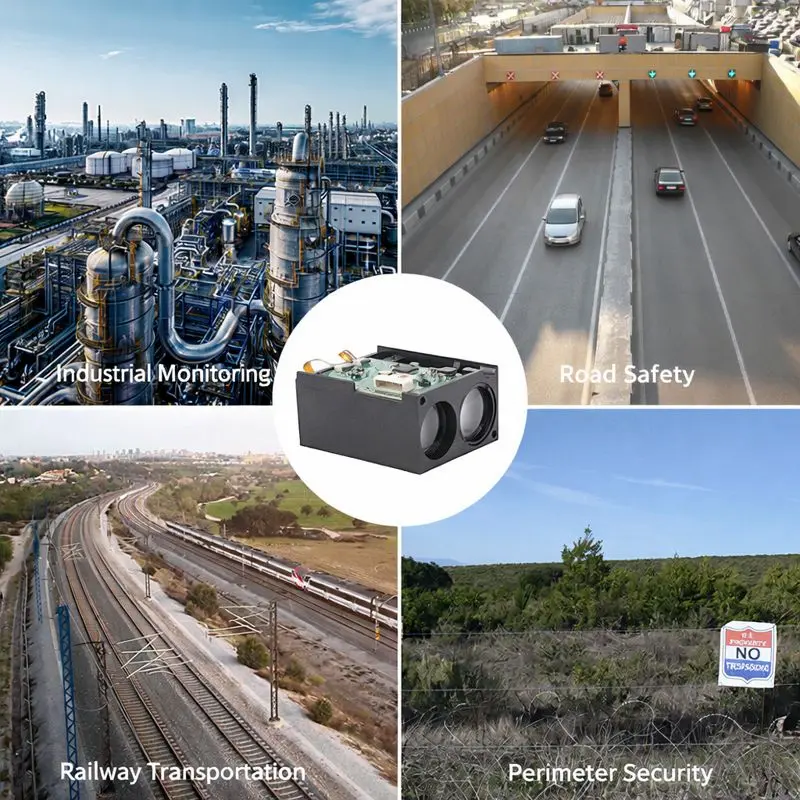



Recommended Laser Sensor Technologies for Intersection Detection
Ideal for most intersection vehicle detection scenarios, phase-based sensors provide high measurement stability, compact form factors, and low power consumption. They are commonly used for lane-level detection and stop-line monitoring.
For higher mounting positions or wider intersections, ToF-based laser sensors offer greater flexibility while maintaining strong resistance to ambient light interference.
Sensor selection depends on installation height, lane width, and required detection resolution.
Integration with Smart Traffic Controllers and ITS Platforms
Laser vehicle detection sensors integrate easily into modern ITS architectures. Standard industrial interfaces such as RS232, RS485, UART, and MODBUS allow seamless connection to traffic signal controllers, edge computing units, and centralized traffic management platforms.
In many smart transportation projects, laser-based vehicle detection sensors serve as a reliable data source that feeds adaptive signal control algorithms and real-time traffic analytics systems.
For a system-level overview of laser-based vehicle detection across smart transportation applications, see our detailed guide on laser-based vehicle detection for smart transportation.
Laser vehicle detection at intersections provides a robust, accurate, and low-maintenance solution for modern smart traffic systems. By overcoming the limitations of cameras and inductive loops, laser-based vehicle detection sensors enable reliable intersection monitoring under all environmental conditions.
As cities continue to deploy intelligent transportation systems, laser-based vehicle detection for smart transportation will play an increasingly important role in improving traffic efficiency, safety, and sustainability.
https://meskernel.net/time-of-flight-sensors/