Arduino distance measurement is a core function in many electronics and embedded projects, ranging from simple Arduino experiments to industrial-grade systems that require accurate and stable distance data. Whether you are working on robotics, automation, UAVs, or OEM product development, understanding how Arduino distance measurement works—and which sensor technology to choose—is essential for long-term success.
This guide explores the most common Arduino distance measurement methods, compares laser and ultrasonic sensors, and explains how to select the right distance sensor for Arduino-based applications, including projects that move from prototyping to mass production.
Common Arduino Distance Measurement Methods
Arduino distance measurement is typically implemented using external sensors that detect the distance between the device and a target object. The most widely used distance sensor options for Arduino include:
- Ultrasonic distance sensors
- Laser distance sensors (TOF and phase-shift)
- Infrared proximity sensors
- Optical and lidar-based distance modules
Among these, ultrasonic and laser-based Arduino distance measurement solutions are the most popular due to their availability, cost range, and ease of integration with Arduino boards.
Ultrasonic Sensors for Arduino Distance Measurement
Ultrasonic sensors are often used in entry-level Arduino distance measurement projects. They calculate distance by emitting a high-frequency sound wave and measuring the time it takes for the echo to return.
Advantages of Ultrasonic Distance Measurement
- Low cost and wide availability
- Simple wiring and Arduino libraries
- Suitable for short-range indoor distance measurement
Limitations of Ultrasonic Sensors
- Sensitive to temperature, airflow, and humidity
- Poor performance on soft or angled surfaces
- Limited measurement accuracy
- Unstable for outdoor or industrial Arduino distance measurement
Ultrasonic distance sensors are best suited for basic Arduino learning projects and simple obstacle detection, rather than precision-focused applications.
Laser Sensors for Arduino Distance Measurement
Laser distance sensors are increasingly preferred for professional Arduino distance measurement projects. These sensors calculate distance using Time of Flight (TOF) or phase-shift laser measurement, providing faster response and higher accuracy.
Key Benefits of Laser-Based Arduino Distance Measurement
- High accuracy (millimeter-level precision possible)
- Short to ultra-long measurement range
- Strong resistance to environmental interference
- Excellent outdoor and industrial performance
Laser distance sensors designed for Arduino distance measurement commonly support UART, I²C, RS485, or analog outputs, making them easy to integrate with Arduino UNO, Mega, Nano, and other microcontrollers.
Laser vs Ultrasonic: Arduino Distance Measurement Comparison
| Feature | Ultrasonic Sensors | Laser Distance Sensors |
|---|
| Typical Range | Short (≤ 4 m) | Short to ultra-long |
| Measurement Accuracy | Low to medium | High (mm-level) |
| Environmental Stability | Poor | Excellent |
| Outdoor Performance | Weak | Strong |
| Industrial Suitability | Limited | Ideal |
| Arduino Integration | Easy | Easy (UART / I²C / RS485) |
For any Arduino distance measurement project that requires accuracy, reliability, or scalability, laser-based solutions provide clear advantages over ultrasonic sensors.
Practical Applications of Arduino Distance Measurement
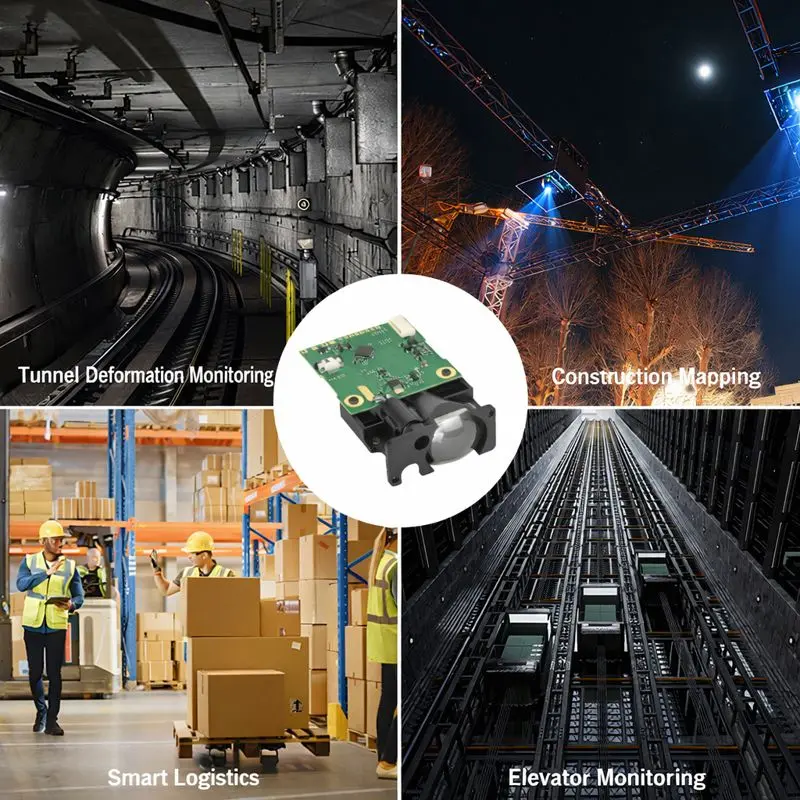
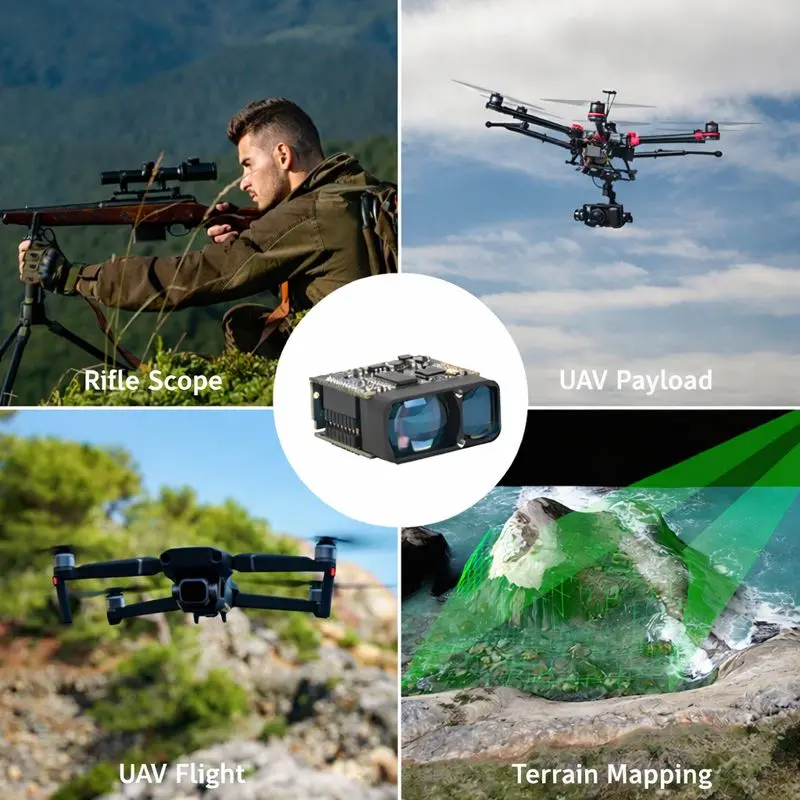
Arduino distance measurement is widely used across various industries and development scenarios, including:
- Robotics obstacle detection and navigation
- UAV altitude control and terrain following
- Industrial automation and position monitoring
- Smart agriculture and liquid level measurement
- Construction measurement tools
- OEM laser rangefinder modules
These applications typically require consistent measurement performance, which is why laser distance sensors are commonly selected for advanced Arduino distance measurement systems.

How to Choose the Right Distance Sensor for Arduino
When selecting a distance sensor for Arduino distance measurement, engineers should consider the following factors:
- Required measurement range
- Accuracy and resolution
- Environmental conditions (dust, vibration, light)
- Communication interface compatibility
- Power consumption
- Scalability from prototype to mass production
Ultrasonic sensors are suitable for learning and proof-of-concept projects. For commercial, industrial, or OEM-grade Arduino distance measurement systems, laser distance sensors are usually the better choice.
Arduino Distance Measurement for OEM and ODM Projects
As Arduino-based projects move beyond prototyping, Arduino distance measurement becomes a key system component rather than a simple accessory.
Meskernel is a laser distance sensor manufacturer, not just a reseller. We support OEM and ODM distance measurement solutions, including:
- Custom measurement range and accuracy
- Mechanical housing and size optimization
- Communication protocol customization
- Firmware tuning for Arduino and MCU platforms
- Stable supply for mass production
Our laser distance sensor modules are widely used in Arduino distance measurement development and then seamlessly integrated into commercial and industrial products.
Why Work with a Factory-Level Arduino Distance Sensor Supplier?
Choosing a factory-level supplier for distance measurement sensors offers significant advantages:
- Consistent and repeatable sensor performance
- Industrial-grade quality control
- Engineering support during Arduino integration
- Customization options for OEM and ODM projects
- Cost efficiency for large-volume production
These benefits are essential for companies planning to scale distance measurement systems into real-world applications.
Frequently Asked Questions (FAQ)
-
What is the best distance sensor for Arduino?
The best distance sensor for Arduino depends on your application.
For short-range and basic projects, ultrasonic sensors are sufficient. For high accuracy, long range, outdoor use, or industrial applications, a laser distance sensor for Arduino is the better choice due to its stability and precision.
-
How does Arduino distance measurement work?
Arduino distance measurement works by reading signals from a distance sensor and converting them into distance values. Ultrasonic sensors measure echo time of sound waves, while laser distance sensors calculate distance using time-of-flight (TOF) or phase-shift laser measurement.
-
Can I use a laser distance sensor with Arduino?
Yes, laser distance sensors can be used with Arduino. Most laser distance sensor modules support UART, I²C, RS485, or analog output, making them easy to integrate with Arduino boards such as Arduino UNO, Mega, or Nano.
-
Laser vs ultrasonic sensors: which is better for Arduino?
Laser sensors are better for Arduino projects that require higher accuracy, longer range, and better environmental resistance. Ultrasonic sensors are cheaper but less reliable in outdoor or industrial environments.
-
What is the maximum distance Arduino can measure?
Arduino itself has no distance limit. The maximum measurable distance depends on the sensor used. Ultrasonic sensors typically measure up to 4 meters, while laser distance sensors can measure from a few centimeters to hundreds of meters.
-
Are laser distance sensors suitable for outdoor Arduino projects?
Yes. Laser distance sensors perform well outdoors because they are not affected by wind, noise, or temperature changes. They are commonly used in UAVs, robotics, construction tools, and industrial automation with Arduino or other microcontrollers.
-
Which communication interface is best for Arduino distance sensors?
UART and I²C are the most commonly used interfaces for Arduino distance sensors. For industrial environments or long-distance communication, RS485 laser distance sensors are often preferred.
https://meskernel.net/oem-laser-distance-sensor/