ESP32 TTL telémetro láser modules are widely used in embedded and IoT systems due to their compact size, fast response, and simple UART communication. When paired with ESP32, they enable accurate, low-latency medición de la distancia for robotics, automation, and smart sensing applications.
This article explains how to connect a TTL laser rangefinder module to ESP32, covering UART wiring, communication logic, protocol structure, power considerations, and real-world accuracy factors. The content is written from an engineering and OEM integration perspective and is suitable for both prototyping and commercial product development.
What Is a TTL Laser Rangefinder Module?
A TTL laser rangefinder module is a laser sensor de distancia that outputs measurement data through UART serial communication at TTL logic levels. Instead of analógico voltage signals, distance values are transmitted digitally, which improves noise immunity and simplifies integration with microcontroladores.
Typical characteristics include:
- TTL-level UART output (TX / RX)
- 3.3V logic compatibility
- Digital distance data (mm / cm)
- Configurable baud rate
- Compact and lightweight design
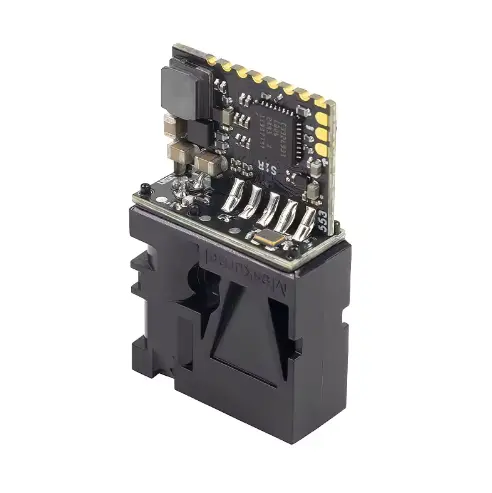
Modules such as LDL-T are optimized for embedded integration, combining high precision, fast measurement speed, and low power consumption, making them suitable for industrial automation and size-constrained systems.
Why Use ESP32 with a TTL Laser Rangefinder?
ESP32 is a powerful MCU platform for distancia láser measurement projects:
- Multiple hardware UART interfaces for stable serial communication
- Native 3.3V logic, directly compatible with most TTL laser modules
- Sufficient processing power for filtering and protocol parsing
- Integrated WiFi and Bluetooth, ideal for IoT distance sensing
- Broad ecosystem support (Arduino / ESP-IDF)
Compared with basic MCUs, ESP32 enables connected alcance láser systems, such as remote monitoring, data logging, and smart automation nodes.
Phase-Shift Measurement Principle in TTL Laser Rangefinders
Many high-precision TTL laser rangefinder modules, including LDL-T, use the phase-shift measurement principle.
In this method:
- A modulated laser signal is emitted toward the target
- The reflected signal returns with a phase delay
- Distance is calculated from the phase difference between transmitted and received signals
Why Phase-Shift Matters
- Excellent accuracy at short to medium range
- High update rate (e.g., 30Hz at close distances)
- Ideal for compact modules where pulse-based ranging is impractical
This is why phase-shift TTL modules are commonly used in precision positioning, robotics, and automation systems, rather than long-range outdoor topografía.
TTL Laser Rangefinder Module: Selection, Integration & Buying Guide
ESP32 ↔ TTL Laser Rangefinder UART Wiring
Correct wiring is essential for reliable UART communication.
Basic UART Wiring
| TTL Laser Rangefinder | ESP32 |
|---|
| VCC | 3.3V (recommended) |
| GND | GND |
| TX | RX (GPIO16) |
| RX | TX (GPIO17) |
Important Wiring Notes
- TX and RX must be crossed
- A common ground is mandatory
- Avoid UART0 to prevent conflicts with USB debugging
- Use short, well-routed wires to reduce interference
LDL-T uses 3.3V TTL communication levels, making it electrically compatible with ESP32 without level shifting.
Power Supply Considerations for ESP32 + TTL Laser Modules
Power stability has a direct impact on measurement reliability.
According to the datasheet, LDL-T operates at 2.5–3.6V, with 3.3V recommended, and draws up to ~170mA during continuous measurement.
Practical Engineering Advice
- ESP32’s onboard 3.3V regulator may not provide enough current margin, especially when WiFi is active
- Voltage drops can cause:
- Measurement instability
- Communication errors
- Reduced accuracy
Best practice:
Use a dedicated 3.3V LDO or DC-DC regulator shared by ESP32 and the laser module, with proper decoupling capacitors.
ESP32 UART Code Logic (Arduino Framework)
TTL laser rangefinder modules communicate using standard UART logic.
Communication Flow
- Initialize UART interface
- Configure baud rate
- Receive distance frames
- Validate and parse data
- Handle errors or invalid frames
Example Arduino Code
HardwareSerial LaserSerial(2);

void setup() {
  Serial.begin(115200);
  LaserSerial.begin(115200, SERIAL_8N1, 16, 17);
}

void loop() {
  if (LaserSerial.available()) {
    String data = LaserSerial.readStringUntil('\n');
    Serial.println(data);
  }
}
LDL-T supports auto-baud detección and defaults to 115200 bps, simplifying integration and reducing configuration errors in mass production environments.
UART Protocol: Distance Data Transmission
TTL laser rangefinder modules typically output data in one of two formats:
ASCII Output
Human-readable format, suitable for development and debugging:
Distance:1234mm
Binary / HEX Frames
Used in industrial modules for higher reliability:
- Frame header
- Distance bytes
- Status information
- Checksum
Binary protocols offer better resistance to noise and ensure data integrity in embedded systems.
How Ambient Conditions Affect Measurement Accuracy
Measurement accuracy is influenced by environmental conditions.
According to the datasheet, under poor conditions such as dark targets, low reflectivity, strong ambient light, or atmospheric interference, accuracy deviation may increase by ±1mm + 50PPM
Engineering Recommendations
- Avoid direct strong sunlight on the target
- Use a target plate for low-reflectivity surfaces
- Maintain stable power supply and mounting
Understanding these factors helps engineers design robust and predictable ranging systems.
Common Problems & Debugging Tips
If ESP32 does not receive valid distance data:
- Verify baud rate configuration
- Check TX/RX wiring
- Confirm voltage stability
- Avoid UART conflicts
- Test the laser module with a USB-TTL adapter independently
Systematic debugging significantly shortens integration time.
TTL vs RS485 Laser Rangefinder Modules
| Característica | TTL | RS485 |
|---|
| Communication distance | Corto | Largo |
| Noise immunity | Moderado | Alta |
| Wiring | Simple | Industrial |
| Typical use | Embedded / IoT | Automation / PLC |
TTL modules are ideal for compact embedded systems, while RS485 modules are preferred for long-distance and harsh industrial environments.
Choosing the Right TTL Laser Rangefinder for ESP32 Projects
Key selection criteria include:
- Measurement range and accuracy
- Update rate and protocol format
- Power consumption
- Physical size and weight
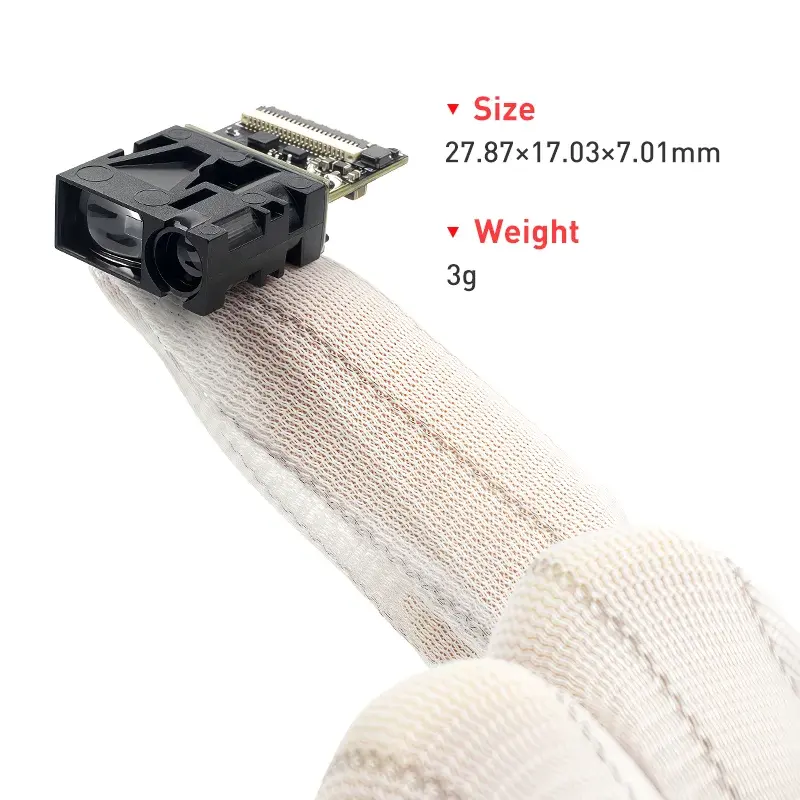
LDL-T features an ultra-compact size (27.87 × 16.57 × 7.01 mm) and ~2g weight, making it suitable for UAVs, robotics, and portable systems.
TTL Laser Rangefinder Modules for ESP32 Integration
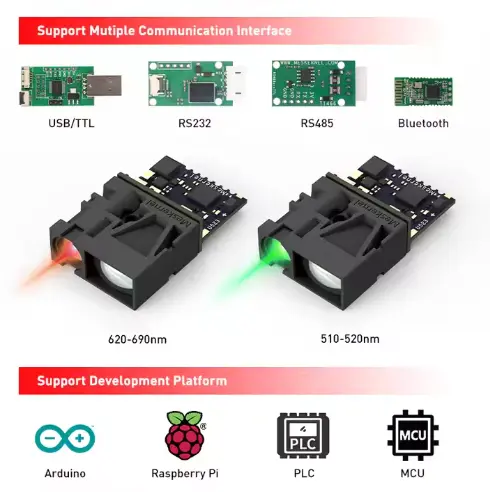
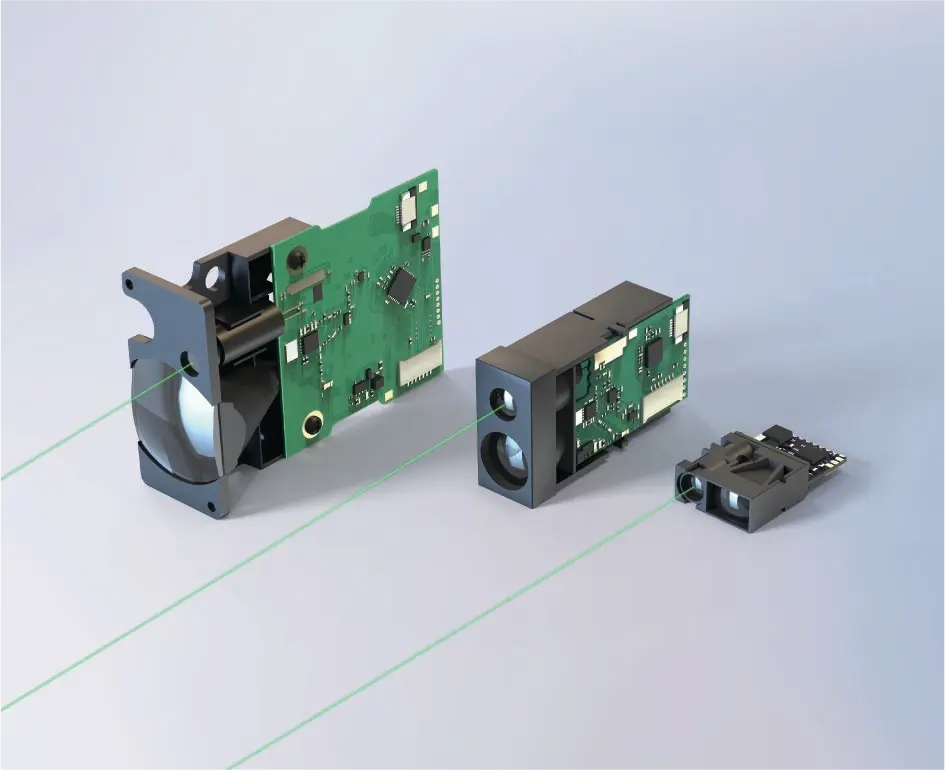
Meskernel provides TTL laser rangefinder modules optimized for ESP32-based systems, offering stable UART output, configurable baud rates, and industrial-grade reliability. Customization options are available for range, frequency, communication interface, and operating conditions.
Conclusión
By combining ESP32 with a TTL módulo telémetro láser, engineers can build compact, accurate, and scalable distance measurement systems. Understanding phase-shift ranging principles, power requirements, UART logic, and environmental effects is essential for achieving reliable performance in real-world applications.
Preguntas frecuentes
-
Can ESP32 directly connect to a TTL laser rangefinder module?
Yes. Most TTL laser rangefinder modules, including LDL-T, use 3.3V TTL logic, which is electrically compatible with ESP32 UART pins. TX and RX lines should be crossed, and both devices must share a common ground. No level shifter is required if the module operates at 3.3V TTL.
-
What UART baud rate should I use for a TTL laser rangefinder with ESP32?
The default baud rate for many TTL laser rangefinder modules is 115200 bps. Modules like LDL-T support auto-baud detection, allowing ESP32 to communicate without manual baud rate configuration. If needed, the baud rate can be set anywhere from 4800 to 115200 bps depending on system requirements.
-
Why does my ESP32 not receive distance data from the laser module?
Common causes include:
TX and RX lines connected incorrectly
Baud rate mismatch
Unstable or insufficient power supply
UART port conflict with ESP32 boot logs
Incomplete data frames due to timing issues
Testing the laser module independently using a USB-to-TTL adapter can help identify wiring or configuration problems.
-
Can ESP32’s 3.3V pin power a TTL laser rangefinder module?
Not always. While the voltage is compatible, ESP32’s onboard 3.3V regulator may not provide sufficient current, especially when WiFi or Bluetooth is active. TTL laser rangefinder modules can draw up to ~170mA during continuous measurement, so a dedicated 3.3V power regulator is recommended for stable operation.
-
What measurement principle do TTL laser rangefinder modules use?
High-precision TTL laser rangefinder modules typically use the phase-shift measurement principle. Distance is calculated by measuring the phase difference between transmitted and reflected laser signals. This method offers high accuracy and fast update rates, making it suitable for short- to medium-range embedded applications.
-
How accurate is a TTL laser rangefinder under real-world conditions?
Under normal conditions, accuracy can reach ±2 mm. However, under poor conditions such as dark or low-reflectivity targets, strong ambient light, or atmospheric interference, accuracy deviation may increase by ±1 mm + 50 PPM. Using a target plate can significantly improve measurement reliability.
-
What data format does a TTL laser rangefinder output?
TTL laser rangefinder modules usually output distance data in:
ASCII format (human-readable, easy to debug), or
Binary / HEX frames (more robust, used in industrial systems).
The protocol type depends on the specific module and configuration.
-
Is a TTL laser rangefinder suitable for outdoor or industrial environments?
TTL laser rangefinders are ideal for embedded, compact, and short-distance systems. For electrically noisy environments, long cable runs, or harsh industrial conditions, RS485 laser rangefinder modules offer better noise immunity and communication stability.
-
What are typical applications of ESP32 + TTL laser rangefinder systems?
Las aplicaciones más comunes son:
Robotics and obstacle detection
Smart parking systems
Tank level and material medición de altura
UAV altitude sensing
Portable and IoT-based distance monitoring devices
-
How do I choose the right TTL laser rangefinder for my ESP32 project?
Key factors to consider:
Measurement range and accuracy
Output protocol and baud rate
Power consumption
Physical size and weight
Environmental conditions
Ultra-compact modules with stable UART output are preferred for OEM integration and mass production.
https://meskernel.net/laser-distance-sensor-selection/