As modern electronic systems continue to shrink in size, engineers are increasingly challenged to integrate precise sensing capabilities into devices with strict size, weight, and power constraints. This trend is especially evident in robotics, portable instruments, UAVs, and embedded industrial systems.
In such scenarios, lightweight and compact laser distance sensors have become a preferred solution for accurate, non-contact distance measurement without compromising system design flexibility.
This article explores where compact laser distance sensor modules excel, why size and weight matter, and what engineers should consider when selecting one.
Why Size and Weight Matter in Distance Measurement Systems
Traditional laser rangefinders are often bulky and power-hungry, making them unsuitable for embedded or portable platforms. In contrast, modern compact laser distance sensor modules offer:
- Reduced mechanical integration complexity
- Lower total system weight
- Easier thermal management
- Greater freedom in enclosure and PCB design
For battery-powered or mobile systems, every gram and millimeter counts.
Key Features of a Lightweight Laser Distance Sensor Module
Taking the LDL-S laser distance sensor module as an example, compact sensors typically offer:
- Ultra-small footprint: approximately 16.6 × 17.0 × 7.0 mm
- Extremely low weight: around 2 g
- Millimeter-level accuracy based on phase-based iToF technology
- Low power consumption, suitable for embedded platforms
- TTL / UART communication, easy to interface with MCUs and SBCs
These characteristics make compact laser distance sensors viable for applications that previously relied on less accurate alternatives such as ultrasonic or infrared sensors. Meskernel User Manual LDL-S
Ideal Applications for Lightweight and Compact Laser Distance Sensors
1. Drones and UAV Altitude Measurement
In UAV systems, payload weight directly impacts flight time and stability. Compact laser distance sensors are widely used for:
- Ground distance measurement
- Precision landing assistance
- Terrain following
Their small size and low mass allow integration without affecting the drone’s center of gravity.
2. Portable Measurement Devices
Handheld or battery-powered devices benefit significantly from miniature مستشعر المسافة بالليزر modules:
- Portable surveying tools
- Handheld inspection instruments
- Smart measurement tools
The combination of small size + high accuracy enables professional-grade measurements in consumer-sized products.
3. Robotics and AGV Obstacle Detection
Mobile robots and AGVs often require multiple sensors distributed across limited space. Lightweight laser distance sensors are ideal for:
- Short- to mid-range obstacle detection
- Position feedback
- Safety distance monitoring
Their fast response and compact form factor allow flexible multi-sensor layouts.
4. Embedded Industrial Equipment
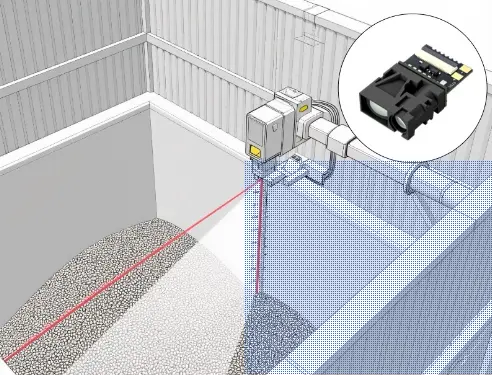
In industrial automation, compact laser distance sensors are often embedded inside:
- Conveyor systems
- Linear motion stages
- Automated inspection equipment
Their non-contact measurement principle and high repeatability improve reliability in harsh environments.
5. Smart Devices and OEM Modules
OEM manufacturers increasingly demand ready-to-integrate laser ranging modules for:
- Smart appliances
- IoT measurement nodes
- Custom electronic products
A compact module simplifies certification, assembly, and long-term maintenance.


Design Considerations When Choosing a Compact Laser Distance Sensor
Before selecting a lightweight laser distance sensor, engineers should evaluate:
- Measurement range vs. accuracy
- Ambient light resistance
- Power supply and current consumption
- Communication protocol compatibility
- Mechanical integration constraints
Phase-based iToF sensors, such as those used in compact modules, are especially suitable for short- to medium-range applications requiring high precision.
Conclusion
Lightweight laser distance sensors are no longer niche components—they are becoming essential building blocks for modern embedded and mobile systems.
By combining millimeter-level accuracy, small size, and low power consumption, compact laser distance sensor modules enable designers to build smarter, lighter, and more efficient products without sacrificing measurement performance.
For engineers seeking a balance between precision and integration flexibility, compact laser distance sensors represent a highly practical and future-proof solution.
FAQ: Lightweight and Compact Laser Distance Sensors for Embedded and Mobile Systems
-
What is a lightweight and compact laser distance sensor?
A lightweight and compact laser distance sensor is a small-form-factor optical sensor designed to measure distance accurately while minimizing size, weight, and power consumption. These sensors are widely used in embedded and mobile systems where space, payload, and energy efficiency are critical design constraints.
-
Why are lightweight laser distance sensors important for embedded systems?
Embedded systems often operate under strict limitations in space, power, and thermal design. Lightweight laser distance sensors reduce mechanical load, simplify integration, and enable stable performance in compact enclosures, making them ideal for embedded controllers, edge devices, and OEM modules.
-
What mobile applications benefit most from compact laser distance sensors?
Compact laser distance sensors are commonly used in AGVs, mobile robots, drones, handheld measurement devices, and portable inspection tools. Their small size and low weight allow seamless integration into moving platforms without compromising speed, stability, or battery life.
-
How does sensor weight affect AGV and robotic performance?
In AGVs and robots, sensor weight directly impacts acceleration, energy consumption, and mechanical stress. Lightweight laser distance sensors help improve navigation accuracy, extend operating time, and reduce wear on motors and structural components, especially in high-duty mobile systems.
-
Are lightweight laser distance sensors accurate enough for industrial use?
Yes. Modern lightweight laser distance sensors can achieve millimeter-level accuracy while maintaining compact designs. Advances in optical design, signal processing, and calibration allow these sensors to meet industrial requirements for positioning, obstacle detection, and distance monitoring.
-
What interfaces are commonly used in compact laser distance sensors?
Compact laser distance sensors typically support interfaces such as UART, TTL, RS485, or CAN. These interfaces enable easy integration with embedded controllers, PLCs, and industrial communication systems while keeping wiring and system complexity low.
-
How do compact sensors simplify embedded system design?
Smaller sensors reduce PCB space requirements, simplify mechanical mounting, and allow more flexible system layouts. This helps engineers shorten development cycles, reduce enclosure size, and improve overall system reliability in embedded and mobile designs.
-
What design factors should engineers consider when selecting a lightweight laser distance sensor?
Key considerations include measurement range, accuracy, update rate, interface compatibility, operating temperature, power consumption, and housing size. Selecting a compact sensor optimized for embedded use ensures reliable performance without increasing system complexity.
-
Are lightweight laser distance sensors suitable for battery-powered devices?
Yes. Lightweight laser distance sensors are well suited for battery-powered devices due to their low power consumption and efficient measurement cycles. This makes them ideal for portable systems, autonomous platforms, and energy-sensitive embedded applications.
-
What is the difference between compact laser distance sensors and traditional rangefinders?
Unlike traditional rangefinders, compact laser distance sensors are designed for continuous measurement, embedded integration, and automated systems. They prioritize small size, low weight, and digital communication over manual operation and bulky optical assemblies.
https://meskernel.net/laser-position-sensor/