A step-by-step Abstandssensor selection guide explaining how wavelength and receiver choice affect measurement on dark, reflective and transparent targets.
Why Distance Sensors Often Fail on “Difficult Objects”
Many distance sensors work perfectly during lab tests, yet fail once installed on real machines.
The reason is usually simple:
the target object behaves very differently than expected.
In real projects, buyers and engineers frequently encounter problems such as:
- Black objects returning unstable or no readings
- Transparent materials like glass being “invisible” to the sensor
- Reflective metal surfaces causing sudden measurement jumps
These issues are not caused by poor-quality sensors.
They are almost always the result of choosing a sensor without fully understanding the target.
This article explains how to make the right distance sensor selection when dealing with dark, reflective, or transparent objects, based on real application experience rather than theory alone.
Understanding the Real Problem: It Starts With the Target, Not the Sensor
Before comparing brands or specifications, it’s important to understand one thing:
Messung der Entfernung problems usually come from the target’s optical behavior, not the sensor itself.
Different materials interact with light in very different ways. Ignoring this is where most selection mistakes begin.
Measuring Dark Objects: Why “Black” Is Harder Than It Looks
What Usually Goes Wrong
When measuring black or matte objects, the sensor may:
- Lose signal intermittently
- Show unstable distance values
- Fail entirely beyond a short range
Why This Happens
Dark surfaces absorb most of the emitted light instead of reflecting it back.
As a result, the sensor’s receiver gets a much weaker signal than expected.
What Actually Helps
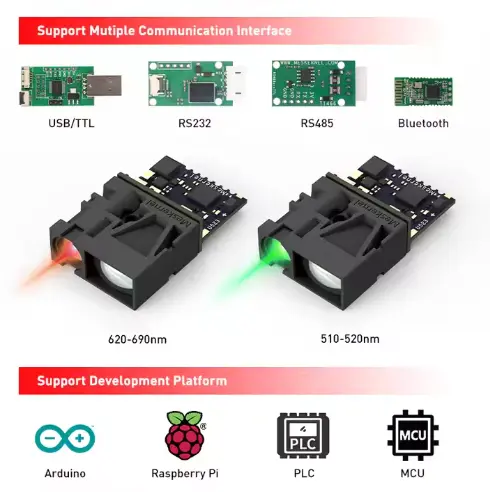
In these cases, wavelength matters more than advertised range.
Sensors using longer wavelengths and higher receiver sensitivity perform far more reliably on dark objects than standard visible-light solutions.
Key takeaway:
👉 When measuring dark objects, distance sensor selection should prioritize signal sensitivity, not maximum range.
Measuring Reflective Surfaces: When Too Much Signal Becomes a Problem
What Usually Goes Wrong
Highly reflective surfaces such as polished metal or shiny parts often cause:
- Sudden spikes in readings
- Saturated signals
- Inconsistent measurements depending on angle
Why This Happens
Instead of reflecting “just enough” light, these surfaces return too much.
Diese kann overload the receiver or create multiple reflection paths that confuse the sensor.
What Actually Helps
For reflective targets, performance depends heavily on the receiver’s ability to manage strong signals.
Laser-Abstand sensors or TOF sensors with proper filtering and dynamic range control are usually far more stable in these conditions.
Key takeaway:
👉 Reflective surface measurement is not a range issue—it is a receiver handling issue.
Measuring Transparent Objects: Why the Sensor Sees “Nothing”
What Usually Goes Wrong
When measuring glass, acrylic, or transparent film, sensors may:
- Measure the background instead of the object
- Return no valid signal
- Produce inconsistent results depending on thickness or angle
Why This Happens
Most of the emitted light passes straight through transparent materials rather than reflecting back to the sensor.
What Actually Helps
In most real-world applications, laser-based Flugzeit (TOF) sensors are the most reliable option for transparent objects.
They are designed to detect very weak reflections and distinguish real targets from background noise.
Key takeaway:
👉 Transparent object measurement usually requires TOF-based distance sensor selection, not standard triangulation sensors.
A Practical Way to Think About Distance Sensor Selection
Instead of asking “Which is the best distance sensor?”, a better question is:
“What does my target do to light?”
Once this is clear, sensor selection becomes much easier:
- Dark objects → prioritize sensitivity and wavelength
- Reflective surfaces → prioritize receiver control and filtering
- Transparent materials → prioritize TOF measurement capability
This approach avoids many of the trial-and-error cycles that slow down projects and increase costs.
Common Distance Sensor Selection Mistakes (Seen in Real Projects)
Mistake 1: Choosing Based on Range Alone
A long range does not guarantee stable measurement on difficult surfaces.
✔ Better approach: start with target characteristics, then confirm usable range.
Mistake 2: Assuming One Sensor Works for All Materials
A sensor that works on white plastic may completely fail on black rubber or glass.
✔ Better approach: treat dark, reflective, and transparent targets as different use cases.
Mistake 3: Skipping Real Material Testing
Datasheets are based on standard test targets, not your actual product.
✔ Better approach: always test with real materials under real conditions.
What to Check Before Finalizing a Distance Sensor Purchase
Before committing to a Sensor, it helps to confirm:
- Has it been tested on materials similar to yours?
- Can the supplier explain why it works on your target?
- Is the performance stable across angle, distance, and surface variation?
Suppliers with real application experience will usually ask detailed questions about your target before recommending a model.

FAQ: Distance Sensor Selection for Challenging Objects
-
What is the best distance sensor for dark objects?
There is no universal best sensor. For dark objects, sensors with longer wavelengths and high receiver sensitivity usually perform best.
-
How should I select a distance sensor for transparent materials?
In most cases, laser-based TOF sensors provide the most reliable results for transparent or semi-transparent objects.
-
Why do sensors work in tests but fail in production?
Because real materials behave very differently from standard calibration targets used in labs.
-
Can one sensor measure all types of surfaces?
Sometimes, but reliable results usually require target-specific distance sensor selection.
Good Distance Sensor Selection Is About Fewer Surprises
Most distance measurement problems are predictable once the target’s behavior is understood.
By starting with the object—not the specification sheet—you can avoid many common mistakes, reduce testing time, and make more confident procurement decisions.
Distance sensor selection is not about finding the most advanced sensor.
It’s about choosing the right sensor for the real-world target in front of you.
In real projects, many OEM teams validate target reflectivity and surface behavior before locking the sensor type.
If you’re unsure how your object will respond to a specific wavelength or receiver design, a short technical check can help clarify the risk early.
https://meskernel.net/oem-laser-distance-sensor/