Phase Laserdistanz sensors are widely used in industrial automation, precision measurement, and 3D scanning applications where high accuracy and fast measurement speed are required.
Verglichen mit Lichtlaufzeit (ToF) methods, phase-shift laser ranging offers superior resolution and stability, making it a preferred choice for professional and industrial-grade Abstandsmessung systems .
This article explains how phase Laser-Distanz-Sensoren work, what parameters matter most when purchasing a module, and how to select the right solution for your application.
How Does a Phase Laser Distance Sensor Work?
A phase laser distance sensor measures distance by comparing the phase difference between the emitted laser signal and the reflected signal returned from the target.
Basic Measurement Process
- Laser emission
The sensor emits a modulated laser beam toward the target.
- Signal reflection
The laser reflects off the object surface and returns to the receiver.
- Phase comparison
The internal processor calculates the distance based on the Phasenverschiebung between transmitted and received signals.
Because the calculation is based on phase difference rather than pulse timing, phase Laser-Sensoren can achieve millimeter-level accuracy with excellent repeatability .
Key Advantages of Phase-Shift Laser Distance Measurement
Phase Laser-Entfernungsmessung sensors are favored in demanding environments due to several intrinsic advantages:
1. High Measurement Accuracy
- Typical accuracy: millimeter or sub-millimeter level
- Ideal for precision positioning, displacement measurement, and industrial inspection
2. High-Speed Measurement
- Continuous measurement rates can exceed 500 Hz
- Suitable for real-time control, robotics, and motion feedback systems
3. Long Measurement Range
- Effective measurement from short distances (cm-level) up to 100+ meters, depending on optical design and laser power
4. Strong Anti-Interference Capability
- Less affected by ambient light compared to ultrasonic or Infrarotsensoren
- Stabile Leistung in industriellen Umgebungen
- No physical contact with the object
- Safe for fragile, moving, or high-temperature targets
Critical Parameters to Consider When Purchasing a Phase Laser Distance Sensor
For buyers and system integrators, understanding what truly affects performance is more important than comparing datasheets line by line.
Laserleistung
- Determines maximum measurable distance
- Higher power improves signal-to-noise ratio
- Excessive power may cause safety, multi-reflection, or spot diffusion issues
Receiver Type (PD vs APD)
- PD (Photodiode): stable, cost-effective
- APD (Avalanche Photodiode): higher sensitivity, faster response, better for long range and weak reflections (but more temperature-sensitive)
Beam Divergence
- Smaller divergence = longer distance & higher accuracy
- Critical for narrow targets and long-range measurement
Modulation Method & Frequency
- Affects measurement resolution and resistance to interference
- Optimized modulation improves accuracy in complex environments
Signal Processing Algorithms
- Advanced algorithms directly impact:
- Stabilität der Messung
- Geschwindigkeit
- Accuracy under low-reflectivity conditions
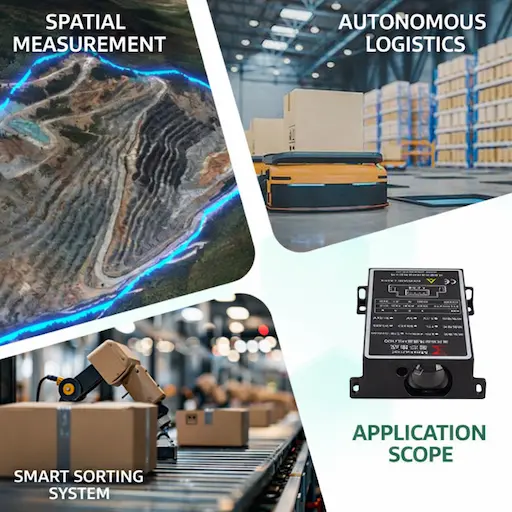
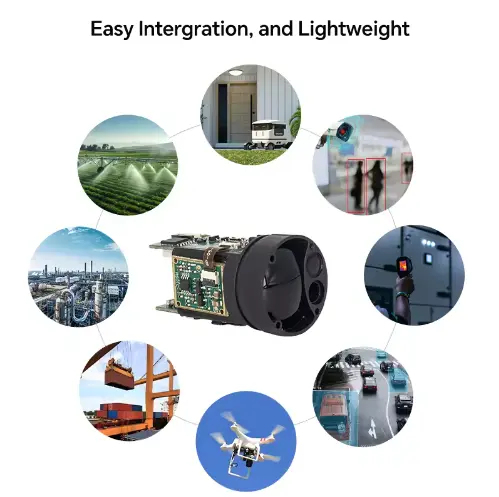
Typical Applications of Phase Laser Distance Sensors
1D Measurement Applications
- Distance and Höhenmessung (Konstruktion, Vermessung)
- Displacement and vibration monitoring (machinery, automation)
- Thickness and surface roughness measurement
- Area and volume calculation
3D Measurement & Scanning
- 3D industrial inspection
- Indoor and object scanning
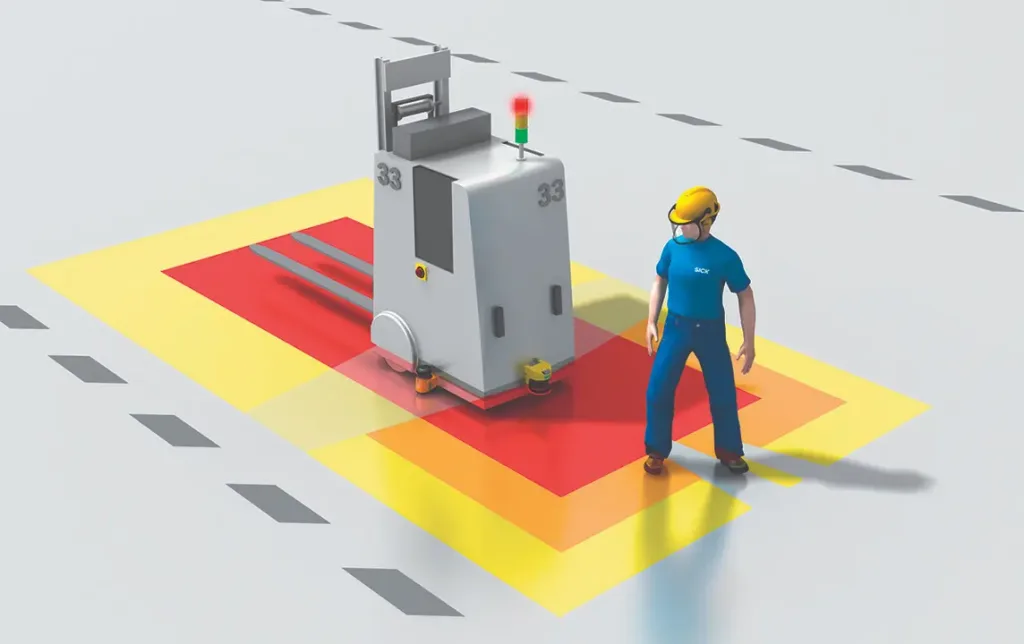
- Robotik Navigation and positioning
- Automated quality control systems
Example: High-Speed Phase Laser Distance Module (Reference Specs)
Below is a typical high-speed phase laser distance module configuration, useful for OEM evaluation:
- Power supply: DC 5V / ~500mA
- Laser wavelength: ~650 nm (red laser)
- Laser power: ~1 mW
- Data interface: Serial (460800 bps, ASCII protocol)
- Measurement range: approx. 0.3 – 140 m
- Accuracy: ±3 mm (optimal reflective surface)
- Measurement speed: up to 520 Hz
Note: Surface reflectivity significantly affects accuracy and speed. Dark or black surfaces may require reflective targets .
How to Choose the Right Phase Laser Distance Sensor for Your Project
Before purchasing, clarify these questions:
- What accuracy does your application truly require?
- Is real-time speed critical?
- What is the target surface material and color?
- Do you need long-range measurement or compact size?
- What interface is required (TTL, UART, RS485, etc.)?
Industrial users and OEM customers often prefer customizable laser distance modules that balance performance, size, and cost.
Phase Laser Distance Sensors from MesKernel
Unter MesKernel, we provide industrial-grade phase Lasermessung sensor modules designed for:
- High-speed continuous measurement
- OEM-Integration
- Automation and robotics
- Customized interface, range, and housing options
Our engineering team supports module selection, customization, and mass production, helping customers reduce development risk and time to market.
👉 Contact us to discuss your application requirements.
Schlussfolgerung
Phase laser distance sensors offer an ideal combination of accuracy, speed, and stability for modern industrial measurement systems.
By understanding the working principle and key parameters, buyers can make more informed decisions and select the optimal sensor for long-term reliability and performance.
FAQ: Phase Laser Distance Sensor
What is a phase laser distance sensor?
A phase laser Abstandssensor is a measurement device that calculates distance by comparing the phase difference between an emitted laser signal and its reflected signal. This method enables high accuracy and fast continuous measurement, making it suitable for industrial and precision applications.
How accurate is a phase laser distance sensor?
Phase Laser-Messsensoren typically achieve millimeter-level accuracy, and in optimized conditions can reach sub-millimeter resolution. Accuracy depends on factors such as surface reflectivity, laser power, beam divergence, and signal processing algorithms.
What is the difference between phase laser and time-of-flight (ToF) sensors?
Phase laser sensors calculate distance using phase shift, while ToF-Sensoren measure the travel time of a laser pulse. Phase laser sensors generally offer higher accuracy and faster measurement speed, whereas ToF sensors are better suited for very long-range or lower-cost applications.
What affects the measurement accuracy of a phase laser distance sensor?
Key factors include laser power, receiver type (PD or APD), beam divergence, modulation frequency, surface color, reflectivity, and ambient light conditions. Dark or low-reflectivity surfaces may reduce accuracy without reflective targets.
What measurement range can a phase laser distance sensor cover?
Depending on the design and optical configuration, phase laser distance sensors can measure from a few centimeters up to 100 meters or more. Actual range varies based on target reflectivity and environmental conditions.
Are phase laser distance sensors suitable for high-speed measurement?
Ja. Phase laser rangefinder sensors support high-speed continuous measurement, often exceeding 500 Hz, which makes them ideal for real-time control, robotics, motion tracking, and industrial automation systems.
Can phase laser distance sensors measure dark or black surfaces?
Dark or black surfaces reflect less laser light, which can reduce Messgenauigkeit or stability. In such cases, using reflective targets, increasing laser power, or optimizing signal processing can improve performance.
What interfaces are commonly available for phase laser distance sensors?
Common interfaces include TTL/UART, RS232, and RS485. Interface selection depends on system architecture, communication distance, and integration requirements in industrial or OEM applications.
What are typical applications of phase laser distance sensors?
hey are widely used in industrial automation, displacement monitoring, dimensional inspection, robotics navigation, 3D scanning, construction measurement, and precision manufacturing.
How do I choose the right phase laser distance sensor for my application?
Start by defining required accuracy, measurement range, speed, target surface type, interface, and environmental conditions. For OEM or industrial projects, selecting a customizable module ensures better performance and system compatibility.
Does MesKernel provide customizable phase laser distance sensors?
Ja. MesKernel offers phase laser measuring sensor modules with customizable range, interface, measurement speed, and housing options for OEM and industrial integration.