The Complete Engineer’s Guide to Wiring, Protocol & MCU / PLC Integration
A laser distance sensor with TTL output is one of the most widely used solutions in embedded systems, industrial automation, robotics, and measurement equipment.
For engineers, the key question is simple:
Can this laser distance sensor connect directly to my MCU or PLC and work reliably?
This guide answers that question in depth. It covers everything from TTL fundamentals to wiring, data protocol, Arduino and STM32 integration, and industrial deployment considerations.
This is a practical, engineer-focused reference for evaluating and deploying laser sensor distance measuring solutions using TTL interfaces.
1. What Is a Laser Distance Sensor with TTL Output?
A laser distance sensor TTL refers to a laser ranging module that outputs measurement data through TTL-level UART communication.
Typical Characteristics
- Digital output via UART
- Logic level: 3.3V or 5V TTL
- Distance data in millimeters
- Continuous or command-based measurement modes
TTL-based laser distance sensors are commonly used in:
Because TTL signals can be read directly by microcontrollers, this interface is especially popular in laser sensor distance measuring applications.
2. Why Engineers Prefer TTL Interfaces
Compared with other communication interfaces, TTL offers a strong balance of simplicity, cost, and performance.
Interface Comparison
| Interface | MCU Direct | Complexity | Cost | Typical Use |
|---|
| TTL (UART) | Yes | Low | Low | Embedded systems |
| RS232 | No | Medium | Medium | PC communication |
| RS485 | With converter | Medium | Medium | Long-distance wiring |
| CAN | With controller | High | High | Automotive |
| Ethernet | No | High | High | Networked systems |
Conclusion:
For MCU-based systems, laser distance sensor TTL is usually the fastest and most efficient integration option.
3. TTL Laser Distance Sensor Wiring Guide

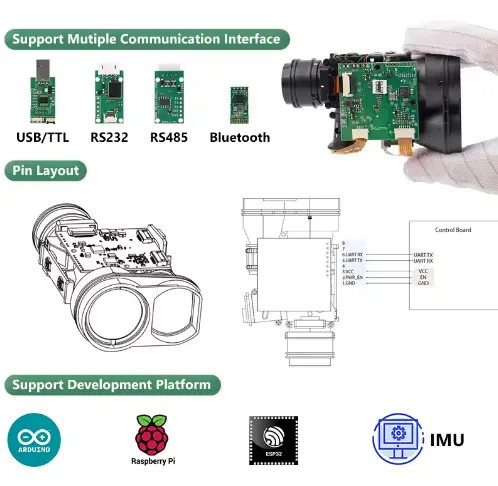
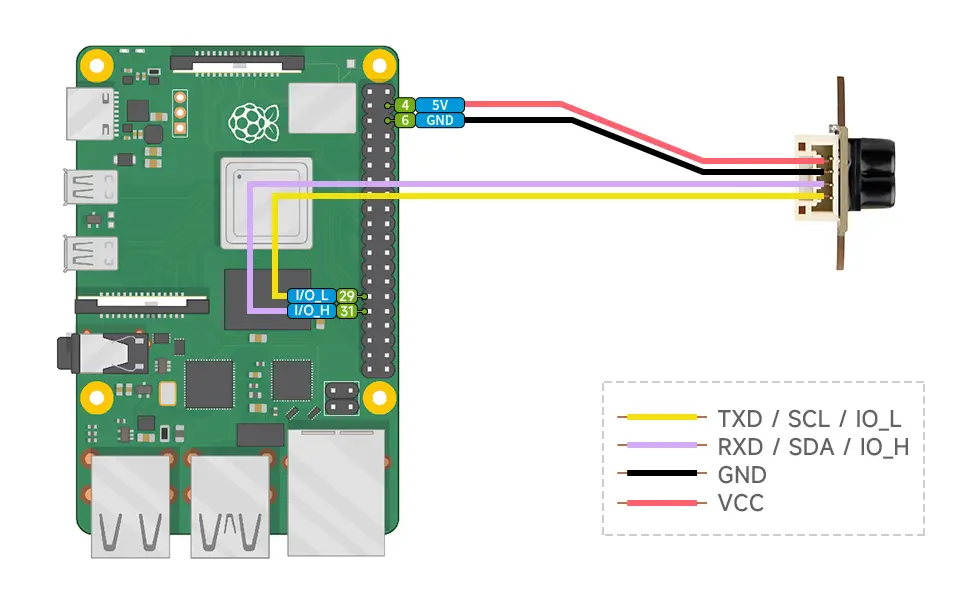
Standard TTL Wiring (UART)
| Sensor Pin | Function | Connection |
|---|
| VCC | Power Supply | 3.3V or 5V |
| GND | Ground | System GND |
| TX | Data Output | MCU RX |
| RX | Command Input | MCU TX |
Common Wiring Mistakes
- TX connected to TX instead of RX
- Mismatched voltage levels (3.3V vs 5V)
- No common ground
- No power filtering in industrial environments
For stable operation, especially in industrial systems, proper grounding and power filtering are strongly recommended.
4. TTL UART Data Protocol Explained
Most TTL laser distance sensors use a simple binary UART protocol.
Typical Data Frame Structure
[Frame Header][Command][Data High][Data Low][Checksum]
Example Frame
AA 55 01 04 D2 XX
0x04D2 = 1234 mm- Distance unit: millimeters
- Fixed frame header for easy synchronization
- Optional checksum for reliability
This protocol design makes laser sensor distance measuring fast, deterministic, and easy to parse on MCUs.
5. Arduino Integration Example
Arduino is often used for rapid validation and prototyping of laser distance sensor TTL modules.
Arduino UART Example
#include <SoftwareSerial.h>SoftwareSerial laser(10, 11); // RX, TXvoid setup() {
  Serial.begin(9600);
  laser.begin(9600);
}void loop() {
  if (laser.available()) {
    byte data = laser.read();
    Serial.println(data, HEX);
  }
}
This setup allows engineers to quickly verify:
- Electrical compatibility
- Data stability
- Protocol correctness
6. STM32 Integration for Production Systems
For production-grade systems, STM32 is commonly used with TTL laser distance sensors.
Recommended STM32 Practices
- Use hardware USART
- Enable DMA for continuous measurement
- Implement checksum verification
- Use timer-based measurement triggering
Typical Applications
- Industrial automation
- AGV and AMR navigation
- Precision positioning systems
TTL output provides low latency and deterministic timing, making it suitable for real-time control systems.
7. Can a TTL Laser Distance Sensor Be Used with PLC?
Yes, with proper interface adaptation.
Common PLC Integration Methods
- TTL to RS485 converter
- TTL to digital input module
- TTL to Modbus gateway
When TTL Is a Good Choice for PLC Systems
- Short cable distances
- Cabinet-level installations
- Cost-sensitive projects
- Custom control logic
For long-distance or high-noise environments, RS485 or Ethernet may be preferred.
8. Industrial Reliability Considerations
A well-designed laser distance sensor TTL solution should include:
- Wide operating temperature range
- EMI-resistant circuit design
- Stable power input
- Industrial-grade enclosure (IP54 or higher)
TTL itself is not a limitation—system reliability depends on overall hardware and electrical design.
9. How to Choose the Right TTL Laser Distance Sensor
Engineer Selection Checklist
- Measurement range
- Accuracy and repeatability
- Output frequency
- TTL voltage level
- UART protocol documentation
- Customization options
- Long-term supply stability
These factors are critical when selecting a sensor for laser sensor distance measuring in OEM or industrial projects.
10. Typical TTL Laser Distance Sensor Configurations
Commonly used configurations include:
- 10–40 m range at high frequency
- 100 m range for industrial automation
- 400 m long-range measurement
- UART TTL output
- Custom baud rate and protocol support
Such configurations are widely used in embedded and industrial systems requiring reliable distance measurement.
FAQ – Laser Distance Sensor TTL
What is a laser distance sensor with TTL output?
A laser distance sensor with TTL output is a laser-based ranging device that transmits distance data using TTL-level UART signals, typically at 3.3V or 5V. It allows direct communication with microcontrollers such as Arduino or STM32 without additional protocol converters, making it ideal for embedded distance measurement applications.
Can a laser distance sensor TTL connect directly to an MCU?
Yes. A laser distance sensor TTL can connect directly to an MCU as long as the voltage levels match. Most microcontrollers support UART communication, allowing them to read distance data directly from the sensor’s TX pin with minimal latency and simple firmware implementation.
Is TTL output suitable for industrial laser distance measuring?
TTL output is suitable for industrial laser sensor distance measuring when cable lengths are short and proper EMI protection is used. In control cabinets or embedded industrial devices, TTL provides stable, low-latency communication. For long-distance wiring or high-noise environments, RS485 may be preferred.
What voltage levels are used by TTL laser distance sensors?
Most TTL laser distance sensors operate at either 3.3V or 5V logic levels. Arduino platforms typically use 5V TTL, while STM32 and ESP32 commonly use 3.3V TTL. Matching the sensor’s TTL voltage to the MCU is essential to avoid communication errors or hardware damage.
How does a TTL laser distance sensor send distance data?
A laser distance sensor TTL usually sends distance data via a UART serial protocol using fixed data frames. These frames often include a header, distance bytes, and a checksum. The distance value is commonly transmitted in millimeters, allowing precise and real-time measurement.
Can a TTL laser distance sensor work with Arduino?
Yes. Arduino boards are widely used to test and deploy TTL laser distance sensors because they support UART communication and 5V TTL logic. This makes Arduino ideal for rapid prototyping, functional validation, and early-stage laser distance measuring system development.
Can a TTL laser distance sensor work with STM32?
Yes. STM32 microcontrollers are well suited for laser distance sensor TTL integration. Using hardware USART and DMA, STM32 systems can achieve high-frequency, low-latency distance measurement suitable for industrial and production-level applications.
What is the difference between TTL and RS485 laser distance sensors?
TTL laser distance sensors are designed for short-distance, embedded communication directly with MCUs, while RS485 sensors support long-distance communication and higher noise immunity. TTL offers lower cost and simpler integration, whereas RS485 is better for distributed industrial systems.
Is a TTL laser distance sensor accurate enough for precision measurement?
Yes. The communication interface does not affect measurement accuracy. A laser distance sensor TTL can provide millimeter-level accuracy, depending on the sensor design, optics, and signal processing. Accuracy is determined by the sensor module, not the TTL interface itself.
How do I choose the right laser distance sensor TTL for my project?
When selecting a laser distance sensor TTL, consider measurement range, accuracy, output frequency, TTL voltage level, protocol documentation, environmental protection, and customization options. These factors ensure reliable integration into embedded or industrial laser distance measuring systems.
A laser distance sensor with TTL output is a proven and engineer-friendly solution for embedded and industrial distance measurement.
If your project requires:
- Direct MCU integration
- Low-latency measurement
- Simple wiring
- High customization flexibility
Then laser distance sensor TTL technology is one of the most practical and reliable options available today.