As autonomous systems continue to expand across robotics, AGVs, UAVs, industrial automation, and smart infrastructure, navigation distance sensors have become a critical sensing component for accurate positioning, obstacle avoidance, and path planning.
Unlike simple proximity sensors, a navigation distance sensor must deliver stable, real-time, and high-precision distance data under complex environmental conditions — including changing light, reflective surfaces, vibration, and temperature variation.
This article explains what a navigation distance sensor is, how laser distance sensing improves navigation accuracy, and what to look for when selecting a sensor for real-world navigation systems, based on Meskernel’s proven product architecture and engineering experience.
What Is a Navigation Distance Sensor?
A navigation distance sensor is a sensing device designed to measure the distance between a system and surrounding objects, landmarks, or reference points in real time, enabling:
- Autonomous navigation and positioning
- Obstacle detection and avoidance
- Motion control and trajectory planning
- Environment mapping and localization
In navigation-oriented applications, the sensor must go beyond basic ranging and offer:
- High measurement stability
- Fast update frequency
- Strong resistance to ambient interference
- Easy integration with control systems
Laser-based distance sensors are increasingly preferred for these requirements.
Why Laser Distance Sensors Are Ideal for Navigation
Compared with ultrasonic or infrared solutions, laser navigation distance sensors offer clear advantages in demanding navigation scenarios:
1. High Accuracy for Precise Path Planning
Laser distance sensors based on phase-shift (iToF) or time-of-flight (dToF) principles can achieve millimeter-level accuracy at short and medium ranges, and reliable meter-level accuracy at long distances — essential for autonomous navigation decisions.
2. Fast Measurement Speed
Navigation systems require rapid feedback. High-frequency laser distance modules (from tens of Hz up to kHz-level in specific models) support real-time motion control and dynamic obstacle avoidance.
3. Non-Contact, Long-Term Stability
Laser measurement is non-contact, reducing mechanical wear and ensuring long service life in continuous navigation tasks such as AGVs or fixed autonomous platforms.
4. Strong Environmental Adaptability
With proper optical design and signal processing, laser navigation distance sensors maintain stable output under:
- Variable lighting conditions
- Outdoor sunlight
- Dusty or industrial environments
Core Technologies Used in Navigation Distance Sensors
Meskernel’s navigation distance sensor portfolio is built on three mature ranging technologies, each optimized for different navigation needs.
Phase Laser Distance Sensors (iToF)
Phase-based sensors are ideal for short to medium range navigation, offering:
- Millimeter-level accuracy
- Compact size and low power consumption
- High measurement repeatability
- Stable continuous output
They are widely used in:
- AGVs and mobile robots
- Industrial automation navigation
- Position feedback systems
Direct Time-of-Flight Sensors (dToF)
dToF navigation distance sensors are designed for long-range navigation and positioning, capable of measuring hundreds or even thousands of meters.
Typical navigation use cases include:
- Outdoor autonomous platforms
- UAV altitude and distance referencing
- Large-area positioning and security navigation
Pulse Laser Rangefinder Sensors
Pulse-based sensors excel in long-distance navigation with fast response, commonly used in:
- UAV and drone navigation
- Outdoor surveying and tracking
- Autonomous defense or monitoring systems
Key Features That Matter in Navigation Applications
When selecting a navigation distance sensor, engineers should focus on the following performance factors:
Measurement Range Matching Navigation Logic
Navigation does not always require extreme distance. The optimal sensor range should match:
- Obstacle detection distance
- Stopping distance of the system
- Position reference spacing
Overspecifying range can increase cost and power consumption unnecessarily.
Accuracy and Repeatability
Stable repeatability is often more important than peak accuracy. Navigation algorithms rely on consistent distance trends, not just single-point precision.
Output Frequency and Latency
Higher output frequency improves system responsiveness, especially in:
- Fast-moving AGVs
- Dynamic obstacle environments
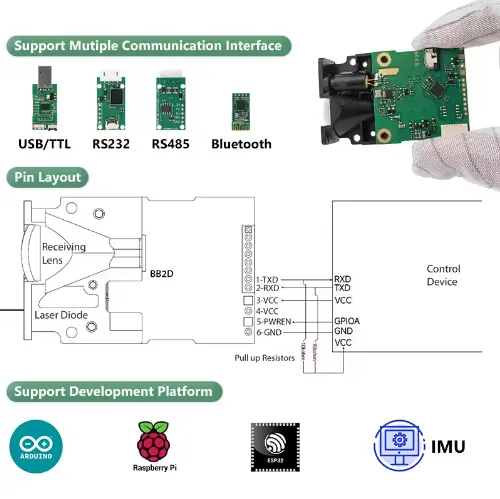
Communication Interfaces
Industrial navigation distance sensors should support standard interfaces such as:
- UART / USART
- RS485 / RS232
- Modbus or custom protocols
This ensures smooth integration with PLCs, embedded controllers, and navigation algorithms.
Navigation Distance Sensors for Harsh Environments
Many navigation systems operate in environments that challenge sensor reliability.
Meskernel provides navigation distance sensors with:
- Industrial-grade metal housings
- IP54 / IP65 / IP67 protection
- Wide operating temperature ranges
These designs ensure reliable navigation performance in:
- Factories and warehouses
- Outdoor autonomous systems
- Dusty, humid, or vibration-prone conditions
OEM & ODM Customization for Navigation Systems
Navigation systems often require tailored sensor solutions, not off-the-shelf products.
Meskernel supports extensive OEM & ODM customization, including:
- Measurement range and accuracy tuning
- Output frequency optimization
- Communication protocol customization
- Mechanical structure and enclosure adaptation
- Power supply and interface configuration
This flexibility allows navigation distance sensors to be deeply embedded into customer navigation architectures, improving system-level performance and reliability.
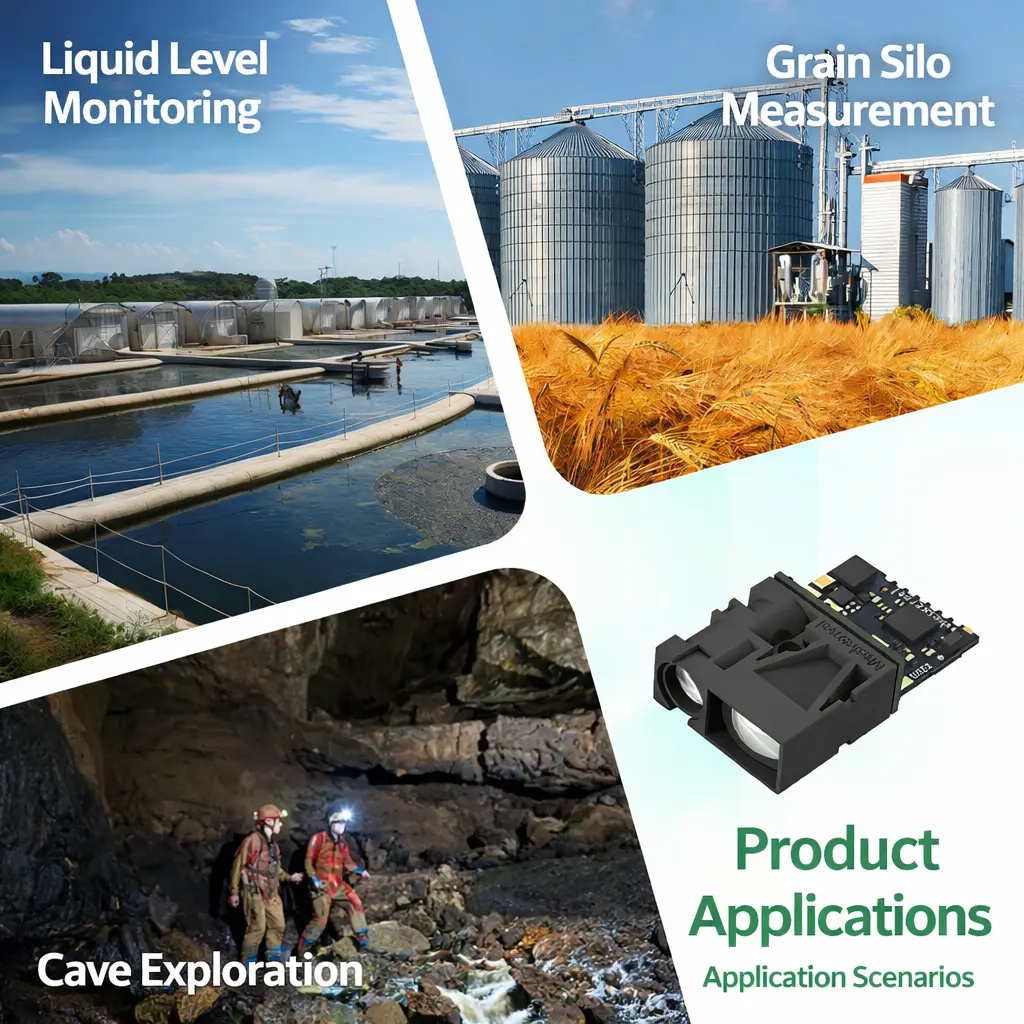
Typical Navigation Applications Using Laser Distance Sensors
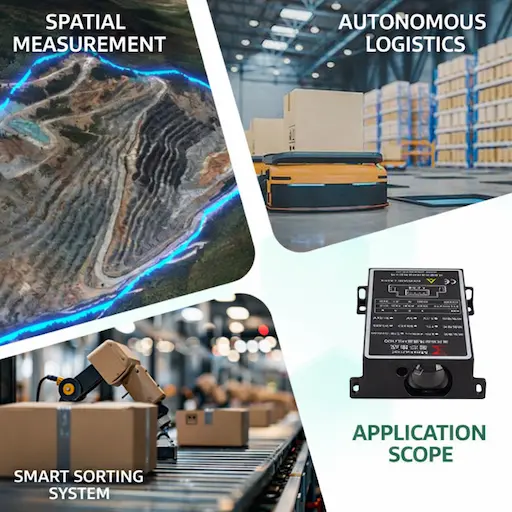
Navigation distance sensors from Meskernel are widely applied in:
- Autonomous guided vehicles (AGVs)
- Mobile robots and AMRs
- UAV navigation and altitude control
- Industrial positioning systems
- Smart infrastructure and security navigation
Each application benefits from stable distance feedback, low latency, and long-term operational reliability.
Why Choose Meskernel for Navigation Distance Sensors?
With over 20 years of laser measurement experience, Chengdu Meskernel Integrated Technology Co., Ltd. has built a comprehensive navigation distance sensor ecosystem:
- Complete laser ranging technology stack (Phase, dToF, Pulse)
- Compact, lightweight sensor modules for embedded navigation
- Industrial-grade protection and quality control
- Strong OEM & ODM customization capability
- Global deployment across industrial and autonomous sectors
If you are developing or upgrading a navigation system and need reliable, scalable, and customizable navigation distance sensors, Meskernel provides proven solutions ready for real-world integration.
FAQ
How does a laser navigation ranging sensor work?
A laser navigation distance sensor emits a laser beam toward a target and calculates distance based on phase shift (iToF), time of flight (dToF), or pulse measurement. These methods allow precise, non-contact distance measurement with fast update rates, making laser sensors ideal for autonomous navigation and dynamic obstacle detection.
What is the difference between a navigation distance sensor and a proximity sensor?
A proximity sensor only detects whether an object is present within a short range, while a navigation distance sensor provides continuous, quantitative distance data. Navigation distance sensors are designed for real-time positioning, motion control, and path planning, whereas proximity sensors are typically used for simple presence detection.
Which navigation laser sensor is best for AGVs and mobile robots?
For AGVs and mobile robots, phase-based laser navigation distance sensors (iToF) are commonly preferred. They offer millimeter-level accuracy, stable repeatability, compact size, and low power consumption. These characteristics make them well suited for continuous indoor navigation and precise positioning tasks.
What measurement range is required for a navigation laser sensor?
The required range depends on the navigation application. Short-range sensors (under 10 m) are suitable for docking and alignment, mid-range sensors (10–100 m) support obstacle avoidance and path correction, while long-range sensors (100 m or more) are used for outdoor navigation, UAVs, and large-area positioning.
What communication interfaces are common for navigation laser sensors?
Most industrial navigation distance sensors support UART, RS485, RS232, and sometimes Modbus protocols. These interfaces allow easy integration with PLCs, embedded controllers, and autonomous navigation systems. Custom communication protocols can also be supported for OEM projects.
Can navigation ranging sensors be customized for OEM projects?
Most autonomous systems require customized sensors. OEM navigation distance sensors can be tailored in measurement range, accuracy, output frequency, communication protocol, mechanical structure, and power supply. Customization improves system compatibility and reduces integration risk for large-scale or long-term projects.
How do I choose a navigation ranging sensor supplier?
When choosing a supplier, look for experience in laser ranging technology, in-house R&D capability, industrial certifications, and OEM support. Suppliers with multiple ranging technologies and long-term production capacity are better suited for autonomous navigation projects.