Why Laser Distance Sensors Are Still Essential
RTK mesure de la distance is widely used in arpentage, agriculture, and autonomous systems for achieving centimeter-level positioning accuracy. However, in real industrial projects, RTK alone is rarely sufficient for reliable distance measurement.
For system integrators and equipment manufacturers, the key question is not “How accurate is RTK positioning?” but rather:
Can RTK provide stable, object-level, real-time distance data in complex industrial environments?
In most cases, the answer is no—and this is where distance laser sensors become essential.
What RTK Distance Measurement Can and Cannot Do
RTK distance measurement excels at global positioning, but its limitations become clear when applied to practical industrial distance measurement tasks.
What RTK Does Well
- Provides absolute position with centimeter-level accuracy
- Works over large outdoor areas
- Ideal for path planning, navigation, and mapping
Where RTK Falls Short
- Cannot measure distance to objects
- No awareness of height, clearance, or obstacles
- Accuracy degrades with signal blockage or multipath
- Not suitable for indoor or partially enclosed environments
- Limited update stability for fast control loops
In short, RTK calculates where you are, not what is around you.
Why RTK Distance Measurement Alone Is Not Enough in Industrial Systems
In industrial automation, distance measurement is rarely just about coordinates. Engineers need reliable answers to questions like:
- How far is the object from the sensor?
- What is the real-time height or gap?
- Is there an obstacle within a safety threshold?
- Has the distance changed by a few millimeters?
RTK distance measurement cannot directly answer any of these questions.
This gap becomes critical in applications such as:
- Automated machinery
- Mobile robots
- Agricultural equipment
- La construction and material handling systems
Laser Distance Sensors: The Missing Piece
Un laser capteur de distance directly measures the physical distance between the sensor and a target surface using temps de vol ou phase-shift principles.
What Laser Distance Sensors Provide
- Object-level distance measurement
- Millimeter-level resolution
- High update rates for real-time control
- Independence from satellite signals
- Reliable operation in localized environments
This makes Détecteurs de distance à laser indispensable in industrial systems where control decisions depend on real, physical distances—not just coordinates.

RTK + Laser Distance Sensor: A Practical System Architecture
In real projects, RTK distance measurement and capteurs laser are not competitors—they are complementary technologies.
Typical Architecture
- RTK GNSS
- Provides absolute position and baseline distance
- Used for navigation and large-scale positioning
- Capteur de distance à laser
- Measures distance to objects, ground, or structures
- Enables precision control, safety, and automation
By combining both, systems achieve:
- Global accuracy from RTK
- Local precision from laser sensing
Real Industrial Scenarios Where Laser Sensors Are Required
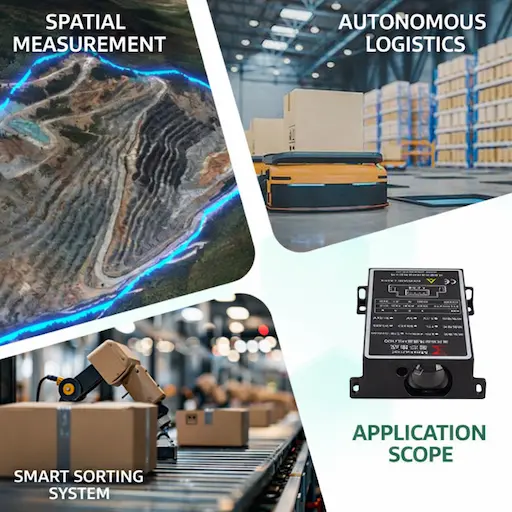
Autonomous Vehicles and Mobile Robots
RTK provides route-level positioning, but laser distance sensors are required for:
- Obstacle détection
- Docking accuracy
- Safety zone monitoring
Construction and Engineering Machinery
RTK defines machine position, while laser sensors handle:
- Blade height control
- Clearance measurement
- Surface leveling feedback
Precision Agriculture
RTK ensures accurate row positioning, but laser sensors measure:
- Crop height
- Ground distance
- Equipment-to-crop spacing
In all these cases, RTK distance measurement alone cannot close the control loop.
Why Industrial Systems Still Depend on Laser Distance Sensors
From an engineering perspective, Détecteurs de distance à laser offer advantages RTK cannot replace:
- Direct physical distance measurement
- High reliability in localized environments
- Fast response for closed-loop control
- Independence from external correction networks
This is why nearly all high-precision industrial systems ultimately rely on laser distance sensors, even when RTK is present.
Choosing the Right Laser Distance Sensor for RTK-Based Systems
When integrating laser sensors into RTK-enabled systems, engineers should consider:
- Measurement range and resolution
- Update rate and latency
- Environmental resistance (dust, vibration, sunlight)
- Interface compatibility (UART, RS485, CAN, analogique)
- Mechanical integration constraints
A well-chosen laser distance sensor transforms RTK positioning data into actionable, real-world distance control.
RTK Is Not a Replacement for Laser Distance Measurement
RTK distance measurement is a powerful positioning technology—but it is not a complete distance measurement solution for industrial applications.
For systems that require:
- Object awareness
- Precision control
- Reliable real-time distance data
Laser distance sensors remain essential.
RTK defines where the system is.
Laser distance sensors define what the system interacts with.
And in real industrial automation, both are required.
FAQ
What is RTK distance measurement?
RTK distance measurement refers to using Real-Time Kinematic GNSS corrections to calculate distance based on highly accurate position data. RTK improves positioning accuracy to the centimeter level, but it does not directly measure physical distance to objects. It is mainly used for global positioning rather than object-level distance sensing.
Can RTK measure distance to objects?
No. RTK cannot measure the distance to physical objects. RTK only calculates the position of a receiver in a global coordinate system. For object distance, height, or clearance measurement, additional sensors such as laser distance sensors are required.
Why is RTK distance measurement not enough for industrial automation?
RTK distance measurement lacks object awareness, height detection, and real-time obstacle measurement. Industrial automation systems require direct, fast, and localized distance data for control and safety, which RTK alone cannot provide.
What is the difference between RTK and laser distance sensors?
RTK provides absolute positioning over large outdoor areas, while laser distance sensors directly measure the physical distance to a target with high resolution. RTK answers “where am I,” whereas laser distance sensors answer “how far is the object.”
Do RTK-based systems still need laser distance sensors?
Yes. Most RTK-based systems still rely on laser distance sensors for object detection, precision control, and safety monitoring. RTK supports navigation, but laser distance sensors enable real-world interaction and closed-loop control.
When should RTK and laser distance sensors be used together?
RTK and laser distance sensors should be used together in applications such as autonomous vehicles, construction machinery, and precision agriculture, where both global positioning and accurate object-level distance measurement are required.