As Autonomous Guided Vehicles (AGVs) become more common in warehouses, factories, and logistica centers, collision avoidance and safety distance monitoring have become critical system requirements.
AGVs must continuously measure the distance to humans, shelves, and surrounding equipment to ensure safe operation, especially in shared human–robot environments.
Leggero distanza laser sensors offer an efficient and reliable solution for real-time safety distance monitoring without adding unnecessary complexity or load to the AGV platform.
Why Safety Distance Monitoring Is Essential for AGVs
AGVs often operate in dynamic environments where people and obstacles may enter their paths unexpectedly. Without accurate distance feedback, the risk of collision, emergency stops, or productivity loss increases significantly.
A safety distance monitoring system enables an AGV to:
- Detect approaching humans or objects in real time
- Gradually decelerate instead of performing abrupt emergency stops
- Automatically stop when the minimum safety distance is exceeded
- Maintain stable operation in mixed human–machine environments
This capability is especially important in human–robot collaboration zones and semi-open industrial spaces.
The Role of Lightweight Laser Distance Sensors
Compact Design for Low-Mount Installation
Leggero sensori di distanza laser can be installed at low heights, close to the ground or near the AGV chassis edge. This allows the AGV to detect legs, pallets, or low-profile obstacles that might be missed by higher-mounted sensors.
Their compact size ensures:
- Minimal intrusion into the AGV’s mechanical layout
- Easy integration into small or low-profile AGV designs
- Compatibility with space-constrained platforms such as AMRs and mini AGVs
No Impact on Existing AGV Structure
Unlike bulky safety scanners or camera systems, lightweight laser distance sensors require no major structural modifications. They can be mounted using simple brackets and connected directly to the AGV controller via standard interfaces.
This makes them ideal for:
- Retrofitting existing AGV fleets
- OEM AGV designs targeting reduced system complexity
- Cost-sensitive automation projects
Low Power Consumption for Continuous Operation
AGVs often run for long hours or even 24/7. Lightweight laser distance sensors are designed for continuous operation with low power consumption, helping to extend battery life and reduce overall system energy usage.
This is particularly valuable for:
- Battery-powered AGVs
- Mobile robots operating across large facilities
- Multi-sensor AGV systems where power budget is limited
Typical Application Scenarios
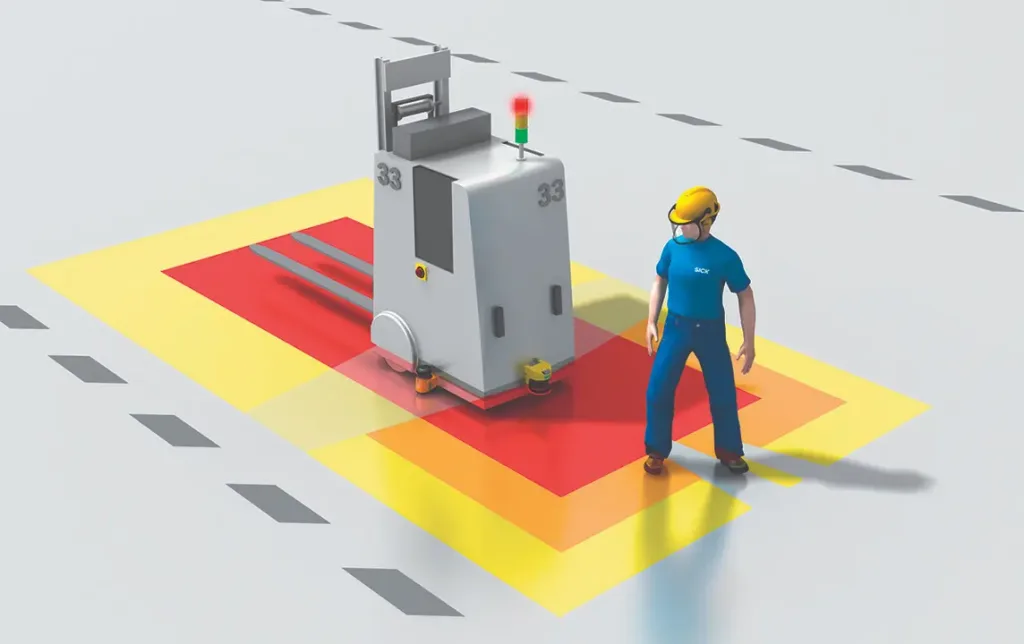
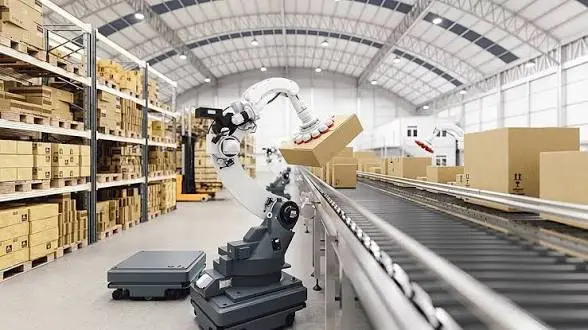
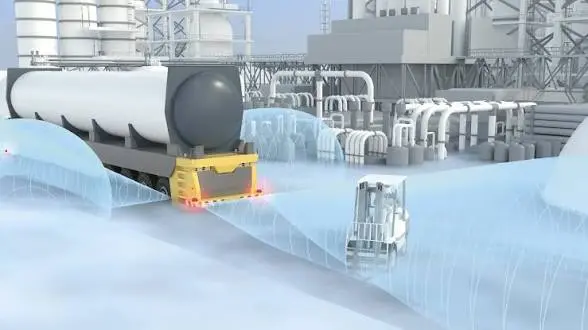
Human–Robot Collaboration Areas
In collaborative zones, AGVs must slow down or stop when people approach. Laser distance sensors provide fast response times and stable measurements, enabling smooth speed adjustment rather than sudden braking.
Semi-Open Warehousing Environments
Warehouses often include open aisles, temporary storage, and moving forklifts. Lightweight sensori laser help AGVs maintain safe distances from racks, pallets, and unexpected obstacles.
Industrial Workshop Corridors
In factory corridors shared by AGVs, carts, and workers, safety distance monitoring ensures reliable navigazione while minimizing downtime caused by unnecessary emergency stops.
Engineering Advantages Over Alternative Technologies
Compared with vision-based systems or bulky safety scanners, lightweight laser distance sensors offer:
- Stable performance independent of lighting conditions
- Simple data processing without heavy computing requirements
- Faster response for short-to-medium range safety monitoring
- Lower system cost and easier certification paths
These advantages make them well suited for AGV safety systems focused on distance-based collision prevention rather than full environment mapping.
Conclusione
Safety distance monitoring is a core requirement for modern AGV systems operating in real-world industrial environments. By using a lightweight laser sensore di distanza for AGV safety systems, manufacturers and integrators can achieve reliable collision avoidance while keeping the vehicle compact, energy-efficient, and easy to integrate.
As AGVs continue to move closer to human workers, lightweight laser distance sensors will play an increasingly important role in ensuring both operational efficiency and workplace safety.
FAQ: AGV Safety Distance Monitoring with Lightweight Laser Distance Sensors
-
What is safety distance monitoring in AGV systems?
Safety distance monitoring in AGV systems refers to the continuous measurement of the distance between an AGV and surrounding humans, equipment, or obstacles. When the measured distance falls below a predefined safety threshold, the AGV automatically slows down or stops to prevent collisions. This function is essential in human–robot collaboration areas and shared industrial environments.
-
How does a laser distance sensor improve AGV collision avoidance?
A sensore di distanza laser improves AGV collision avoidance by providing fast, accurate, and real-time distance measurements independent of ambient lighting. Unlike vision-based systems, laser sensors directly measure distance, allowing the AGV controller to respond immediately when an obstacle enters the safety zone. This ensures smoother deceleration and more reliable stopping behavior.
-
Why are lightweight laser distance sensors preferred for AGVs?
Lightweight laser distance sensors are preferred for AGVs because they can be mounted at low heights without affecting vehicle balance or structure. Their compact size and low mass make them ideal for small or battery-powered AGVs, while their low power consumption supports long-term continuous operation in industrial environments.
-
What measurement range is suitable for AGV safety distance monitoring?
For most AGV safety applications, a measurement range between 0.1 m and 10 m is sufficient, depending on vehicle speed and braking distance. Short- to medium-range laser distance sensors provide the best balance between accuracy, response time, and system cost for safety distance monitoring rather than long-range navigation.
-
Can laser distance sensors detect humans reliably in AGV systems?
Yes. Laser distance sensors can reliably detect human legs, bodies, and clothing regardless of color or ambient light conditions. This makes them particularly effective in warehouses and factories where lighting may vary. When installed at low mounting heights, they are especially suitable for detecting pedestrians entering AGV paths.
-
How are laser distance sensors integrated into AGV controllers?
Laser distance sensors are typically integrated into AGV controllers via industrial interfaces such as UART, RS485, CAN o analogico outputs. Distance data is processed by the AGV control system to define safety zones, trigger speed reduction, or initiate emergency stops based on configurable distance thresholds.
-
Are lightweight laser distance sensors suitable for 24/7 AGV operation?
Yes. Lightweight laser distance sensors are designed for continuous 24/7 operation with stable performance and low power consumption. This makes them suitable for logistics centers, factories, and warehouses where AGVs operate around the clock without frequent maintenance or sensor recalibration.
-
What is the difference between laser distance sensors and safety laser scanners?
Laser distance sensors measure distance along a single axis or narrow field, making them ideal for safety distance monitoring and collision prevention. Safety laser scanners, by contrast, provide 2D area scanning and are more complex and expensive. For many AGV safety applications, lightweight laser distance sensors offer a simpler and more cost-effective solution.
-
Can lightweight laser distance sensors be used in retrofitted AGVs?
Yes. Due to their compact size and simple mounting requirements, lightweight laser distance sensors are well suited for retrofitting existing AGVs. They can be added without major structural changes, allowing older AGV systems to gain improved safety distance monitoring capabilities.
-
What industries benefit most from AGV safety distance monitoring?
Industries such as warehousing, logistics, manufacturing, and automotive assembly benefit most from AGV safety distance monitoring. These environments often involve shared spaces between humans and AGVs, where reliable distance sensing is critical for reducing accidents and improving overall operational safety.
-
What accuracy is required for laser distance sensors in AGV safety applications?
AGV safety distance monitoring typically requires millimeter-level accuracy rather than centimeter-level precision. An accuracy of ±1–5 mm is sufficient for reliable deceleration and stopping decisions, as safety logic depends more on stable and repeatable misurazione della distanza than ultra-high absolute precision.
-
What response time is needed for AGV collision prevention sensors?
For effective AGV collision prevention, laser distance sensors should provide measurement update rates of at least 50–100 Hz. Faster response times allow the AGV controller to react smoothly to approaching obstacles, especially at higher vehicle speeds or in narrow industrial corridors.
-
How does AGV speed affect safety distance sensor selection?
Higher AGV speeds require longer safety distances and faster sensor response times. As vehicle speed increases, engineers must select laser distance sensors with higher update rates and stable output to ensure braking distance calculations remain accurate under dynamic operating conditions.
-
Are single-point laser distance sensors sufficient for AGV safety?
Single-point laser distance sensors are sufficient for many AGV safety distance monitoring tasks, especially frontal collision prevention and low-height obstacle rilevamento. They are commonly used as complementary safety sensors alongside bumpers or scanners, offering a cost-effective and reliable safety layer.
-
What output interfaces are commonly used for AGV safety sensors?
Common output interfaces for AGV safety laser distance sensors include UART, RS485, CAN, and analog voltage or current outputs. Digitale interfaces are preferred for software-defined safety zones, while analog outputs are often used in PLC-based or legacy AGV control systems.
-
How is a safety distance threshold defined in AGV systems?
Safety distance thresholds are typically defined based on AGV speed, braking capability, and reaction time. Engineers configure multiple distance zones, such as warning, deceleration, and stop zones, allowing the AGV to respond progressively as an obstacle approaches.
-
Can lightweight laser distance sensors replace safety bumpers on AGVs?
Lightweight laser distance sensors do not fully replace safety bumpers but significantly reduce reliance on them. While bumpers act as last-resort contact safety devices, laser sensors enable non-contact collision prevention, reducing mechanical wear and improving operational efficiency.
-
What mounting height is recommended for AGV safety distance sensors?
A mounting height between 100 mm and 300 mm is commonly recommended for AGV safety distance sensors. Low-height mounting improves detection of human legs, pallets, and low obstacles, which are among the most common collision risks in industrial AGV operations.