When choosing a IP54 Distance Measure Sensor, many engineers and system integrators ask the same practical question:
Can this distance detector sensor work in dusty environments, outdoors, or on 건설 sites?
The answer depends on how IP54 protection works in real-world conditions and whether it matches your application environment.
This article explains the IP54 testing standard, compares IP54 vs IP65 vs IP67, and shows where IP54 레이저 거리 measuring sensors are most commonly used.
Understanding the IP54 Rating for Distance Measure Sensors
The IP (Ingress Protection) rating defines how well an electronic device is protected against dust and water according to IEC 60529.
What Does IP54 Mean?
| Digit | Protection Type | Meaning |
|---|
| 5 | Dust protection | Dust may enter, but not enough to affect operation |
| 4 | Water protection | Protected against water splashes from any direction |
For a IP54 distance measure sensor, this means it can operate reliably in environments with:
- Airborne dust
- Industrial particles
- Outdoor airflow
- Occasional splashes or condensation
But it is not designed for heavy rain, water jets, or immersion.
Is an IP54 Distance Detector Sensor Suitable for Dusty or Outdoor Use?
Yes — within defined limits.
An IP54 distance detector sensor is ideal for:
- Dusty industrial environments
- Outdoor installations with partial shelter
- Construction sites without direct water exposure
It provides a balance between environmental protection, compact size, and cost efficiency, which is why IP54 is widely used in industrial 거리 측정 시스템.
IP54 vs IP65 vs IP67: What’s the Difference?
Choosing the right IP rating is about real needs, not just higher numbers.
| IP Rating | Dust Protection | Water Protection | Typical Scenarios |
|---|
| IP54 | Dust-protected | Splash resistant | Perimeter systems, warehouses, construction sites |
| IP65 | Dust-tight | Water jets | Fully exposed outdoor equipment |
| IP67 | Dust-tight | Temporary immersion | Flood-prone or extreme environments |
어떤 것을 선택해야 할까요?
- Choose IP54 Distance Measure Sensor if:
- Dust is present
- Outdoor air exposure exists
- The sensor is installed under a cover or housing
- Choose IP65 or IP67 only if:
- Direct rain or washdown is unavoidable
- The sensor is fully exposed 24/7
👉 For many applications, IP54 is the most practical and cost-effective choice.
Typical Applications of IP54 Laser Distance Measuring Sensors
1. Perimeter Monitoring & Security Systems
- Fence intrusion 탐지
- Boundary distance monitoring
- Long-range 레이저 거리 측정
Why IP54 works: Outdoor dust and airflow without direct water exposure.
2. Warehousing & Logistics Automation
- Shelf and stack 높이 측정
- AGV 탐색 distance sensing
- Conveyor position detection
Why IP54 works: Dust, vibration, and stable indoor-outdoor transitions.
3. Construction Sites & Temporary Installations
- Structural distance checks
- Equipment alignment
- Monitoring object displacement
Why IP54 works: Construction dust, wind, and occasional splashes.
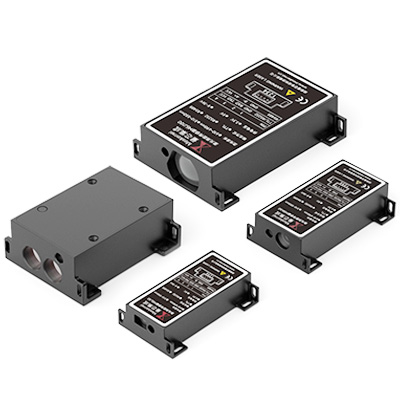
IP54 Distance Measure Sensor Product Overview
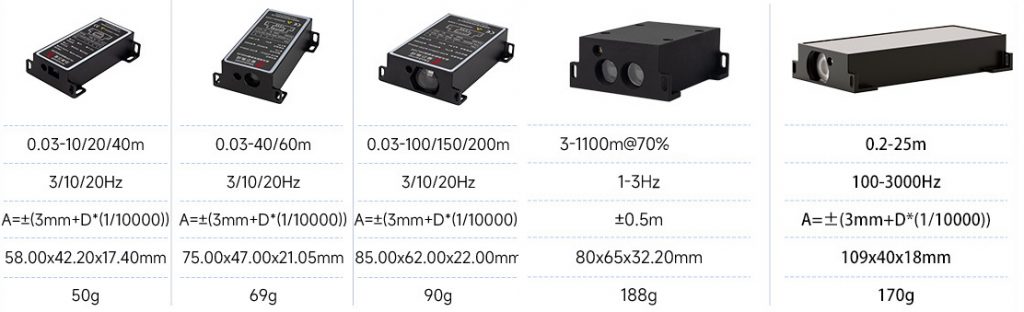
An industrial IP54 laser distance measuring sensor typically offers:
- Long measurement range (e.g. 100 m – 400 m)
- High accuracy and resolution
- Stable performance in dusty environments
- Compact enclosure design
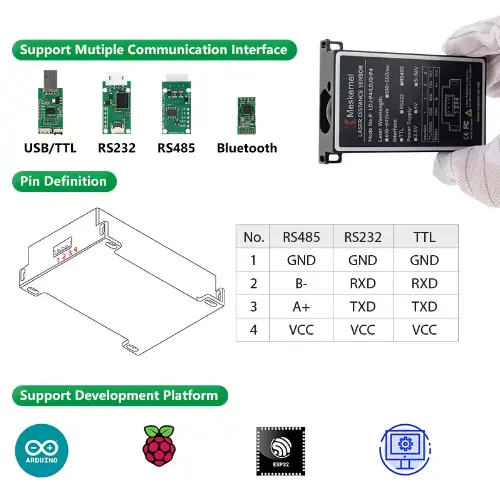
- Industrial interfaces such as UART or RS485
IP54 protection ensures the sensor remains reliable and durable in real industrial conditions without unnecessary bulk.
자주 묻는 질문
Can an IP54 distance measure sensor be used outdoors?
Yes. An IP54 distance measure sensor can be used outdoors with partial protection, such as under a roof, enclosure, or cabinet.
Is IP54 enough for dusty environments?
Yes. IP54 is dust-protected, meaning dust will not interfere with normal operation, making it suitable for warehouses and construction sites.
Can IP54 sensors handle construction sites?
In most cases, yes. IP54 sensors are widely used on construction sites where dust and vibration are present but heavy water exposure is not.
What is the difference between IP54 and waterproof sensors?
IP54 sensors are splash-resistant, not waterproof. Waterproof protection typically starts at IP67.
When should I choose IP65 instead of IP54?
Choose IP65 if the sensor is fully exposed to rain, water jets, or outdoor washdown conditions.
Is IP54 the Right Choice for Your Application?
If your application involves:
- Dust ✔
- Outdoor airflow ✔
- Industrial or construction environments ✔
- No direct water jets or immersion ✔
Then a IP54 Distance Measure Sensor is often the best balance of protection, performance, and cost.
Understanding what IP54 really means helps you choose a distance detector sensor that fits your environment — without overengineering or overspending.