Why Hidden Integration Costs Are Often Overlooked
When buyers evaluate a laser czujnik odległości for mobile robots, the initial focus tends to be on unit price and measurement specifications.
However, the true integration cost often comes from factors that are not immediately obvious, such as electrical wiring, communication protocols, software adaptation, calibration, and mechanical adjustments. Overlooking these can significantly increase total cost of ownership (TCO) and delay deployment for AMR or AGV projekty.
This article explores the hidden integration costs of mobile robot odległość lasera sensors and provides insights that OEMs, robotics system integrators, and procurement managers must consider before purchasing.
1. Electrical & Communication Integration Challenges
Even high-quality robotic laserowe czujniki odległości can encounter electrical or interface issues:
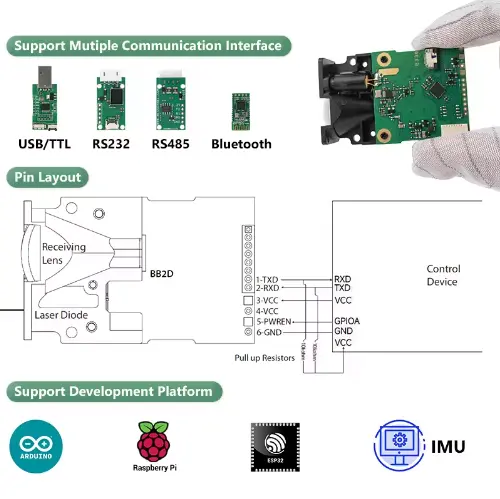
- Voltage & logic compatibility: Some sensors operate at TTL 3.3V, while robot controllers may require 5V or RS485/RS232 levels.
- Protocol alignment: Many laser distance sensors support UART, Modbus, or custom ASCII/HEX output. Integrating these with your robot’s MCU often requires custom firmware or middleware.
- Signal noise & grounding: EMI or improper shielding can cause intermittent errors, leading to costly debugging.
💡 Buyers frequently underestimate the engineering hours required for stable electrical integration.


2. Mechanical Integration & Space Considerations
Mobile robots have compact layouts, and hidden costs may arise from:
- Mounting and alignment: Correct positioning is crucial for consistent obstacle wykrywanie and motion control.
- Vibration isolation: Moving robots can introduce jitter; some sensors need damping mounts.
- Environmental protection: Dust, moisture, and impact protection (IP54/IP65 housings) require additional mechanical design.
These adjustments are often not included in the initial sensor quote, increasing time and cost for deployment.
3. Calibration & Field Testing Costs
A mobile robot laserowy czujnik odległości is not fully operational until it is:
- Calibrated with the robot’s coordinate frame
- Tested across multiple surfaces and materials (metal, wood, pallets)
- Validated under varying lighting and environmental conditions
Even premium sensors require days of calibration and field testing per robot model, especially for fleets.
💡 Skipping these steps often leads to early operational errors and rework.
4. Software & Control System Adjustments
Hidden costs are also software-related:
- Data filtering and smoothing: Raw sensor readings may fluctuate; filtering is required for motion control loops.
- Integration with PID controllers: Sensor latency and frequency must be accounted for.
- Multi-sensor fusion: Combining czujniki laserowe z LiDAR, cameras, or IMUs requires synchronization and fusion logic.
These tasks need specialized engineering, which adds time and labor costs beyond the sensor price.
5. Compliance & Safety Testing
For industrial robots, mechanical or electrical modifications can trigger:
- Re-validation for ISO or CE compliance
- Safety checks for emergency stops, collision avoidance, and operational limits
Ignoring these can cause regulatory delays or even deployment halts.
6. How Buyers Can Reduce Hidden Integration Costs
- Choose robotics-ready sensors: Compact, low-power, multi-interface modules reduce mechanical and electrical adaptation.
- Work with experienced OEM suppliers: Companies like Meskernel provide pre-tested modules optimized for mobile robots.
- Allocate time for field testing: Include calibration, environmental validation, and fleet-scale testing in project schedules.
This proactive approach ensures smoother integration and lowers TCO.
7. Key Takeaways: Total Cost vs Unit Price
While the unit price of a laserowy czujnik odległości may appear low, hidden integration costs often exceed the initial purchase cost.
| Hidden Cost Type | Impact on Mobile Robot Projects |
|---|
| Electrical & Protocol | Extra engineering hours, unstable performance |
| Mechanical & Mounting | Custom brackets, housing, IP protection |
| Calibration & Field Testing | Time-intensive setup, repeat tests |
| Software & Fusion | Programming, latency compensation |
| Safety & Compliance | Validation and certification requirements |
Investing in robotic laser distance sensors designed for integration can reduce risk and accelerate deployment.
FAQ
Why do integration costs matter more than sensor price for mobile robots?
Integration impacts engineering time, reliability, and deployment speed, often exceeding the sensor’s upfront cost.
How can I reduce laser sensor integration issues?
Use robotics-ready modules, verify interface compatibility, and work with OEM/ODM suppliers experienced in mobile robot integration.
Are all laser distance sensors suitable for robot fleets?
No. Industrial-grade, multi-interface, and compact sensors designed for robotics are preferred.
Do mechanical enclosures affect integration cost?
Yes. Proper IP-rated housings prevent damage but require design adjustments, adding hidden costs.
Can laser distance sensors work alongside LiDAR and cameras?
Yes. They provide deterministic short-range distance measurements, ideal for motion control and redundancy in sensor fusion.
Focus Beyond Unit Price
For mobile robots, hidden integration costs often outweigh the initial sensor price. By carefully considering:
- Electrical and communication compatibility
- Mechanical mounting and environmental protection
- Calibration, field testing, and software adaptation
OEMs and system integrators can avoid delays, minimize risk, and reduce TCO.
Partnering with experienced suppliers like Meskernel ensures smooth integration, reliable performance, and predictable costs for your mobile robot projects.