High-precision positioning has become a foundational technology for modern outdoor systems such as UAV mapping, autonomous vehicles, smart agriculture, and konstrukcja pomiary. While RTK (Real-Time Kinematic) positioning is widely known for its centimeter-level accuracy, RTK alone is not sufficient for many real-world measurement tasks.
In modern outdoor positioning systems, the RTK laser czujnik odległości has become a critical component for achieving reliable centimeter-level dokładność pomiaru. By combining precise global positioning with accurate local pomiar odległości, RTK-based systems can operate more reliably in complex and dynamic environments.
This article explains why RTK needs odległość lasera sensing, how an RTK laserowy czujnik odległości works within positioning systems, and how to choose the right solution for engineering and industrial applications.
Why RTK Alone Is Not Enough for Precise Outdoor Measurement
RTK significantly improves GNSS positioning accuracy by using real-time correction data from a base station. Under ideal conditions, RTK systems can achieve centimeter-level horizontal positioning accuracy. However, in real-world outdoor environments, RTK still faces several limitations:
- Vertical accuracy is generally less stable than horizontal accuracy
- RTK cannot directly measure distance to objects or surfaces
- Performance can degrade near buildings, terrain edges, or reflective environments
- RTK provides position, but not real-time obstacle or height feedback
Because of these limitations, relying solely on RTK may lead to unreliable altitude estimation, poor obstacle awareness, or inaccurate surface profiling. This is where the RTK laser distance sensor becomes essential.
RTK determines gdzie a system is located, while a laser distance sensor determines how far the system is from surrounding objects or surfaces. Together, they form a complete spatial measurement solution.
What Role Does an RTK Laser Distance Sensor Play in RTK Positioning Systems?
An RTK laser distance sensor does not replace RTK—it complements it by adding high-resolution local measurement capability.
Key roles include:
- Accurate Height and Elevation Measurement
Laserowe czujniki odległości provide precise vertical distance data to the ground, crops, terrain, or structures, compensating for RTK’s weaker vertical accuracy.
- Relative Distance Measurement
Unlike RTK, laser distance sensors can measure the distance between a moving platform and nearby objects in real time.
- Dynamic Feedback for Moving Platforms
In UAVs, autonomous vehicles, and robots, laser distance sensors provide fast response data for altitude control, obstacle wykrywanie, and terrain following.
- System Stability and Redundancy
When RTK accuracy fluctuates due to multipath effects or signal obstruction, laser distance measurements help maintain stable system behavior.
By integrating an RTK laser distance sensor, engineers can achieve centimeter-level positioning combined with millimeter-level local measurement accuracy.
Key Applications of RTK Laser Distance Sensors
UAV Mapping and Terrain Surveying
In UAV-based mapping systems, RTK is used to georeference flight paths and image data. However, accurate terrain modeling and safe flight control depend heavily on laser distance measurements.
In UAV mapping applications, an RTK laser distance sensor is commonly used to provide accurate altitude and ground clearance data in real time. This improves terrain elevation models, landing precision, and overall flight safety—especially during low-altitude missions.
Key requirements include:
- Compact size and low weight
- Stable performance under strong sunlight
- Fast measurement response
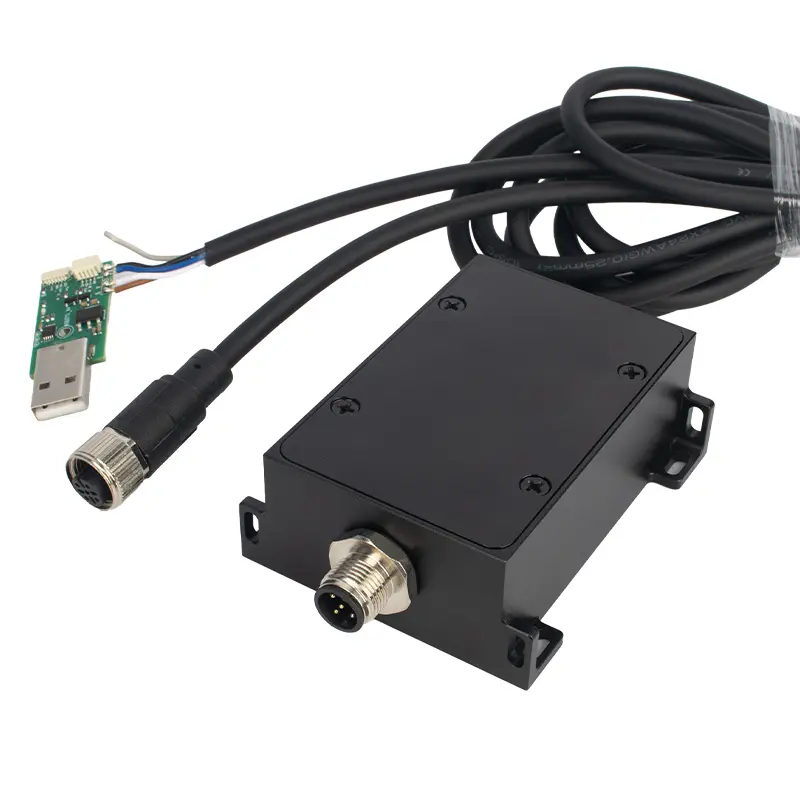
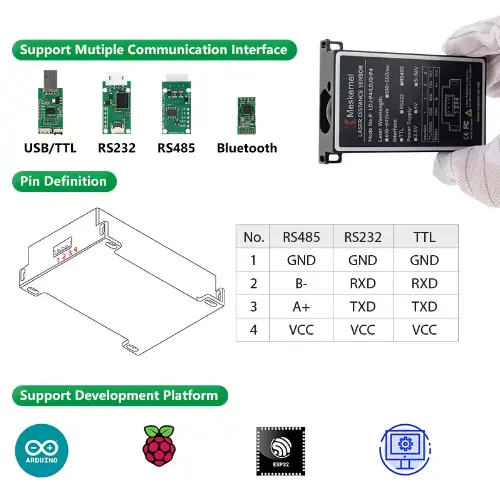
- Simple integration via UART or RS485
Autonomous Vehicles and Agricultural Robots
RTK is widely adopted in autonomous vehicles and agricultural machinery for path planning and nawigacja. However, practical tasks such as Omijanie przeszkód, crop pomiar wysokości, and implement control require reliable distance sensing.
For autonomous vehicles and agricultural robots, the RTK laser distance sensor enables precise distance feedback that complements RTK-based navigation. It allows the system to react to terrain changes, crop growth, or unexpected obstacles in real time.
Key requirements include:
- High measurement frequency
- Strong resistance to environmental interference
- Industrial communication interfaces
- Stable operation under vibration and temperature variation
Construction, Surveying, and Engineering Measurement
In construction and surveying projects, RTK provides global positioning reference points, while laser distance sensors are used to measure heights, clearances, and relative distances between structures.
By integrating an RTK laser distance sensor, engineers can reduce manual measurement work and improve efficiency in large or complex construction environments.
Key requirements include:
- Dokładność na poziomie milimetra
- Long-term measurement stability
- Industrial-grade protection (IP-rated housings)
- Reliable data output for system integration
How to Choose the Right RTK Laser Distance Sensor
Choosing the right RTK laser distance sensor is critical to overall system performance. Below are the most important technical factors to consider.
1. Measurement Principle: Phase vs. Pulse
Phase-based (iToF) laser distance sensors
- High accuracy, often at the millimeter level
- Ideal for short- to medium-range measurement
- Excellent repeatability and fast response
Pulse-based (dToF) laser rangefinder sensors
- Long measurement range (hundreds to thousands of meters)
- Wysoka odporność na światło otoczenia
- Suitable for large-scale outdoor applications
The measurement principle should match the system’s range, accuracy, and environment requirements.
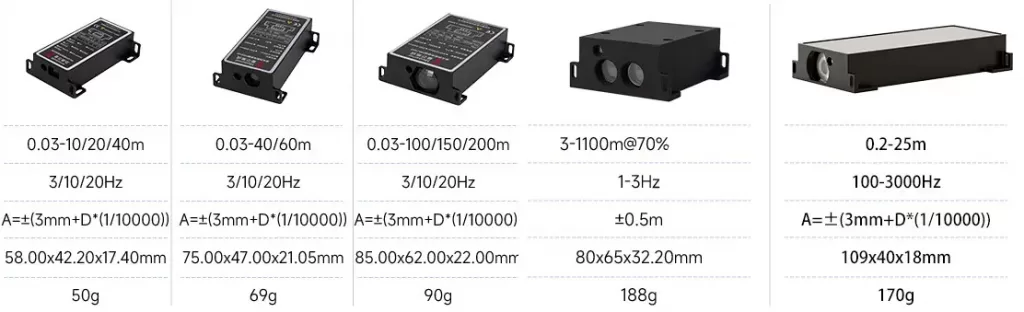
2. Accuracy and Measurement Range
When selecting an RTK laser distance sensor, engineers must balance accuracy and measurement range. While RTK provides centimeter-level positioning, the czujnik laserowy defines the precision of local measurements such as height and object distance.
Consider:
- Required accuracy (millimeter vs. centimeter)
- Maximum measurement distance
- Long-term repeatability
3. Measurement Frequency and Response Speed
Dynamic systems require fast feedback. A well-matched RTK laser distance sensor significantly improves system stability and responsiveness.
- Low-frequency sensors (1–5 Hz) are suitable for static measurements
- Higher-frequency sensors (30 Hz, 100 Hz, or more) support real-time control
Latency is often more critical than maximum range in mobile RTK systems.
4. Communication Interface and Protocol Compatibility
An RTK laser distance sensor must integrate seamlessly into existing control systems. Common interfaces include:
- UART / TTL
- RS232 / RS485
- CAN bus
Supported protocols such as Modbus, ASCII, or custom formats improve integration efficiency and system reliability.
5. Environmental Adaptability and Protection
Outdoor RTK systems often operate in harsh environments. Important considerations include:
- Zakres temperatur pracy
- Odporność na kurz, wilgoć i wibracje
- IP-rated housings (IP54, IP65, IP67)
Durability directly impacts maintenance cost and long-term system performance.
Why OEM and Customization Matter in RTK-Based Systems
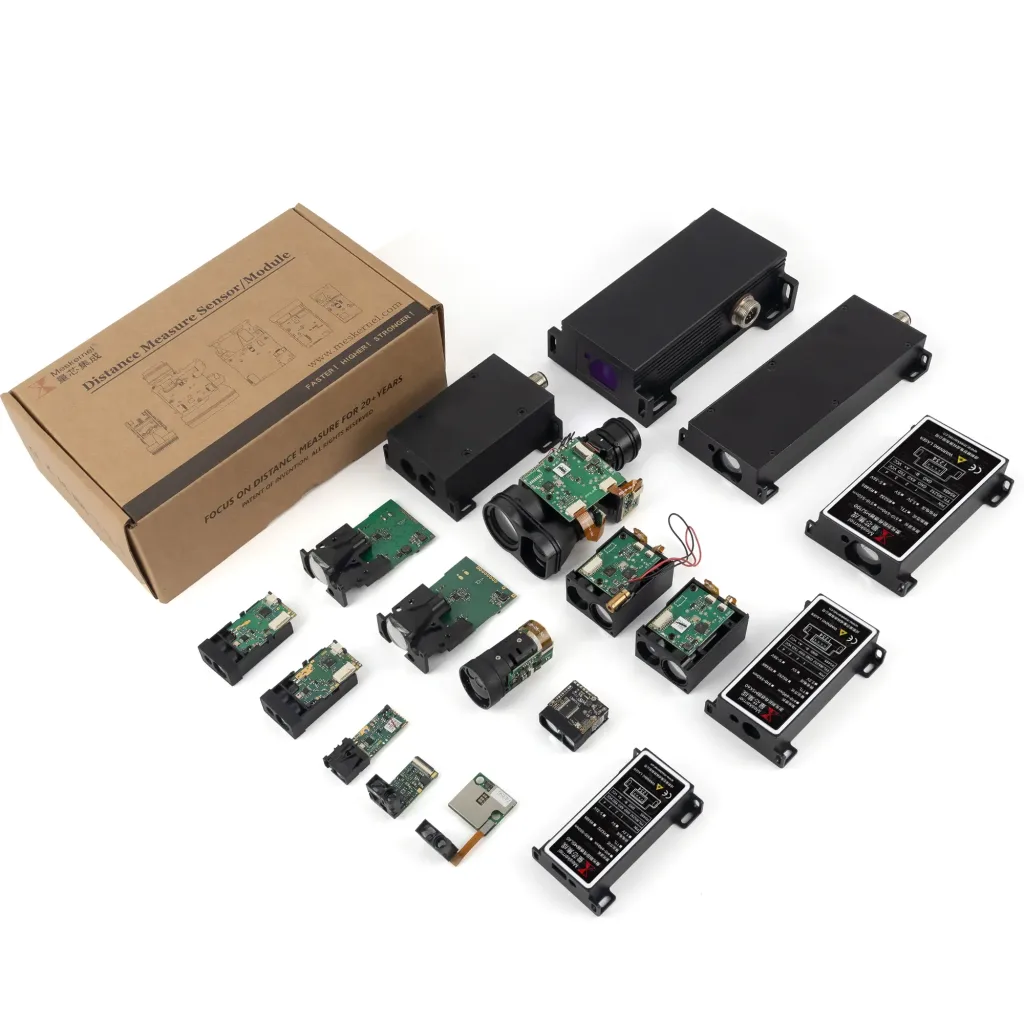
RTK-based systems are rarely standardized products. Many applications require customized sensor configurations, such as:
- Specific measurement ranges or frequencies
- Customized communication interfaces
- Mechanical size or mounting adaptations
- Enhanced environmental protection
Choosing a supplier with strong OEM and ODM capabilities allows the RTK laser distance sensor to be optimized for the entire system, rather than forcing system design to adapt to a fixed sensor.
FAQ
Can RTK replace a laser distance sensor?
No. RTK provides global positioning, while laser distance sensors provide local distance measurement. They serve different purposes and are complementary.
What is an RTK laser distance sensor?
An RTK laser distance sensor combines RTK-based positioning with laserowy pomiar odległości to deliver both global position accuracy and precise local distance data. RTK provides centimeter-level coordinates, while the laser sensor measures height, clearance, or object distance in real time, making the system suitable for outdoor measurement applications.
Why does an RTK system need a laser distance sensor?
RTK systems determine position but cannot directly measure distance to objects or surfaces. A laser distance sensor adds accurate height and distance measurement, improves reliability in complex environments, and compensates for RTK’s weaker vertical accuracy. This combination is essential for UAVs, autonomous vehicles, agriculture, and surveying systems.
What applications use RTK laser distance sensors most commonly?
RTK laser distance sensors are widely used in UAV mapping, terrain surveying, autonomous vehicles, agricultural machinery, construction measurement, and outdoor robotics. These applications require both precise positioning and reliable distance or height measurement in real time.
How accurate is an RTK laser distance sensor?
Accuracy depends on the pomiar laserowy principle and sensor specification. Phase-based laser distance sensors typically achieve millimeter-level accuracy at short to medium ranges, while pulse-based sensors support long-range measurement with centimeter-level precision. When combined with RTK, overall system accuracy is significantly improved.
What is the difference between phase-based and pulse-based RTK laser distance sensors?
Phase-based (iToF) sensors offer higher accuracy and faster response for short to medium distances, making them ideal for height measurement and industrial automation. Pulse-based (dToF) sensors support much longer measurement ranges and perform better in large outdoor environments such as UAV or long-range surveying applications.
How do RTK laser distance sensors integrate with positioning systems?
Most RTK laser distance sensors support industrial communication interfaces such as UART, RS232, RS485, or CAN bus. These interfaces allow easy integration with RTK receivers, controllers, and onboard computers, enabling real-time data fusion and system control.
Are RTK laser distance sensors suitable for harsh outdoor environments?
Yes. Industrial RTK laser distance sensors are designed to operate in challenging environments and often feature wide operating temperature ranges, resistance to vibration, and IP-rated housings (such as IP54 or IP67) to protect against dust and moisture.
Can RTK laser distance sensors be customized for OEM projects?
Yes. Many RTK-based systems require customized measurement range, frequency, interface, or mechanical design. OEM and ODM customization allows the RTK laser distance sensor to match specific system requirements rather than forcing design compromises.
Przemyślenia końcowe
RTK technology has transformed outdoor positioning, but its full potential is realized only when combined with accurate distance sensing. Selecting the right RTK laser distance sensor is a key step in building reliable, scalable, and high-precision outdoor positioning systems.
By carefully evaluating measurement principles, accuracy, frequency, interfaces, environmental robustness, and customization options, engineers and system integrators can create RTK-based solutions that perform consistently in real-world conditions.