Laser Ranging Sensors for AGVs: Why They Matter in Autonomous Navigation
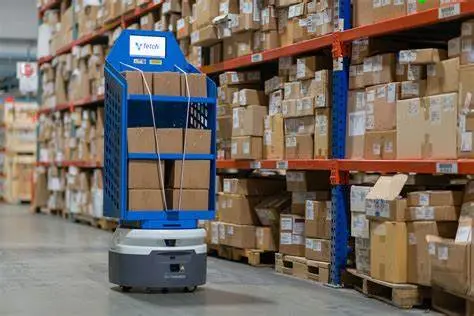
Alcance laser sensors for AGVs are a core technology enabling safe, precise, and reliable autonomous navigation in modern industrial environments. In warehouses, factories, and logística centers, AGVs must continuously perceive their surroundings to avoid collisions, control speed, and achieve accurate positioning—all without physical contact.
By providing real-time medição de distâncias with high accuracy, laser ranging sensors for AGVs allow mobile robots to operate efficiently in dynamic environments where people, pallets, and equipment are constantly moving.
What Are Laser Ranging Sensors for AGVs?
Laser ranging sensors for AGVs are non-contact distance measurement devices designed to provide continuous and precise distance data between the vehicle and surrounding objects. These sensors typically use tempo de voo (ToF) or phase-shift measurement principles to calculate distance based on laser signal reflection.
Unlike basic presence sensors, laser ranging sensors for AGVs deliver continuous ranging data, enabling autonomous vehicles to make real-time navigation decisions such as braking, rerouting, or speed adjustment.
Core Applications of Laser Ranging Sensors
1. Obstacle Detection and Collision Avoidance
One of the most common applications of laser ranging sensors for AGVs is obstacle deteção. By continuously monitoring the distance ahead of the vehicle, AGVs can detect humans, pallets, and other vehicles in real time.
When an object enters a predefined safety zone, the AGV control system can automatically reduce speed or trigger an emergency stop, significantly improving operational safety in human–robot collaboration environments.
2. Precise Docking and Positioning Control
Laser ranging sensors for AGVs are widely used for precise docking at pallet stations, conveyors, and charging points. Accurate distance feedback allows AGVs to stop at consistent positions, reducing mechanical alignment issues and improving repeatability in automated logistics systems.
This level of positioning accuracy is especially important for high-throughput warehouse operations.
3. Dynamic Speed Control Based on Distance
By integrating laser ranging sensors for AGVs into the vehicle control system, distance data can be used to dynamically regulate speed. AGVs can slow down when approaching narrow aisles, intersections, or buffer zones, improving traffic efficiency and reducing collision risk.


Why AGV Manufacturers Prefer Laser Ranging Sensors
Compared with ultrasonic or infrared alternatives, laser ranging sensors offer several advantages:
- Longer and more stable measurement range
- Faster update rates suitable for moving platforms
- Higher accuracy for navigation and docking
- Reliable detection across different surface colors
- Medição sem contacto with minimal maintenance
These characteristics make laser ranging sensors the preferred solution for AGV manufacturers focused on safety, efficiency, and long-term system reliability.
Typical Specifications of Laser Ranging Sensors for AGVs
When evaluating laser ranging sensors for AGVs, buyers commonly focus on:
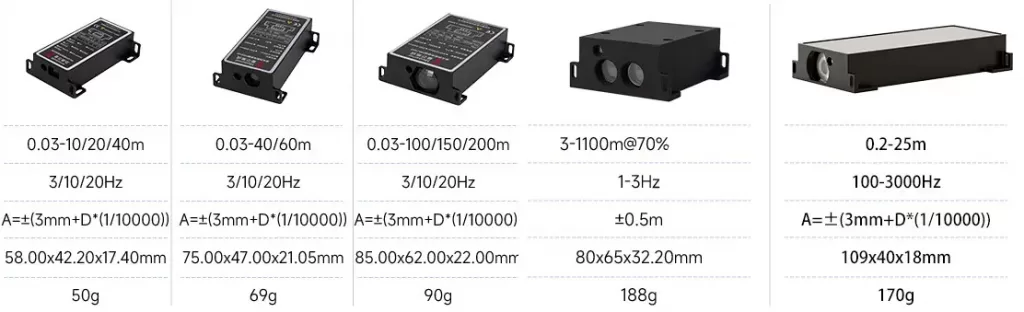
- Gama de medição: typically 0.1 m to 10 m
- Exatidão: millimeter-level precision
- Update rate: ≥100 Hz for smooth navigation
- Interfaces: UART, RS485, CAN, or análogo resultado
- Power consumption: optimized for battery-powered AGVs
Understanding these specifications helps buyers select sensors that match both technical and operational requirements.
Integrating Laser Ranging Sensors into Control Systems
Laser ranging sensors for AGVs are usually integrated into PLCs or embedded controllers via digital or analog interfaces. Distance data is used to implement control logic such as speed regulation, stop positioning, and safety zone monitoring.
For system integrators, ease of integration and protocol compatibility are key considerations when selecting laser ranging sensors.
Buyer Checklist: What to Verify Before Purchasing
Before ordering sensores de alcance laser, buyers should verify:
- Real AGV application test results
- Stable performance during continuous movement
- Detection reliability for different object materials
- Response time under braking conditions
- Compatibility with existing AGV control systems
Before selecting laser ranging sensors for AGVs, buyers should review laser distance sensor test and performance videos to evaluate accuracy, ranging stability, and response behavior under controlled conditions. These demonstrations help verify whether a specific sensor model meets the technical requirements before system integration.
FAQ – Laser Ranging Sensors for AGVs
-
What type of laser ranging sensors for AGVs are best for navigation?
The best laser ranging sensors for AGVs offer fast update rates, stable ranging accuracy, and compact size. Sensors designed for continuous operation and real-time distance feedback are ideal for obstacle detection, docking, and speed control in mobile robot systems.
-
What measurement range is typically required for laser ranging sensors for AGVs?
Most AGV applications use laser ranging sensors with ranges between 0.1 m and 10 m. Short-range sensors are suitable for precise docking, while longer-range models support obstacle detection in open warehouse areas.
-
How do laser ranging sensors for AGVs improve safety?
Laser ranging sensors for AGVs continuously monitor the distance to surrounding objects. When an object enters a defined safety zone, the AGV can automatically slow down or stop, significantly reducing collision risks in shared workspaces.