Why Military Laser Range Finders Are a High-Value Segment
Military and defense-related laser menzil bulucu systems represent one of the highest entry-barrier and highest-value markets in optik sensing. Compared with consumer or industrial distance meters, military-grade systems demand:
- Longer effective ranging distance
- Higher resistance to interference
- Extreme environmental robustness
- Stable long-term supply and customization capability
For OEM manufacturers specializing in lazer telemetre modules, this segment is less about volume and more about system compatibility, reliability, and trust.
Core Military-Grade Requirements for Laser Range Finders
1. Long-Range Capability (Hundreds to Thousands of Meters)
Military laser range finders typically operate in mid- to long-range regimes, commonly:
- 500 m – 1 km (vehicle-mounted, İHA payloads)
- 1 km – 3 km (reconnaissance, observation systems)
This range requirement strongly favors pulse-based (dToF) lazer menzili technology, usually operating at 905 nm wavelength due to its balance between range performance, component maturity, and eye safety.
Relevant long-range module characteristics:
- Stable pulse emission
- High-sensitivity receiver
- Optimized optical path
- Metal shielding to reduce signal loss
2. Eye-Safe Laser Wavelength
Eye safety is a mandatory baseline requirement in military and security applications, especially for:
- Human-operated observation devices
- UAV-mounted sensors
- Multi-sensor reconnaissance platforms
Most military laser range finder modules use:
- 905 nm infrared laser (Class I / Class II)
This wavelength is:
- Invisible to the human eye
- Less distracting in night or covert operations
- Widely accepted in international laser safety standards
3. Anti-Interference & Signal Reliability
Military environments introduce multiple sources of interference:
- Strong sunlight and background radiation
- Dust, smoke, fog, rain
- Electromagnetic interference (EMI)
- Multi-sensor cross-talk
To ensure reliable ranging results, military laser range finder systems emphasize:
- Narrow-band optical filtering
- Optimized signal processing algorithms
- Strong signal-to-noise ratio (SNR)
- Stable output under fluctuating reflectivity
Pulse laser ranging is particularly effective here, as time-domain filtering allows rejection of background noise.
4. Ruggedized & Harsh-Environment Design
Unlike consumer rangefinders, military laser range finder modules must survive:
- Wide operating temperature ranges (typically -20°C to +60°C)
- Mechanical shock and vibration
- Long-term outdoor exposure
Key structural features include:
- Metal housing for mechanical stability
- Compact, sealed optical structures
- Industrial or military-grade connectors
- Support for protective enclosures (IP54–IP67)
Typical Military Applications of Laser Range Finders
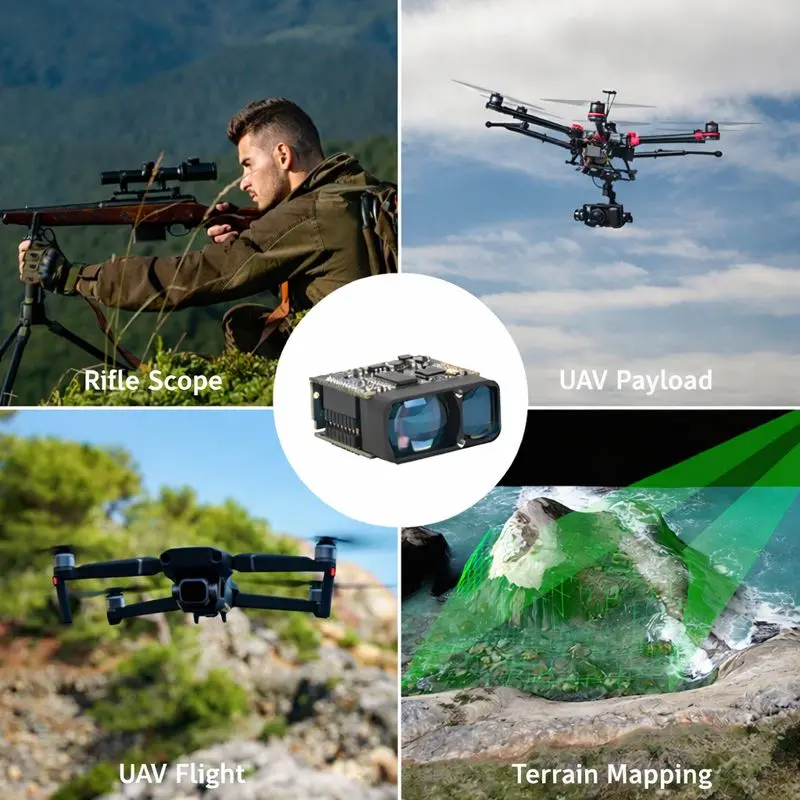
1. Target Ranging & Observation Systems
Laser range finders are integrated into:
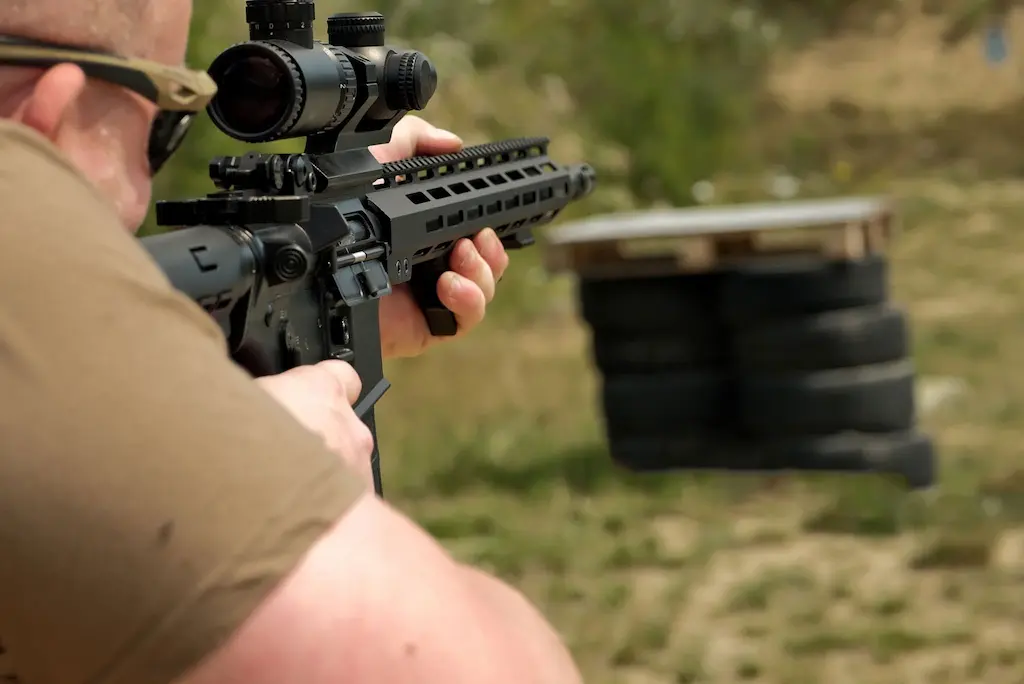
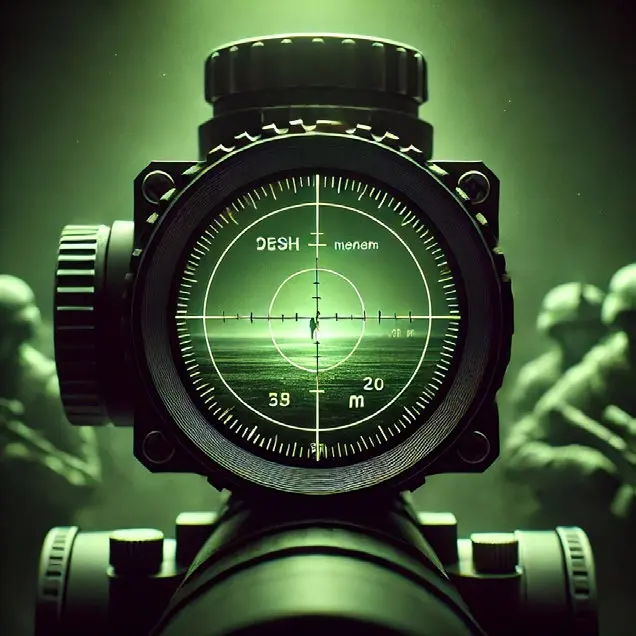
- Observation scopes
- Surveillance towers
- Handheld or tripod-mounted optical systems
In these systems, the range finder works alongside:
- Optical zoom lenses
- Image sensors
- Data processing units
The ranging module provides distance data, not targeting instructions.
2. Fire Control & Integrated Sensing Platforms
In fire-control-related systems, laser range finders act as mesafe ölçümü components within a larger sensor fusion framework.
Typical integrations include:
- Range + angle measurement
- Ballistic computation systems
- Stabilized optoelectronic platforms
From a component perspective, this requires:
- Fast response time
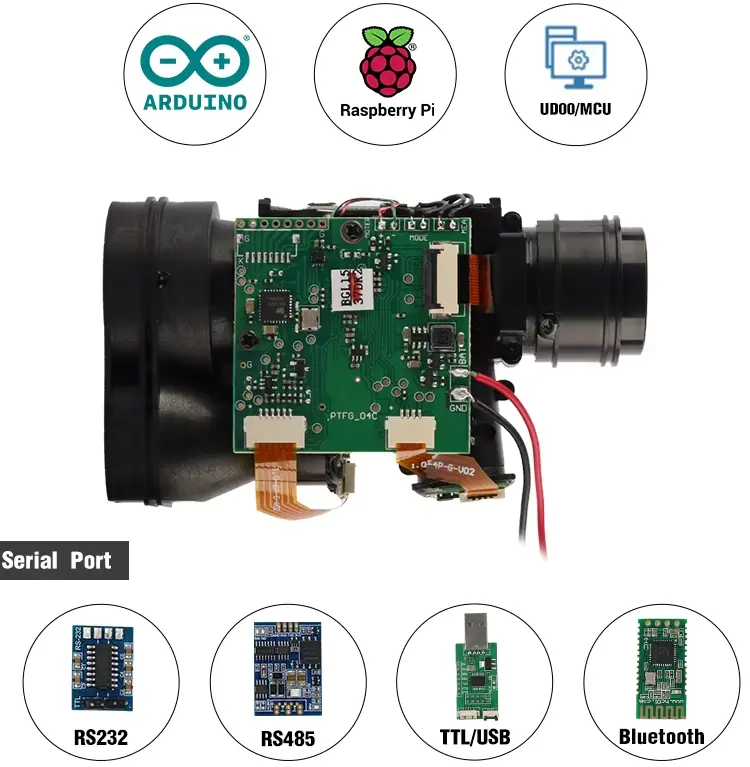
- Stable communication protocols (UART / RS485 / RS232)
- Deterministic data output
3. UAV & Reconnaissance Payloads
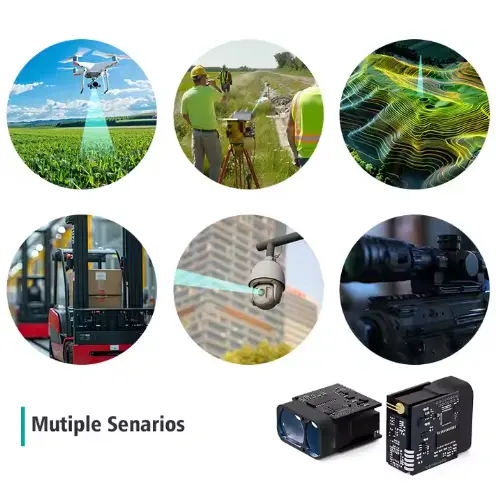
Unmanned aerial systems rely heavily on compact, lightweight laser range finder modules for:
- Terrain profiling
- Obstacle distance estimation
- Ground object ranging
Critical module features for UAV integration:
- Small size and low weight
- Düşük güç tüketimi
- Resistance to vibration
- Clean dijital interfaces for onboard controllers
Consumer Rangefinders vs Military Laser Range Finder Modules
| Aspect | Consumer Rangefinder | Military / Defense Module |
|---|
| Typical Range | <200 m | 500 m – 3000 m |
| Lazer Tipi | Visible red / green | 905 nm infrared |
| Anti-Interference | Sınırlı | Yüksek |
| Housing | Plastic | Metal / Rugged |
| Özelleştirme | Hiçbiri | OEM / ODM supported |
| System Integration | Standalone | Embedded module |
Military systems almost never use off-the-shelf consumer products. Instead, they rely on OEM lazer telemetre modülleri designed for system-level integration.
Why OEM Laser Range Finder Modules Matter
Defense and security projects often require:
- Customized ranging distance
- Specific communication protocols
- Mechanical adaptation to existing housings
- Uzun vadeli arz istikrarı
An experienced OEM manufacturer can support:
- Pulse laser rangefinder modules (up to kilometer-level range)
- Compact cylindrical or square module designs
- Metal-housed versions for rugged environments
- Protocol customization (UART, RS485, RS232)
This flexibility is critical in military-grade system development cycles.
Military laser range finder systems are not defined by tactics, but by engineering reliability. Long range, eye safety, anti-interference performance, and rugged design form the true value core.
İçin OEM manufacturers with strong laser ranging technology, this segment represents a high-barrier, high-trust, high-value market — where module capability and customization matter far more than branding.
If you are evaluating laser range finder modules for defense, security, or high-reliability sensing platforms, focusing on pulse-based long-range designs with proven OEM support is the correct starting point.
What is the difference between a military laser range finder and a standard rangefinder?
A military laser range finder is engineered for long-range, high-reliability environments and system-level integration. Compared with standard or consumer rangefinders, military-grade systems emphasize longer measurement distance, eye-safe infrared wavelengths, stronger anti-interference capability, rugged metal housing, and support for OEM integration through dedicated laser rangefinder modules rather than standalone devices.
How far can a military laser range finder measure?
Most military laser range finder systems operate in the range of several hundred meters up to 1–3 kilometers, depending on the optical design, laser power, and target reflectivity. Long-range performance is typically achieved using pulse-based (direct Time of Flight) laser ranging technology, which is optimized for outdoor and high-background-light conditions.
Why are pulse laser rangefinders preferred in military applications?
Pulse laser rangefinders are preferred because they offer superior performance over long distances and in complex environments. By measuring the direct time of flight of laser pulses, these systems can effectively suppress background light, improve signal-to-noise ratio, and maintain stable ranging results under sunlight, dust, fog, or electromagnetic interference.
What laser wavelength is commonly used in military laser range finder systems?
Most military laser range finder systems use 905nm infrared lasers. This wavelength is widely adopted because it supports eye-safe laser classifications, is invisible to the human eye, and provides reliable long-range performance with mature optical and electronic components.
Are military laser range finders eye-safe?
Yes. Eye safety is a fundamental requirement in military and security-related laser range finder systems. Most designs comply with Class I or Class II laser safety standards, particularly when using 905nm infrared lasers, making them suitable for human-operated equipment, UAV platforms, and multi-sensor reconnaissance systems.
What makes a laser range finder suitable for military or defense systems?
Key factors include long-range capability, strong resistance to environmental interference, ruggedized mechanical design, stable communication interfaces, and long-term reliability. Military systems also require consistent performance across wide temperature ranges and compatibility with existing optoelectronic or sensor fusion platforms.
Can military laser range finder modules be integrated into UAV systems?
Yes. Compact and lightweight military laser range finder modules are widely integrated into UAV payloads for distance measurement, terrain profiling, and object ranging. These modules are designed to withstand vibration, operate with low power consumption, and communicate reliably with onboard flight controllers or processing units.
What communication interfaces are used in military laser range finder modules?
Military laser range finder modules commonly support digital interfaces such as UART, RS232, and RS485. These interfaces allow stable, deterministic data transmission and make it easier to integrate the ranging module into fire control systems, UAV platforms, or centralized processing units.
Why are OEM laser range finder modules preferred over finished products?
Finished rangefinder products are designed for standalone use and offer limited customization. OEM laser range finder modules, on the other hand, allow system integrators to tailor the mechanical structure, communication protocol, optical configuration, and environmental protection level to meet specific military or defense system requirements.
How reliable are military laser range finder systems in harsh environments?
Military laser range finder systems are designed to operate reliably in harsh environments, including strong sunlight, rain, dust, vibration, and wide temperature variations. Rugged housings, optimized optics, and robust signal processing ensure stable performance in outdoor and long-term deployment scenarios.
Do military laser range finders require special calibration?
Military laser range finder modules are typically factory-calibrated and optimized for stability over time. In most applications, no frequent field calibration is required, which is critical for systems that operate in remote or difficult-to-access environments.
Are military laser range finder systems customizable for specific projects?
Yes. OEM manufacturers can customize military laser range finder modules based on project requirements, including ranging distance, size, weight, communication protocol, enclosure design, and environmental protection level. This flexibility is essential for defense, UAV, and optoelectronic system integration.