Accurate grain storage sensor solutions play a critical role in modern agricultural and bulk material management systems, where reliable grain level measurement is essential for inventory visibility and operational efficiency. In large cylindrical silos, automated silo volume monitoring has become increasingly important as operators seek more accurate and real-time insight into stored materials.
Traditional methods such as manual inspection, mechanical probes, or weight-based estimation often suffer from limited accuracy, high maintenance costs, and poor suitability for automation. With the growing demand for real-time inventory monitoring, non-contact distance sensors have emerged as a reliable solution for measuring grain level and estimating stored volume — particularly in tall, enclosed, and dusty environments such as grain silos up to 15 meters in height.
This article explains how distance sensors can be used for grain storage volume measurement, the key technical considerations involved, and how to select a suitable sensor for silo-based applications.
Application Overview: Grain Volume Measurement in Cylindrical Silos
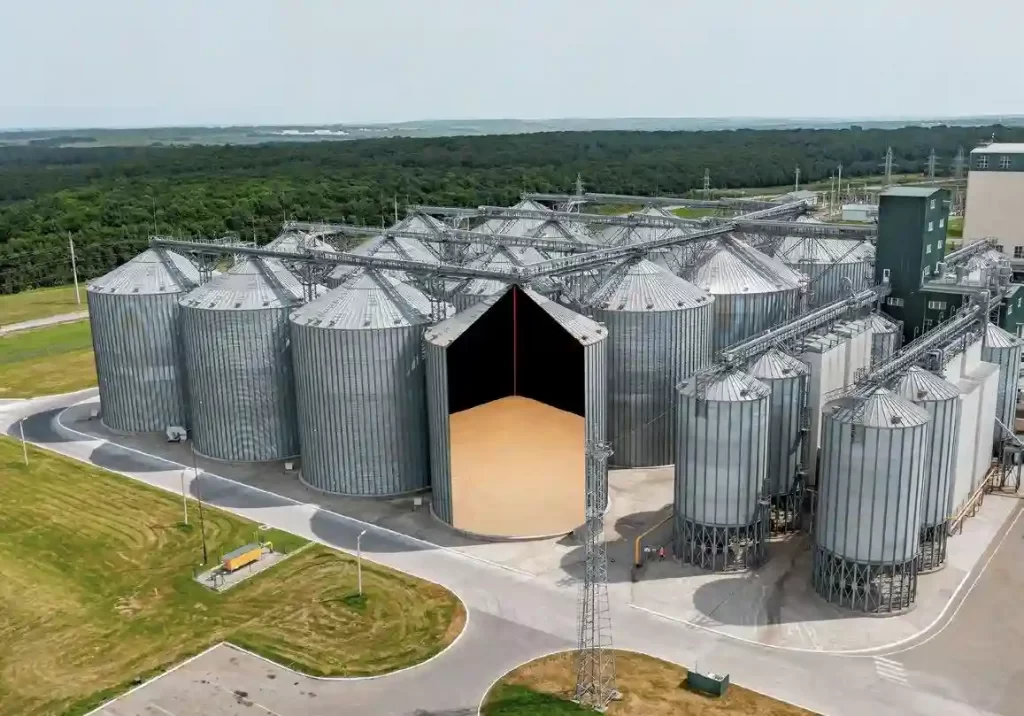
Typical application parameters:
- Storage type: Cylindrical grain silo
- Height: ~15 meters
- Diameter: ~5 meters
- Stored material: Bulk grains (corn, wheat, rice, feed, seeds)
- Installation method: Top-mounted, downward measurement
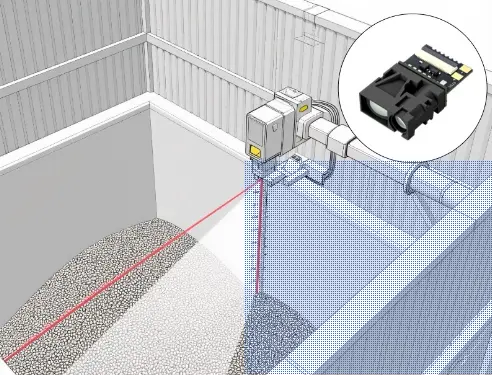
The sensor is installed at the top of the silo and continuously measures the distance to the grain surface. By converting the measured distance into grain height, the system can estimate the total stored volume.
Technical Challenges in Grain Storage Measurement
Grain storage environments present several challenges that directly affect sensor performance:
1. Irregular Grain Surface
Grains form uneven and constantly changing surfaces due to filling, discharge, and settling. A sensor must provide stable and repeatable measurements, not just high peak accuracy.
2. Dust and Low Reflectivity
Grain silos often contain dust particles that can interfere with ultrasonic or optik sensors. Lazer tabanlı mesafe sensörleri with strong signal processing perform better in such conditions.
3. Large Measurement Range
A 15 m silo requires sufficient measurement margin. Sensors designed for short-range applications are not suitable.
4. Embedded System Integration
Most grain monitoring systems rely on MCUs, PLCs, or embedded controllers, requiring simple and reliable communication interfaces such as UART or RS485.
Key Sensor Requirements for Grain Storage Applications
Ölçüm Aralığı
For a silo height of 15 m, a sensor with a 20–30 m effective range is recommended to ensure sufficient margin and stable signal quality.
Field of View (FoV)
A wider FoV allows the sensor to “see” more of the grain surface, which is beneficial for volume estimation in uneven bulk materials.
- Recommended FoV: >100°
- Wide FoV helps reduce errors caused by localized peaks or depressions in the grain surface.
Accuracy and Repeatability
For volume estimation, measurement repeatability is often more important than absolute millimeter accuracy. Stable distance readings enable more reliable volume calculations over time.
İletişim Arayüzü
Preferred interfaces for grain storage systems include:
- UART (TTL level) for MCU-based designs
- RS485 for industrial or long-distance communication
- Support for standard baud rates and stable protocols
Suitable Distance Sensor Technologies for Grain Storage
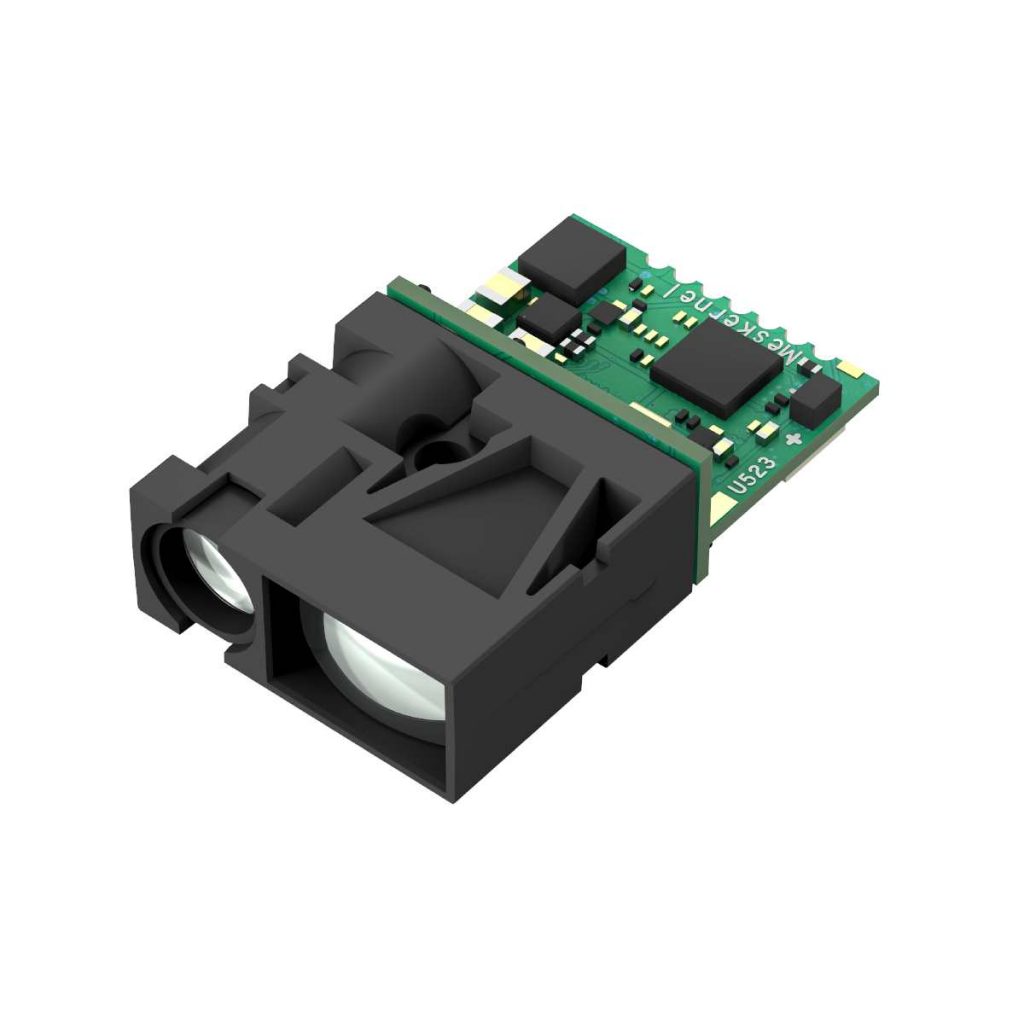
Lightweight, Accurate, and Compact – LDL-T 1mm laser mesafe sensörü provides 80m range, 3g weight, and Perfect for space-saving applications.
Phase-based lazer mesafesi sensors are particularly suitable for grain silo applications due to:
- Stable performance over medium ranges (15–100 m)
- High repeatability and low measurement drift
- Compact size and low power consumption
- Non-contact operation, unaffected by grain movement
Compared to ultrasonic sensors, laser-based solutions offer better resistance to dust interference and provide more consistent results in tall storage structures.
Recommended Sensor Modules for Grain Storage Measurement
Based on typical grain silo requirements and the parameters outlined above, the following sensor types are well-suited for this application:
Compact phase-based laser distance modules with millimeter-level accuracy are ideal for top-mounted grain level measurement in silos up to 15 m high.
Key characteristics:
- Measurement range: 0.03–60 m / 80 m / 100 m
- Accuracy: ±(1–3 mm + D × 1/10000)
- Interfaces: UART / RS485 / RS232
- Low power consumption and lightweight design
These modules integrate easily into embedded monitoring systems and are suitable for OEM designs requiring compact size and stable performance.
Industrial Housing Distance Sensors (Dusty Environments)
For harsher grain storage environments with higher dust concentration or outdoor installation, distance sensors with industrial protective housings offer improved reliability.
Typical features:
- Metal housing with IP54–IP67 protection
- Operating temperature range suitable for agricultural facilities
- Long-term stability in dusty or humid conditions
- RS485 interface for industrial controllers
Such sensors are recommended for permanent silo installations where durability and environmental resistance are critical.
From Distance Measurement to Volume Estimation
Grain volume estimation is typically performed using the following steps:
- Measure the distance from the sensor to the grain surface
- Calculate the grain height inside the silo
- Apply the cylindrical volume formula:
- Apply correction factors if required (grain angle of repose, filling pattern)
For higher accuracy, some systems use multiple measurements over time to average surface variations.
Embedded System Integration Example
A typical grain storage monitoring system architecture includes:
- Laser distance sensor → UART or RS485
- MCU or PLC → distance processing and volume calculation
- Output → HMI, SCADA, or cloud-based monitoring platform
The simplicity of serial communication allows easy integration with existing agricultural automation systems.
Tipik Kullanım Örnekleri
Distance sensor–based grain measurement solutions are widely used in:
- Grain silos and storage towers
- Feed and seed storage facilities
- Agricultural warehouses
- Bulk material containers (pellets, fertilizers, powders)
Sonuç
Accurate grain storage volume measurement requires a sensor solution that combines sufficient range, stable performance, wide field of view, and easy system integration. Phase-based lazer mesafe sensörleri provide an effective, non-contact method for monitoring grain levels in tall silos up to 15 meters and beyond.
By selecting a sensor with the right measurement range, communication interface, and environmental protection level, grain storage operators and system integrators can achieve reliable, automated volume monitoring with minimal maintenance.
For customized grain storage measurement solutions, sensor selection support, or OEM integration options, engineering consultation can help ensure optimal performance for your specific application.
To learn more about our OEM and ODM customization capabilities, please visit our Hakkımızda page.
You can also explore real-world demonstrations, product overviews, and performance tests on our YouTube channel, where we share application and testing videos of our distance sensor modules.
Sıkça Sorulan Sorular (SSS)
What is the best sensor for grain silo level measurement?
Laser-based distance sensors using phase measurement technology are well suited due to their accuracy, stability, and resistance to dust.
Can laser distance sensors work in dusty grain storage environments?
Yes. Properly selected laser distance sensors perform reliably in dusty conditions, especially when using industrial housings and stable signal processing.
How accurate is laser-based grain volume measurement?
While surface irregularities affect precision, consistent distance measurements enable accurate and repeatable volume estimation when combined with proper algorithms.
Which interface is recommended for grain storage monitoring systems?
UART is common for embedded MCU designs, while RS485 is preferred for industrial installations and longer cable distances.
Can one sensor cover a 15 m grain silo?
Yes. A single laser distance sensor with a suitable measurement range can effectively monitor grain levels in silos of this size.