This Laser Mesafe Sensörü Selection guide helps engineers and system integrators choose the right lazer mesafesi sensor based on measurement principle, range, accuracy, and application requirements.
Doğru seçimi yapmak lazer mesafe sensörü is not just about maximum range or accuracy. Measurement principle, size, laser wavelength, frequency, environmental protection, and integration method all play a critical role in whether a sensor performs reliably in your real-world application.
1. First Step: Identify the Measurement Principle
Meskernel’s laser distance sensors are mainly divided into Phase (iToF) and Pulse (dToF) technologies. Understanding this difference is the foundation of correct selection.
Phase Laser Distance Sensors (iToF)
En iyisi: short to medium range, high precision, high frequency, compact integration
Key characteristics:
- Measurement range: 0.03 m – 200 m
- Accuracy: up to ±1 mm
- High measurement frequency (up to 10 kHz for special models)
- Compact size and low power consumption
- Ideal for continuous measurement
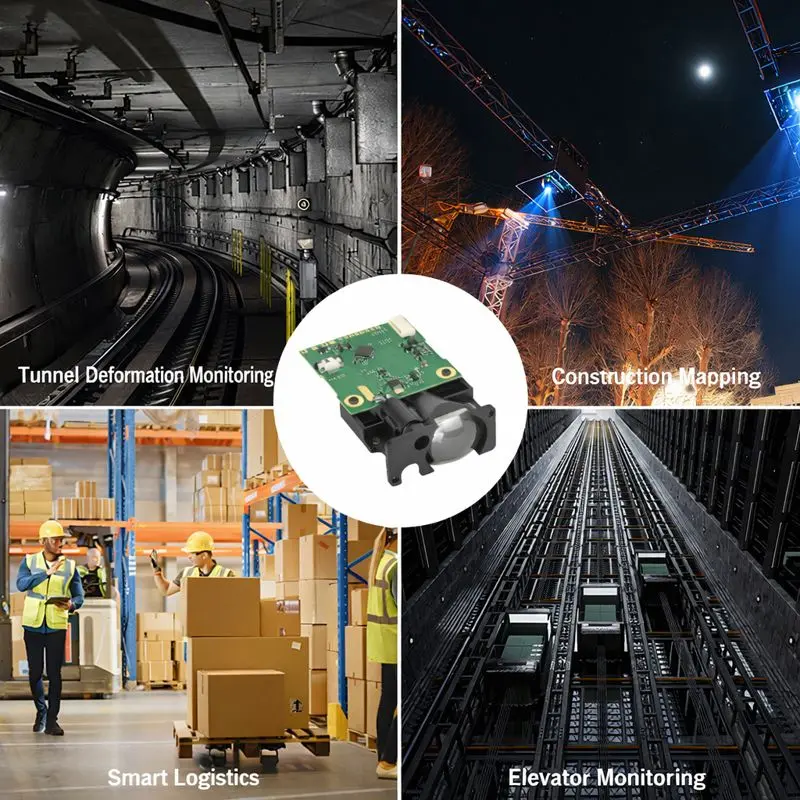
Typical applications:
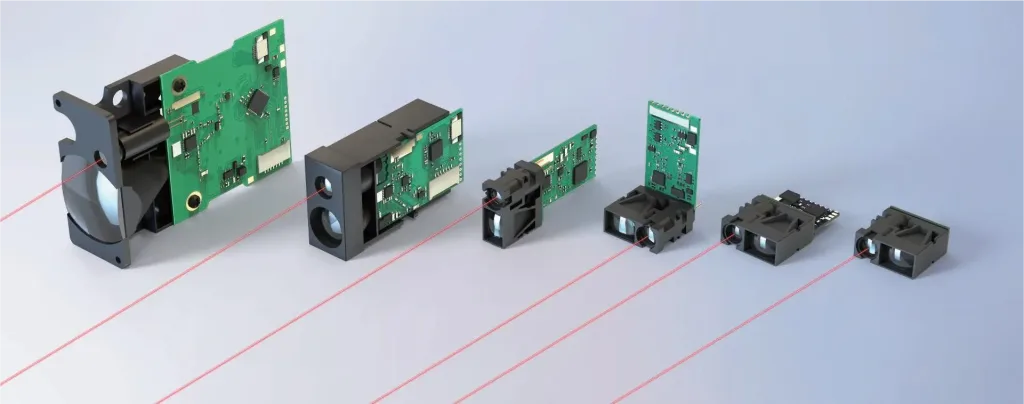
Pulse Laser Rangefinder Sensors (dToF)
En iyisi: long range, outdoor, target acquisition
Key characteristics:
- Measurement range: 400 m – 5000 m
- Accuracy: typically ±1 m
- Strong outdoor adaptability
- Better performance under strong sunlight
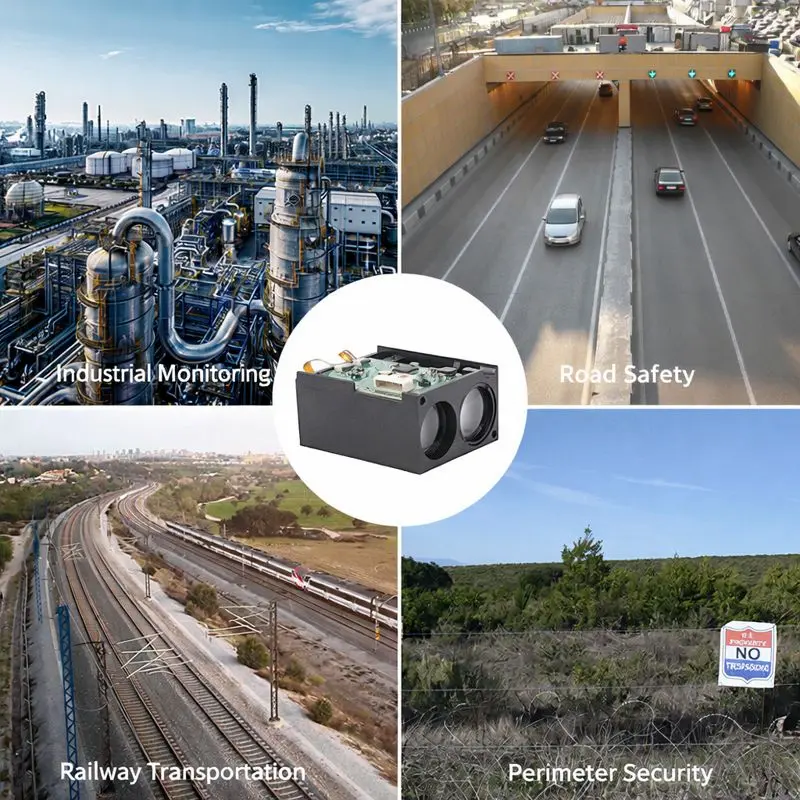
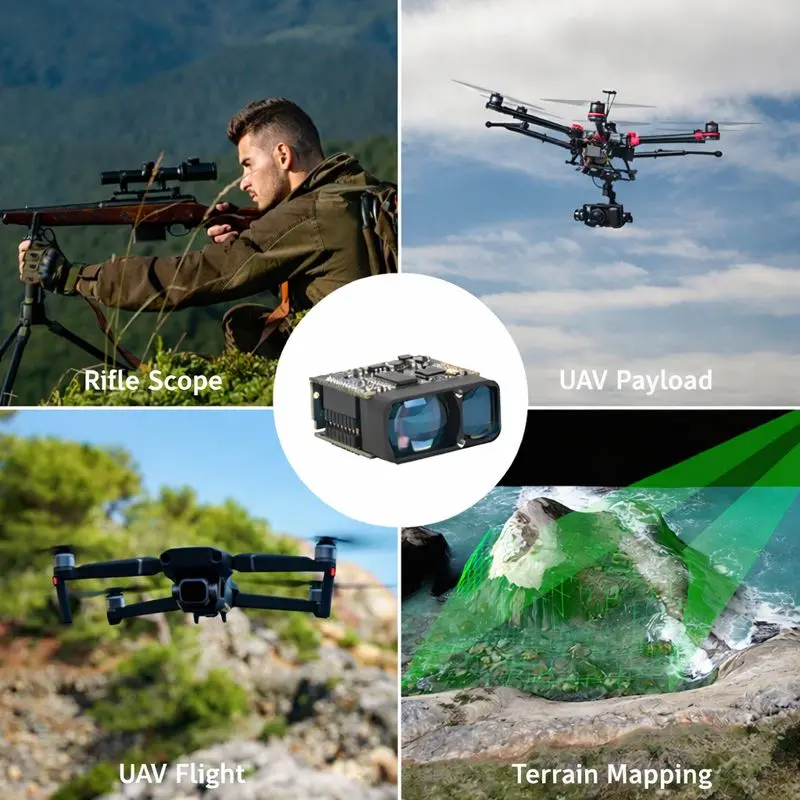
Typical applications:
- İHA / drone altitude & ranging
- Ölçme & mapping
- Security & defense
- Long-range monitoring
2. Phase Laser Distance Sensor Series: How to Choose
2.1 Ultra-Compact Phase Modules (Short–Medium Range)
Typical specs:
- Range: 0.03–60 / 80 / 100 m
- Accuracy: ±(1 mm + D×1/10000)
- Size: as small as 16.57 × 17.03 × 7.01 mm
Best suited for:
- Embedded systems with strict size constraints
- Robotics, UAV payloads
- OEM sensor integration
Why choose this series: If your system requires millimeter-level accuracy in a very limited space, these modules offer the best balance of size, precision, and cost.
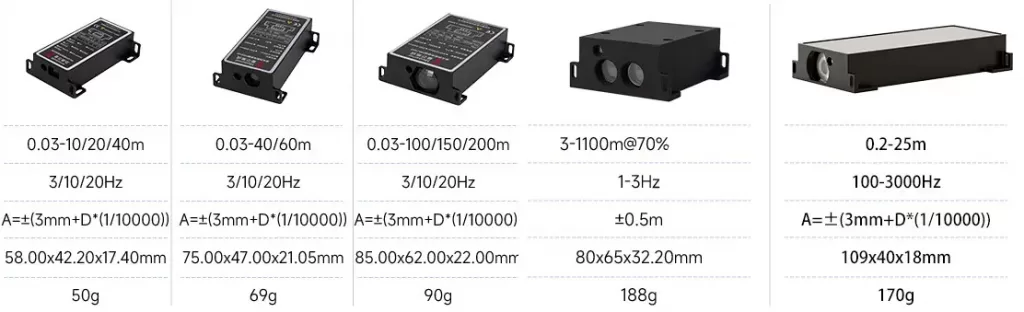
2.2 Medium & Long Range Phase Modules
Typical specs:
- Range: up to 150–200 m
- Accuracy: ±(3 mm + D×1/10000)
- Higher power and larger optics
Best suited for:
- Industrial measurement systems
- Construction and structural monitoring
- Outdoor fixed installations
Selection tip: Choose these models when range is more important than compact size, but you still need high repeatability.
2.3 Red vs Green Laser Phase Sensors
| Lazer Tipi | Avantajlar | Recommended Scenarios |
|---|
| Red (610–690 nm) | Lower power consumption, cost-effective | Indoor, controlled lighting |
| Green (510–550 nm) | Better visibility, less ambient light interference | Outdoor, liquid level, reflective surfaces |
Special note: Green laser phase sensors perform better on liquids and complex surfaces, making them ideal for water level and outdoor industrial applications.
2.4 High-Frequency Phase Modules (LDJU Series)
Key highlight: measurement frequency up to 10,000 Hz
Best suited for:
- High-speed motion tracking
- Dynamic object tespit
- Real-time feedback control systems
If your application values speed over range, this series is unmatched.
When to choose housing versions:
- Dusty or humid environments
- Outdoor installations
- Harsh industrial sites
Metal housing improves mechanical stability, EMC resistance, and service life.
3. Pulse Laser Rangefinder Series: How to Choose
3.1 Mini Long-Range Modules (TS1224 Series)
Typical specs:
- Range: up to 2000 m
- Size: coin-sized metal housing
- Accuracy: ±1 m
Best suited for:
- UAVs & dronlar
- Portable surveying devices
- Space-constrained long-range systems
3.2 Square & Cylindrical Rangefinder Modules
Square (PTFS):
- Easier system integration
- Higher frequency options (up to 500 Hz)
Cylindrical (TC25):
- Optimized for drone and optik systems
- Lightweight design
3.3 Telescope Rangefinder Sensors
Key advantage:
- Integrated optical viewfinder
- Direct distance display
Best suited for:
- Manual measurement
- Surveying & inspection
- Field operations
4. Quick Sensor Selection Checklist
Before choosing a model, confirm these questions:
- Required ölçüm aralığı?
- Accuracy requirement: millimeter or meter level?
- Indoor or outdoor use?
- Target surface: solid, liquid, reflective?
- Installation space constraints?
- Required measurement frequency?
- Communication interface (UART / RS485 / RS232)?
5. Final Recommendation
If your application needs:
- High precision & continuous measurement → Phase laser distance sensor
- Ultra-long range & outdoor robustness → Pulse lazer telemetre
- Liquid level or outdoor measurement → Green laser phase sensor
- High-speed dynamic tracking → High-frequency phase module
For exact model comparison, mechanical drawings, and full specifications, we recommend downloading the complete Meskernel 2025 Product Catalog.
👉 Download the full catalog to compare all models in detail and find the best fit for your project.
FAQ: Laser Distance Sensor Selection
What is the difference between phase and pulse laser distance sensors?
Phase (iToF) lazer mesafe sensörleri calculate distance by measuring phase differences in a modulated laser signal. They offer higher accuracy (millimeter-level) and faster update rates, making them ideal for industrial automation and continuous measurement. Pulse (dToF) sensors measure the uçuş süresi of laser pulses and are better suited for long-range and outdoor applications, typically with meter-level accuracy.
How do I approach laser distance sensor selection for industrial applications?
Start by defining your required measurement range, accuracy, and environment. Indoor, short-to-medium range applications usually benefit from phase lazer sensörleri, while outdoor or long-distance projects require pulse laser rangefinders. Also consider target surface, installation space, and communication interface requirements.
When should I use a green laser instead of a red laser?
Green laser distance sensors (510–550 nm) are more visible to the human eye and less affected by ambient light. They perform better on reflective surfaces and liquids, making them ideal for outdoor measurement and liquid level monitoring. Red lasers are more energy-efficient and cost-effective for indoor use.
Are laser distance sensors suitable for liquid level measurement?
Yes. Phase-based laser distance sensors, especially green laser models, can penetrate liquid surfaces more reliably and provide stable measurements for non-contact liquid level monitoring in industrial environments.
What communication interfaces do Meskernel laser distance sensors support?
Most Meskernel laser distance sensors support UART, RS232, and RS485 interfaces. Some models also support Modbus and high-baud-rate communication, making them easy to integrate into industrial control systems, PLCs, and embedded platforms.
How can I compare different laser distance sensor models in detail?
The fastest way is to download the Meskernel Product Catalog, which includes full specifications, mechanical dimensions, accuracy data, and available customization options for each model.
If your application needs:
High precision & continuous measurement → Phase laser distance sensor
Ultra-long range & outdoor robustness → Pulse laser rangefinder
Liquid level or outdoor measurement → Green laser phase sensor
High-speed dynamic tracking → High-frequency phase module
For exact model comparison, mechanical drawings, and full specifications, we recommend downloading the complete Meskernel 2025 Product Catalog.
👉 İndir the full catalog to compare all models in detail and find the best fit for your project.
You may also want to explore specific application guides such as UAV ranging, liquid level measurement, or high-speed distance sensing.
https://meskernel.net/laser-distance-measurer-sensor/
https://meskernel.net/oem-laser-distance-sensor/