Laser Distance Sensor vs LiDAR for AMR: Which One Really Works Better?
Autonomous Mobile Robots (AMRs) rely heavily on perception sensors to navigate safely and efficiently.
One of the most common questions AMR engineers and system integrators ask during the design phase is:
Should we use a laser czujnik odległości lub LiDAR for AMR Omijanie przeszkód?
This article provides a practical, engineering-driven comparison of a odległość lasera sensor vs LiDAR for AMR, focusing on real deployment constraints such as cost, power consumption, response time, integration complexity, and safety coverage.
Rather than positioning these sensors as competitors, we’ll explain where each technology excels—and why many industrial AMRs use both.
Why Obstacle Avoidance Sensors Matter in AMR
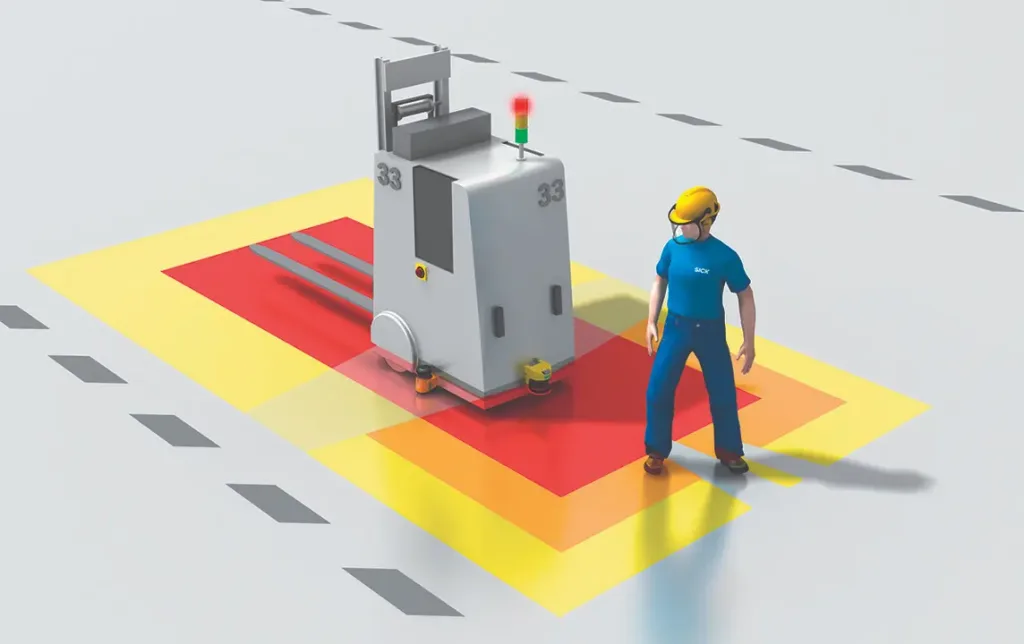
Obstacle avoidance is not a single function—it is a layered safety and nawigacja strategy.
In a typical AMR system, sensors must handle:
- Near-field collision prevention
- Wykrywanie of humans, pallets, racks, and forks
- Redundant safety coverage in blind zones
- Reliable operation under dust, ambient light, or vibration
This is why the debate around laserowy czujnik odległości vs LiDAR for AMR is often misleading.
The correct question is not which is better, but which sensor is best for each role.
For a broader introduction to sensor roles in mobile robots, see our pillar guide on laser distance sensor for AMR navigation
How Laser Distance Sensors Work in AMR Systems
A laser distance sensor (also called a laser range sensor or dalmierz laserowy module) measures the distance to an object along a single optyczny axis using time-of-flight (ToF) lub phase-shift principles.
Key characteristics in AMR applications
- Single-point or narrow-angle measurement
- Fast response time (often milliseconds)
- Compact size and low power consumption
- Easy integration with MCU, PLC, or embedded controllers
- Typically outputs UART, RS485, CAN lub analogowy signals
In AMRs, laserowe czujniki odległości are commonly used for:
Because of their simplicity, laser distance sensors are often selected as cost-effective, highly reliable safety sensors in industrial robots.
How LiDAR Works for AMR Obstacle Detection
LiDAR (Light Detection and Ranging) systems emit laser pulses across a wide field of view and build a 2D or 3D point cloud of the surrounding environment.
Key characteristics of LiDAR in AMRs
- Wide scanning angle (typically 180°–360°)
- Rich environmental data
- Enables SLAM (Simultaneous Localization and Mapping)
- Higher computational and power requirements
- Higher system cost
LiDAR is usually the primary perception sensor for:
- Global navigation
- Mapping and localization
- Path planning in dynamic environments
In ROS-based robots, LiDAR data feeds directly into navigation and SLAM stacks provided by ROS, making it indispensable for autonomous navigation.
Laser Distance Sensor vs LiDAR for AMR: Key Differences
| Aspekt | Laserowy czujnik odległości | LiDAR |
|---|
| Pomiar | Single point / narrow beam | Multi-point scanning |
| Field of View | Wąski | Wide (180°–360°) |
| Wyjście danych | Distance only | Point cloud |
| Zużycie energii | Bardzo niski | Wysoki |
| Koszt | Niski | Wysoki |
| Integracja | Simple | Kompleks |
| Best Use | Local obstacle avoidance | Global navigation |
From an engineering perspective, LiDAR answers “Where am I?”, while a laser distance sensor answers “Is something too close right now?”
When a Laser Distance Sensor Is the Better Choice for AMR
There are many AMR scenarios where a laser distance sensor is not only sufficient—but preferable.
1. Near-Field Collision Prevention
Laser distance sensors react quickly and are ideal for detecting objects within a defined safety distance.
2. Blind-Zone Coverage
LiDARs mounted on top of AMRs often miss:
- Low obstacles
- Fork tips
- Side or rear approach angles
Czujniki laserowe can be mounted precisely to cover these zones.
3. Cost-Sensitive AMR Designs
For high-volume AMRs, replacing multiple LiDARs with several laser distance sensors can dramatically reduce BOM cost.
4. Low-Power AMRs
Battery-powered robots benefit from the ultra-low power consumption of laser distance sensors.
For selection tips, refer to our detailed laser distance sensor for AMR selection guide.

When LiDAR Is Essential in AMR Navigation
Despite their advantages, laser distance sensors cannot replace LiDAR in all cases.
LiDAR is essential when:
- The AMR must build or update maps
- Long-range environment perception is required
- Complex path planning is needed
- Human-robot interaction occurs in large open spaces
In these scenarios, LiDAR serves as the primary navigation sensor, while other sensors play supporting roles.
Best Practice: Hybrid AMR Sensor Architecture (LiDAR + Laser Distance Sensors)
Most industrial AMRs today use a hybrid sensor architecture.
Typical configuration
- LiDAR: Global navigation, SLAM, and path planning
- Laserowe czujniki odległości:
- Front short-range obstacle detection
- Side and rear collision prevention
- Redundant safety sensing
This layered approach improves:
- Bezpieczeństwo
- Reliability
- Fault tolerance
- Overall system robustness
From a functional safety standpoint, this architecture aligns with guidance often discussed in industrial robotics literature published by organizations such as IEEE.
FAQ: Laser Distance Sensor vs LiDAR for AMR Obstacle Avoidance
Can a laser distance sensor replace LiDAR in AMR?
No. A laser distance sensor cannot provide global perception or mapping. However, it is highly effective as a local obstacle avoidance and safety sensor.
How many laser distance sensors are needed for an AMR?
It depends on robot geometry and safety requirements. Many AMRs use 2–6 laser distance sensors to cover blind zones.
Are laser distance sensors compatible with ROS?
Yes. Laser distance sensors can be integrated into ROS systems via mikrokontrolery or sensor nodes, often complementing LiDAR-based navigation.
Which is better for AMR obstacle avoidance: laser distance sensor or LiDAR?
Neither sensor is universally better. In Laser Distance Sensor vs LiDAR for AMR, LiDAR is better for early obstacle detection at long distances, while laser distance sensors are better for high-speed, low-latency detection at close range. Effective AMR designs typically combine both for layered safety and reliability.
What is the difference between a Laser Distance Sensor vs LiDAR for AMR obstacle avoidance?
A Laser Distance Sensor vs LiDAR for AMR comparison shows a clear role split.
LiDAR provides wide-area scanning for navigation and SLAM, while laser distance sensors deliver fast, precise single-point distance measurements for close-range obstacle detection. Most AMRs use LiDAR for environment mapping and laser distance sensors for docking, safety stops, and short-range avoidance.
Why do AMRs often use both laser distance sensors and LiDAR?
AMRs use both because Laser Distance Sensor vs LiDAR for AMR is a complementary decision. LiDAR handles global perception, while laser distance sensors provide precise, fast distance measurements at short range. This sensor fusion improves obstacle avoidance accuracy, redundancy, and safety in dynamic industrial environments.
Which sensor reacts faster in AMR obstacle avoidance?
A laser distance sensor typically reacts faster. In Laser Distance Sensor vs LiDAR for AMR, laser distance sensors offer higher sampling rates and lower processing latency, making them ideal for last-moment collision prevention, safety stop zones, and precise docking applications.
Which sensor consumes less power in AMR applications?
A laser distance sensor consumes significantly less power. In Laser Distance Sensor vs LiDAR for AMR, laser distance sensors usually operate at hundreds of milliwatts, while LiDAR systems often require several watts. This makes laser distance sensors better suited for battery-powered AMRs and always-on safety functions.
Final Thoughts: Laser Distance Sensor vs LiDAR for AMR
The debate over laser distance sensor vs LiDAR for AMR should not be framed as a competition.
In real industrial deployments, the best AMRs use both.
- LiDAR provides awareness
- Laserowe czujniki odległości provide protection
Understanding this distinction allows AMR designers to build safer, more efficient, and more cost-effective robots.