Wprowadzenie
In the world of industrial automation and pomiar odległości, the choice between laser vs ultrasonic sensor comparison often represents a critical decision point for engineers and system designers. Both technologies offer unique advantages and limitations that make them suitable for different applications. Understanding these differences is essential for selecting the optimal sensing solution that balances performance, cost, and reliability. Chengdu Meskernel Integrated Technology Co., Ltd., with expertise in both pomiar laserowy technologies, provides this comprehensive comparison to help you make informed decisions for your specific application requirements.
Fundamental Technology Principles
Jak działają laserowe czujniki odległości
Czujniki laserowe, such as Meskernel’s LDJ series, operate on the principle of Czas lotu (ToF) measurement. They emit a laser beam toward a target and measure the time it takes for the reflection to return. Two primary methods are used:
- Phase Measurement (iToF): Used in Meskernel’s LDL, LDJ, and LDK series
- Modulates laser intensity at a specific frequency
- Measures przesunięcie fazowe between emitted and reflected signals
- Provides millimeter-level accuracy
- Typical range: 0.03-200m
- Pulse Measurement (dToF): Used in Meskernel’s TS1224 and PTFS series
- Emits short laser pulses
- Measures direct time delay
- Provides longer ranges (up to 3km)
- Accuracy: ±1m
How Ultrasonic Distance Sensors Work
Ultrasonic sensors operate by emitting high-frequency sound waves (typically 40-200 kHz) and measuring the time for the echo to return. Key characteristics include:
- Sound waves travel through air at approximately 343 m/s (at 20°C)
- Measurement based on echo time calculation
- Typically used for ranges from a few centimeters to 10+ meters
- Accuracy affected by temperature, humidity, and air turbulence
Technical Comparison: Key Parameters
| Parametr | Czujniki laserowe | Czujniki ultradźwiękowe | Advantage |
|---|
| Dokładność | ±1mm to ±3mm (phase) / ±1m (pulse) | ±0.1% to ±1% of range | Laser (for precision) |
| Zakres pomiaru | 0.03m-3,000m | 2cm-15m (typical) | Laser (for long range) |
| Czas reakcji | 0.01-10ms (up to 10KHz) | 10-100ms (10-100Hz) | Laser (for speed) |
| Minimum Distance | As low as 3mm | Typically 20-50mm | Comparable |
| Beam Characteristics | Narrow, focused beam | Wide, conical beam | Laser (for precision targeting) |
| Czynniki środowiskowe | Minimal effect from air conditions | Affected by temperature, humidity, wind | Laser (for stability) |
| Target Surface | Works on most surfaces, some reflection needed | Works on most materials, absorbs sound | Comparable |
| Koszt | Higher initial cost | Lower initial cost | Ultrasonic (for budget) |
| Zużycie energii | Low to moderate (LDJ: <250mA) | Niski do umiarkowanego | Comparable |
Model selection guide: real product comparison videos
Accuracy and Precision Analysis
Laser Sensor Accuracy
Meskernel's czujniki laserowe fazy achieve exceptional accuracy through advanced measurement techniques:
LDJ Series Specifications:
- Dokładność: ±(3mm + D×1/10000)
- Rozdzielczość: 0.1mm
- Repeatability: ±1mm
Factors affecting laser accuracy:
- Współczynnik odbicia celu: Higher reflectivity improves signal quality
- Surface angle: Perpendicular surfaces provide best results
- Environmental light: Minimal effect with proper filtering
- Temperature stability: Built-in compensation in Meskernel sensors
Ultrasonic Sensor Accuracy
Typical ultrasonic sensor accuracy characteristics:
- Dokładność: 0.1-1% of measured distance
- Rozdzielczość: 1mm to 1cm depending on range
- Repeatability: 0.5-2% of range
Factors affecting ultrasonic accuracy:
- Temperature variations: Sound speed changes with temperature (0.6% per °C)
- Humidity changes: Affects sound propagation
- Air turbulence: Wind and drafts cause measurement errors
- Target absorption: Soft materials absorb sound waves
Environmental Considerations
Operating Temperature Range
- Czujniki laserowe: 0-40°C standard (Meskernel LDJ series), extended ranges available
- Czujniki ultradźwiękowe: -25°C to 70°C typically, wider operational range
Environmental Protection
- IP Ratings: Both technologies offer IP54 to IP67 options
- Meskernel Protective Solutions:
- LDJ-P4: IP54 protective housing for phase sensors
- PTFS-P4: IP54 housing for pulse laser sensors
- Custom enclosures available for specific environmental requirements
Special Environmental Challenges
Dust and Particulate Matter
- Laser: Can penetrate light dust, but heavy accumulation affects performance
- Ultradźwiękowy: Less affected by dust, but condensation on transducer reduces effectiveness
Moisture and Humidity
- Laser: Minimal effect, but water films on lenses can scatter beams
- Ultradźwiękowy: Humidity affects sound speed, requiring compensation
Extreme Temperatures
- Laser: Electronic components may require temperature control
- Ultradźwiękowy: Wider natural temperature tolerance
Application-Specific Recommendations
When to Choose Laser Sensors
Precision Manufacturing and Robotics
- Zastosowanie: Robotic arm positioning, CNC machine tool monitoring
- Recommended Product: Meskernel LDJ series
- Dlaczego: Millimeter accuracy, fast response (up to 30Hz), compact size
Long-Range Outdoor Measurement
- Zastosowanie: UAV nawigacja, konstrukcja site monitoring, border security
- Recommended Product: Meskernel TS1224 or PTFG series
- Dlaczego: Range up to 3km, environmental resilience, Class I laser safety
High-Speed Applications
- Zastosowanie: Conveyor belt monitoring, high-speed sorting
- Recommended Product: Meskernel LDJU high-frequency module
- Dlaczego: Measurement frequency up to 10KHz, real-time feedback
When to Choose Ultrasonic Sensors
Pomiar poziomu cieczy
Bulk Material Wykrywanie
- Zastosowanie: Grain silos, powder level monitoring
- Dlaczego: Penetrates dust clouds, reliable in particulate environments
Cost-Sensitive Applications
- Zastosowanie: Simple presence detection, basic Omijanie przeszkód
- Dlaczego: Lower initial cost, adequate performance for basic requirements
Wide Area Coverage
- Zastosowanie: Parking lot monitoring, area intrusion detection
- Dlaczego: Wide beam angle covers larger areas with fewer sensors
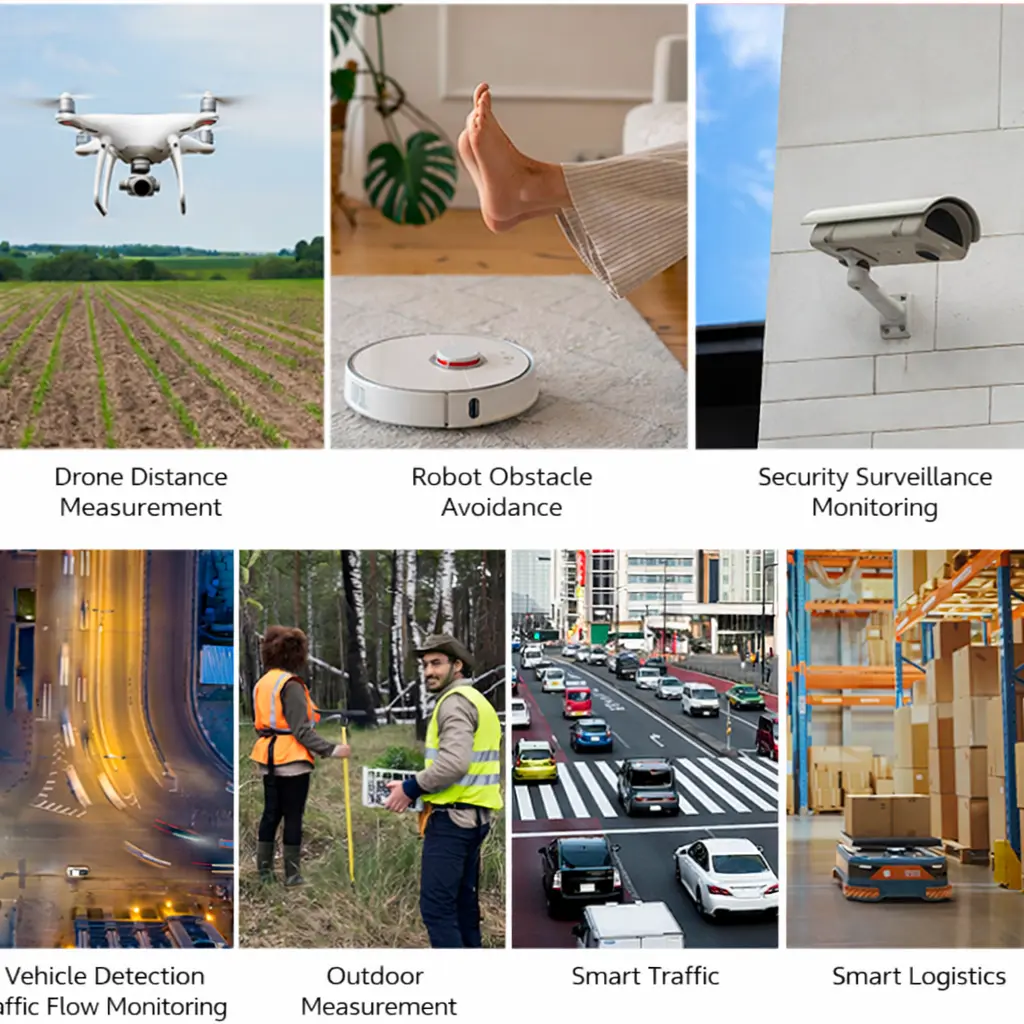
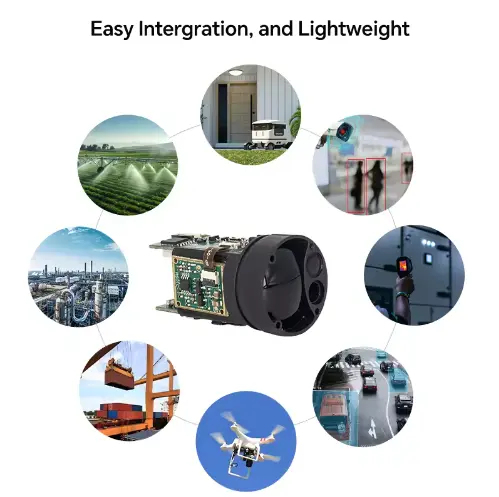
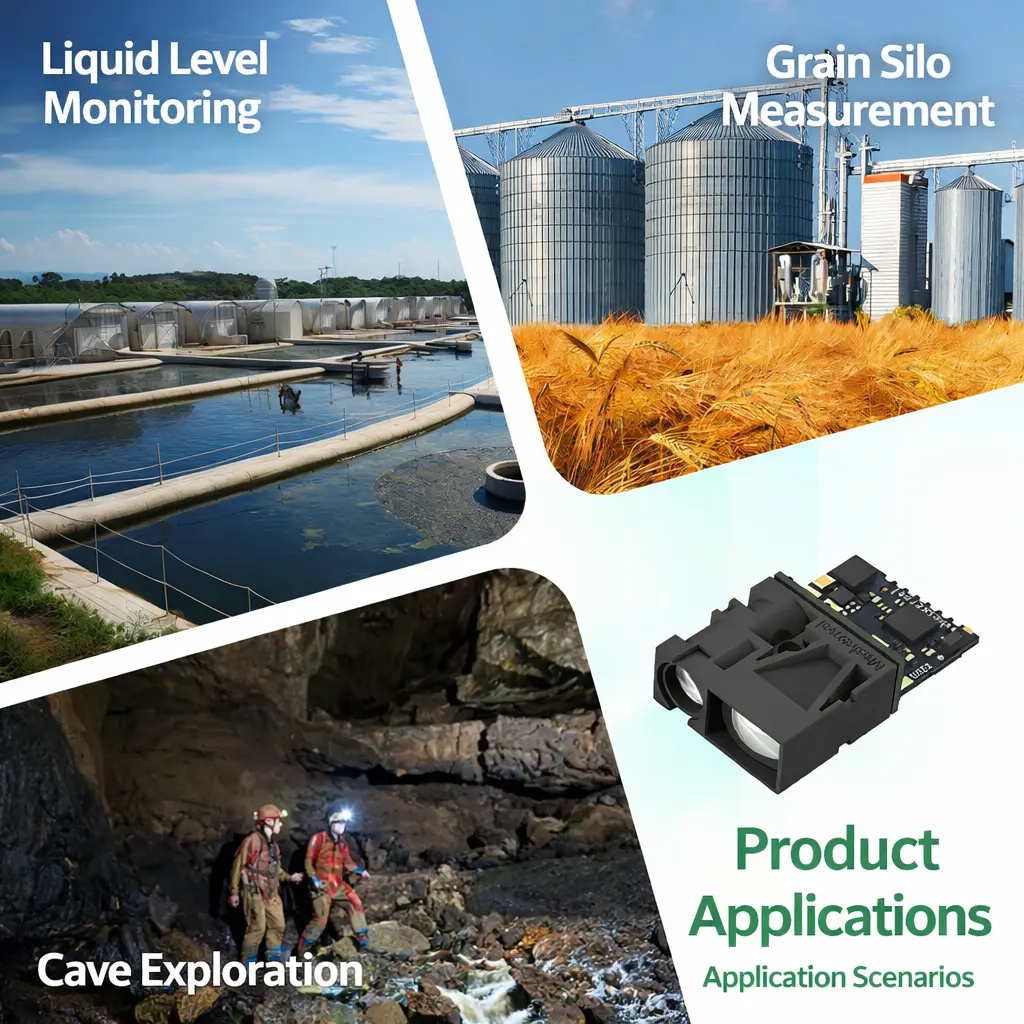
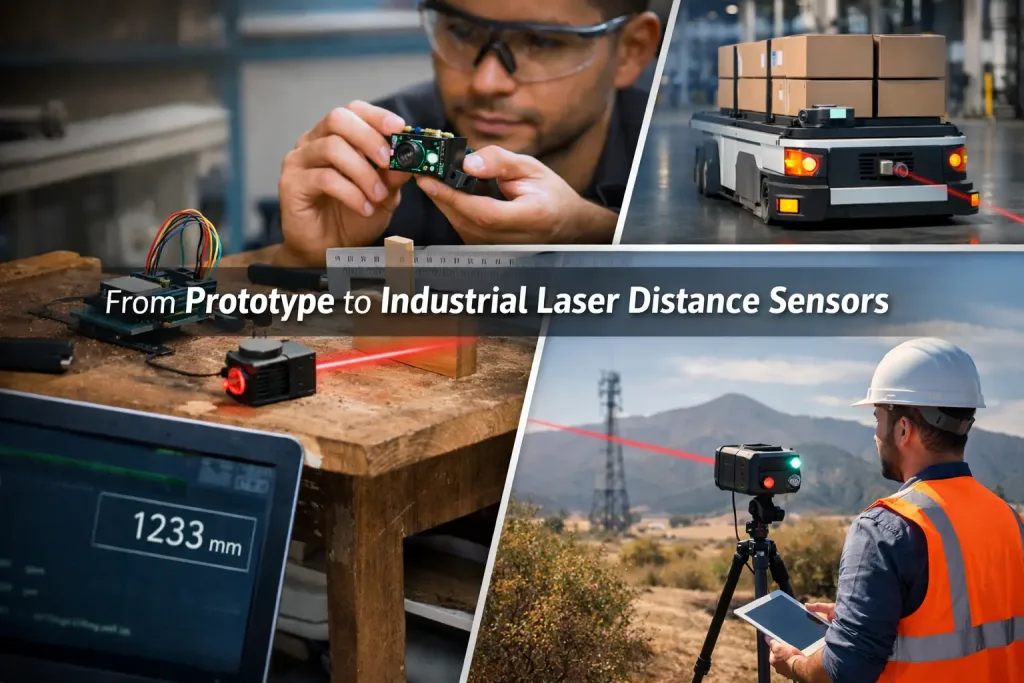
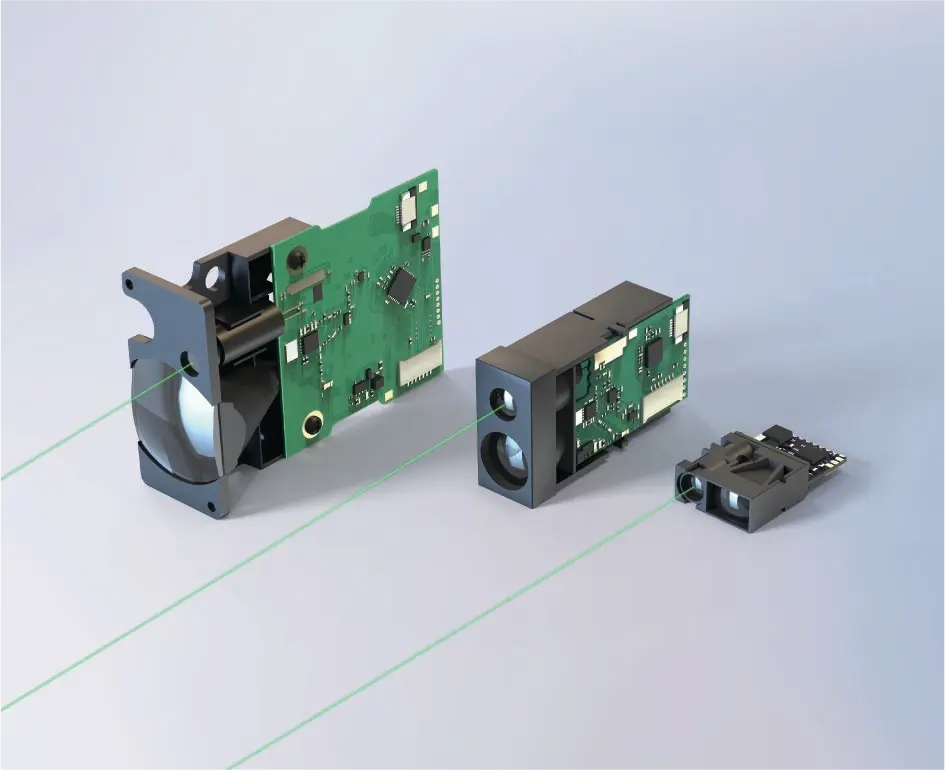

Meskernel Product Solutions
Laser Sensor Portfolio
Phase Measurement Sensors (High Precision)
- Seria LDL: Ultra-compact (27.87×17.03×7.01mm), 3g weight, up to 100m range
- LDJ Series: Standard compact (62.91×40.00×18.00mm), 14g weight, up to 200m range
- LDK Series: Mid-size (46.80×26.00×13.00mm), 9g weight, up to 60m range
Pulse Measurement Sensors (Long Range)
- TS1224: Miniature design (25.72×24.60×13.40mm), up to 2km range
- PTFS Series: Square housing (42.79×35.19×21.37mm), up to 1.3km range
- PTFG: Telescope design with 6x magnification, up to 3km range
Specialized Solutions
High-Frequency Applications
- LDJU Module: Up to 10KHz measurement frequency, ideal for dynamic control systems
Harsh Environments
- Protective Housings: IP54 to IP67 rated enclosures for both laser and ultrasonic sensors
- Custom Designs: OEM/ODM capabilities for specific environmental requirements
Cost-Benefit Analysis
Initial Investment
- Czujniki laserowe: Higher initial cost, but superior performance
- Czujniki ultradźwiękowe: Lower initial cost, suitable for budget-constrained projects
Total Cost of Ownership
Consider these factors beyond initial purchase:
Maintenance Requirements
- Laser: Minimal maintenance, occasional lens cleaning
- Ultradźwiękowy: Transducer cleaning, more frequent calibration
Calibration Frequency
- Laser: Stable calibration, less frequent adjustments needed
- Ultradźwiękowy: More frequent calibration due to environmental sensitivity
System Integration Costs
- Both: Similar integration efforts, but laser may require more precise alignment
Long-Term Reliability
- Laser: Typically longer operational lifespan
- Ultradźwiękowy: May require more frequent replacement in harsh environments
Hybrid Solutions: Combining Technologies
For complex applications, consider combining laser and ultrasonic sensors:
Example: Automated Warehouse System
- Czujniki laserowe: Precise pallet positioning (LDJ series)
- Czujniki ultradźwiękowe: Wide-area obstacle detection
- Korzyści: Combines precision of laser with coverage of ultrasonic
Example: Outdoor Security System
- Czujniki laserowe: Long-range perimeter monitoring (PTFG series)
- Czujniki ultradźwiękowe: Close-range intrusion detection
- Korzyści: Multi-layer security with different detection ranges
Future Technology Trends
Laser Sensor Advancements
- Miniaturyzacja: Smaller form factors without compromising performance
- Integrated Intelligence: Onboard processing and AI capabilities
- Multi-Wavelength Systems: Combined visible and infrared sensing
- Quantum Enhancements: Improved precision through quantum techniques
Ultrasonic Sensor Developments
- Advanced Signal Processing: Better noise rejection and accuracy
- Array Technologies: Phased arrays for beam steering
- Material Innovations: Improved transducer materials
- Wireless Integration: Reduced cabling requirements
Decision Framework: How to Choose
Use this 5-step decision framework:
Step 1: Define Primary Requirements
- Accuracy needs (mm vs cm level)
- Zakres pomiarowy
- Response speed
- Warunki środowiskowe
Step 2: Evaluate Application Constraints
- Available space for sensor installation
- Power supply limitations
- Budget considerations
- Integration complexity
Step 3: Consider Environmental Factors
- Temperature variations
- Humidity levels
- Dust and particulate presence
- Potential obstructions
Step 4: Assess Long-Term Considerations
- Maintenance requirements
- Calibration frequency
- Expected operational lifespan
- Scalability needs
Step 5: Test with Samples
- Request samples from Meskernel
- Conduct real-world testing
- Validate performance in actual conditions
- Compare results against requirements
Studia przypadków
Case Study 1: Automotive Assembly Line
Challenge: Precise positioning of robotic welders
Rozwiązanie: Meskernel LDJ series laser sensors
Results:
- Accuracy improved from ±5mm to ±1mm
- Production speed increased by 15%
- Reject rate reduced by 40%
Case Study 2: Agricultural Silo Monitoring
Challenge: Reliable grain level measurement in dusty conditions
Rozwiązanie: Ultrasonic sensors with dust-resistant design
Results:
- Continuous monitoring in high-dust environments
- Reduced sensor maintenance frequency
- Accurate inventory management
Case Study 3: Port Container Handling
Challenge: Container positioning during crane operations
Rozwiązanie: Hybrid system with laser for precision and ultrasonic for backup
Results:
- Millimeter-accurate positioning
- Redundant safety system
- Reduced operational accidents
Często zadawane pytania (FAQ)
Which is more accurate, laser or ultrasonic sensors?
Laser sensors are significantly more accurate. Meskernel’s phase laser sensors achieve ±(3mm + D×1/10000) accuracy, while ultrasonic sensors typically provide 0.1-1% accuracy of the measured distance. For applications requiring millimeter precision, laser sensors are the clear choice.
Are ultrasonic sensors better for dusty environments?
Generally yes. Ultrasonic sensors can often penetrate light dust clouds better than laser sensors, making them suitable for applications like grain silo monitoring or industrial environments with airborne particulates.
How does temperature affect sensor accuracy?
Temperature affects both technologies differently. Ultrasonic sensors are more sensitive because sound speed changes with temperature (approximately 0.6% per °C). Laser sensors are less affected but may require thermal compensation for highest accuracy in varying conditions.
Can laser sensors measure through glass or transparent materials?
Laser sensors typically measure the first surface they encounter. For glass or transparent materials, they will measure the glass surface rather than what’s behind it. Special configurations or different sensor types may be needed for such applications.
What’s the typical lifespan comparison?
Laser sensors generally have longer operational lifespans due to solid-state construction and fewer moving parts. Meskernel laser sensors are designed for industrial durability with typical lifespans exceeding 5-10 years in normal operating conditions.
How do I decide between phase and pulse laser sensors?
Choose phase sensors (like Meskernel’s LDJ series) for high-precision, shorter-range applications (up to 200m). Choose pulse sensors (like TS1224 or PTFS series) for longer-range applications (up to 3km) where ±1m accuracy is acceptable.
The laser vs ultrasonic sensor comparison reveals that each technology serves distinct application needs. Laser sensors excel in precision, speed, and long-range capabilities, making them ideal for demanding industrial automation, robotics, and high-accuracy measurement applications. Ultrasonic sensors offer cost-effective solutions for applications where environmental factors like dust are present or where wider coverage areas are needed.
Chengdu Meskernel Integrated Technology Co., Ltd. provides comprehensive solutions across both technologies, with specialized products like the LDJ series for precision laser measurement and customizable ultrasonic solutions for specific application requirements. By understanding the fundamental differences outlined in this comparison, engineers and system designers can make informed decisions that optimize performance, reliability, and cost-effectiveness for their specific applications.
Ready to select the right distance measurement technology for your application? Contact Meskernel’s technical experts for personalized consultation. Request samples of our LDJ series laser sensors or discuss your ultrasonic sensing requirements. Our team will help you evaluate your specific needs and recommend the optimal solution for your industrial application.