
Laser Distance Measurement Technology
Laser distance measurement technology uses a laser beam to calculate the distance between a sensor and a target by analyzing the behavior of reflected light. Compared with contact or ultrasonic methods, laser-based measurement offers higher accuracy, faster response, and better adaptability to industrial environments.
Modern laser distance sensors are widely used in automation, robotics, outdoor monitoring, and precision positioning, where non-contact and real-time distance measurement is required.
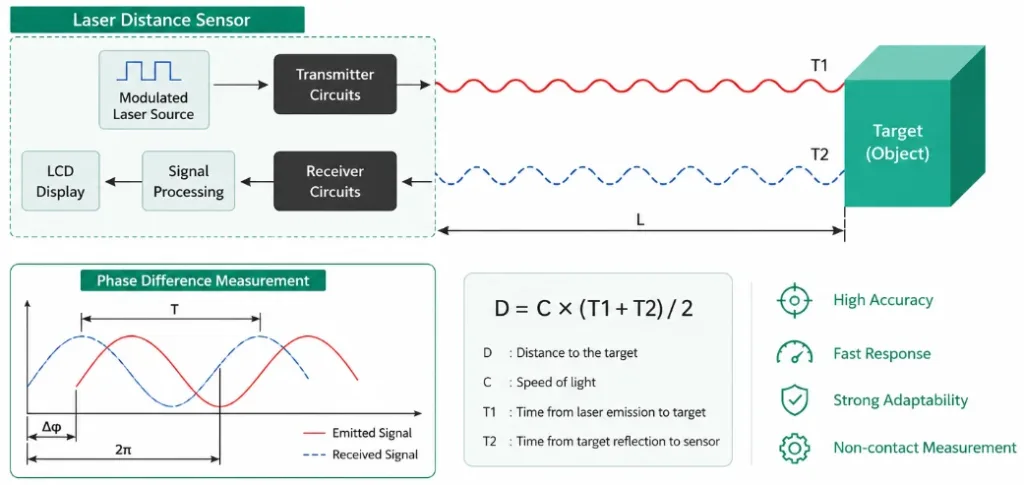
How Laser Distance Measurement Works (Phase vs Pulse)
Laser distance sensors mainly use phase-shift or pulse (Time of Flight) measurement principles.
- Phase-based measurement calculates distance by comparing the phase difference between emitted and reflected continuous laser waves, making it suitable for short to medium distances with high precision.
- Pulse-based measurement calculates distance by measuring the time a laser pulse takes to travel to the target and back, enabling long-range measurement and strong outdoor performance.
Each method is optimized for different distance ranges and application requirements.
When to Use a Phase Laser Distance Sensor and When to Use a Pulse Sensor
Different laser measurement technologies are designed for different distance ranges and use cases.selecting the right technology ensures optimal performance, reliability, and cost efficiency.
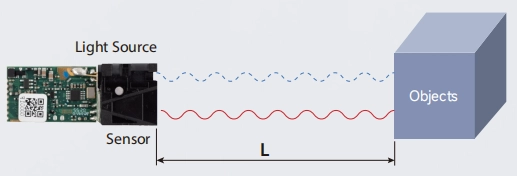
Phase-based laser sensors are ideal for short and medium distances where high precision is required.
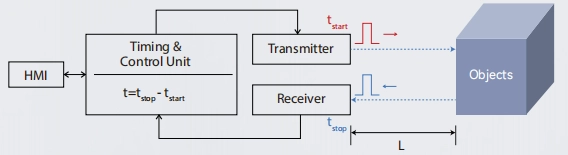
Pulse laser distance sensors are better suited for long-distance measurement, outdoor environments, and applications with strong ambient light.
Typical Industrial Applications
Laser distance sensors are commonly used in a wide range of industrial applications, including:
- Industrial automation and positioning
- Robotics and AGV navigation
- Conveyor and material handling systems
- Outdoor monitoring and surveying
- Safety and perimeter detection
Their non-contact nature and fast response make them suitable for both static and dynamic measurement tasks.

Measurement Accuracy Explained
Measurement accuracy refers to how close the measured distance is to the true value, not just the sensor’s resolution. In laser distance sensors, accuracy is determined by both the measurement principle and real-world application conditions.
Key factors influencing measurement accuracy include the measurement method (phase or pulse), target surface reflectivity, ambient light intensity, measurement distance, and signal-to-noise ratio. Environmental factors such as dust, vibration, and temperature variation can also affect long-term stability.
In practical industrial applications, accuracy should always be evaluated together with repeatability, stability, and environmental adaptability rather than as a single isolated parameter.
Reflectivity and Its Impact on Laser Distance Measurement
Reflectivity describes how much of the emitted laser light is reflected back from the target surface to the sensor receiver. High-reflectivity surfaces generally provide stronger return signals and more stable measurement results, while low-reflectivity or dark surfaces reduce signal strength and may affect accuracy, especially at longer distances.
Surface material, color, texture, and angle all influence reflectivity. For this reason, reflectivity is a critical factor when selecting a laser distance sensor for reliable performance in real industrial environments.
Material Reflectivity Reference Table
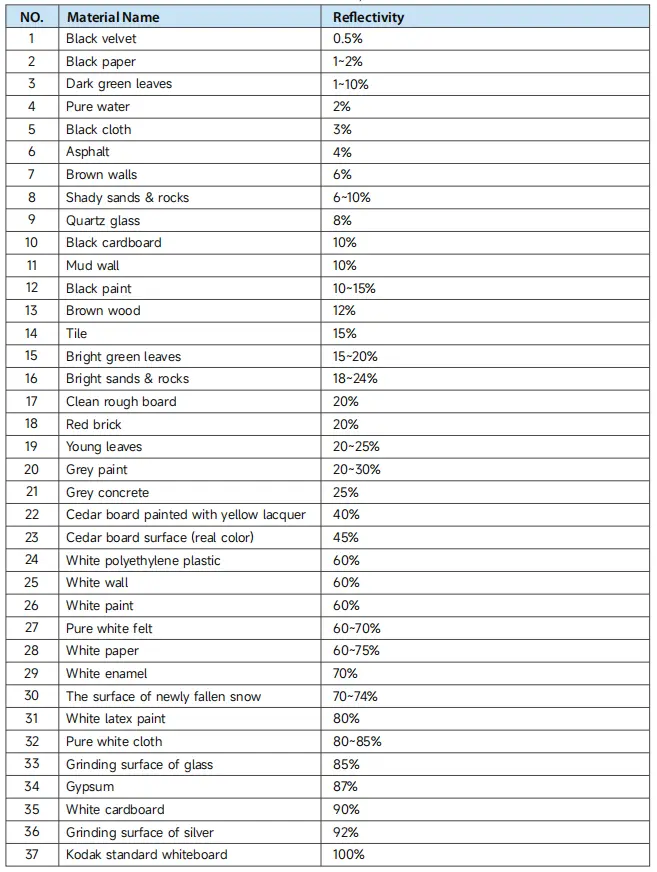
Material reflectivity indicates how efficiently a target surface reflects emitted laser light back to the sensor receiver. It is one of the most critical factors influencing signal strength, measurement stability, and achievable accuracy in laser distance measurement systems.
Surfaces with higher reflectivity typically return stronger optical signals, allowing the sensor to maintain stable detection and consistent accuracy, especially at longer measurement distances. In contrast, low-reflectivity materials—such as dark, matte, or absorbent surfaces—return weaker signals, which can reduce measurement reliability and effective range.
This reference table provides typical reflectivity values for common industrial materials, serving as a practical guideline for evaluating expected measurement performance during system design and sensor selection. The listed values represent general reference conditions and do not account for all real-world variables.
Actual measurement results may vary depending on surface finish, color, texture, target angle, ambient light conditions, and environmental influences such as dust or temperature changes. These factors can alter the amount of reflected laser energy received by the sensor and should be considered when defining application requirements.
Selection tip: When measuring low-reflectivity targets or operating in challenging environments, using a higher-power laser source or a pulse-based laser distance sensor can significantly improve signal robustness and measurement reliability.
Red Laser vs Green Laser: Wavelength and Applications
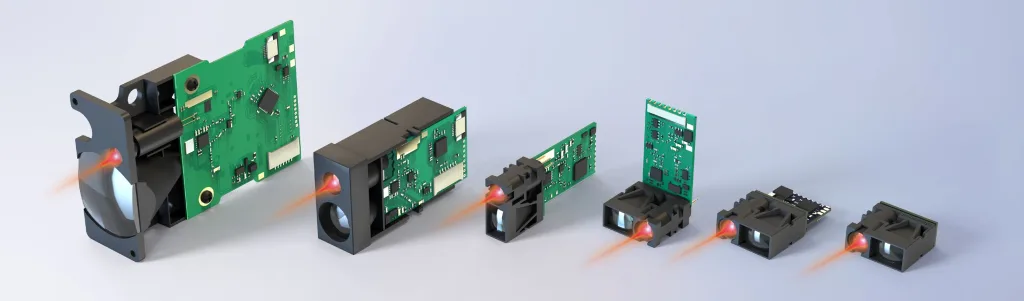
Laser distance sensors commonly use red or green laser wavelengths, each with different characteristics.
Red lasers, typically operating around 610–690 nm, are widely used in indoor and general industrial applications due to their stable performance, mature technology, and cost efficiency. They are suitable for most standard measurement tasks where visibility is not the primary concern.
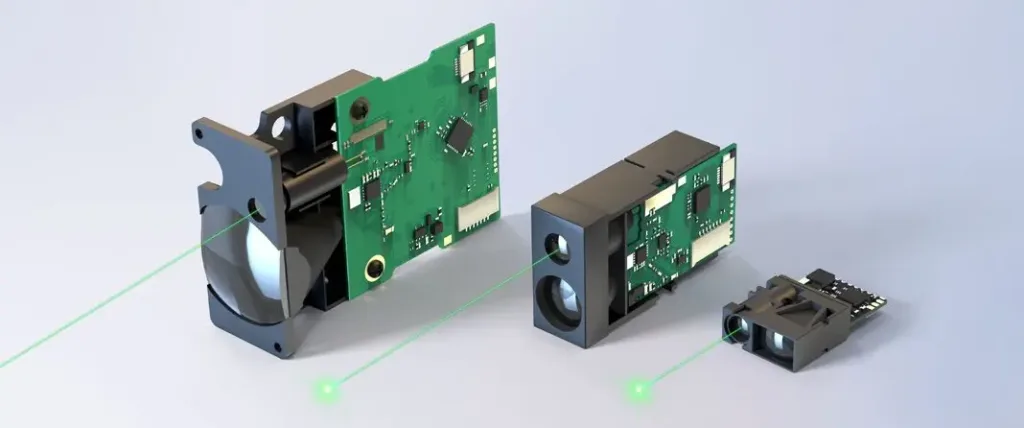
Green lasers, commonly operating around 510–550 nm, offer significantly higher visibility to the human eye. This makes them particularly effective in bright ambient light or outdoor environments, where laser spot visibility is important for alignment, setup, or manual targeting.
Laser Safety Class Overview (Class 1 & Class 2)
Laser distance sensors are classified according to international laser safety standards, primarily to define eye safety under normal and foreseeable use conditions.
Class 1 lasers are considered eye-safe during normal operation, including continuous and prolonged exposure. The emitted laser power remains below the maximum permissible exposure (MPE) limits, making Class 1 sensors suitable for unattended industrial and commercial environments.
Class 2 lasers emit visible laser light and are safe for accidental short-term exposure, as natural human blink and aversion responses typically limit eye exposure to within safe durations. Direct and intentional staring into the beam should be avoided.
Understanding laser safety classes is essential when selecting laser distance sensors, particularly for applications involving human presence, manual alignment, or open industrial environments.
Single-Point vs Multi-Point Distance Measurement
Laser distance measurement can be divided into single-point and multi-point measurement methods.
- Single-point measurement focuses on precise distance data at a specific spot and is widely used in positioning and alignment tasks.
- Multi-point measurement captures multiple distance points to analyze surface profiles, shapes, or object dimensions.
The choice depends on whether the application requires point accuracy or spatial information.
ToF vs Triangulation vs Ultrasonic Measurement
Different distance measurement technologies serve different purposes.
- Time of Flight (ToF) sensors measure distance based on light travel time and are suitable for medium to long distances.
- Triangulation sensors use geometric principles and offer high precision at short distances.
- Ultrasonic sensors use sound waves and are suitable for simple, low-cost, short-range measurements.
Each technology has its own advantages and limitations depending on the application.
How to Choose the Right Laser Distance Sensor
Choosing the right laser distance sensor depends on several key parameters:
- Measurement range
- Accuracy and repeatability
- Measurement frequency or response time
- Communication interfaces
- Environmental conditions such as dust, vibration, and sunlight
- Customization requirements for specific integration needs
A clear definition of application requirements is essential before selecting a sensor.
Compare different Meskernel laser distance sensor models in video demos
Why Industrial Integrators Choose Meskernel
Industrial integrators choose Meskernel for its focus on reliable laser distance measurement solutions designed for real-world applications. Meskernel offers a wide range of laser distance sensors covering different measurement principles, distance ranges, and form factors.
Flexible customization, stable performance, and integration-friendly designs make Meskernel suitable for diverse industrial systems.
Customization Options for Laser Distance Sensor Modules
Basic Parameters
- Measuring range
- Measuring accuracy
- Measuring speed
- Measuring resolution
- Operating temperature range
- Laser class
- Power supply options (battery or DC supply)
Communication Interface and Protocol
- TTL / CMOS
- USB
- RS-232 / RS-485
- CAN
- Communication baud rate
- MODBUS / ASCII / HEX protocols
- Wireless modules (Bluetooth, etc.)
Enclosure Design
- Size for Customer Enclosure
- Structural customization
- IP protection levels (IP54 / IP65 / IP67 / IP68)
- Environmental adaptability
- Temperature & Humidity
Functional and Module Customization
- Display customization
- Keypad layout and position
- Operation logic customization
- Distance-related peripherals (tilt, voice, communication modules)
FAQ
What is a laser distance sensor?
A laser distance sensor is a non-contact measurement device that calculates the distance between the sensor and a target by emitting a laser beam and analyzing the reflected light. It is widely used in industrial automation, positioning, alignment, and outdoor measurement applications where high accuracy and fast response are required.
How does a laser distance sensor measure distance?
Laser distance sensors typically measure distance using phase-shift or time-of-flight (pulse) principles. Phase-based sensors compare the phase difference between emitted and reflected light, while pulse-based sensors calculate distance based on the travel time of a laser pulse.
What affects the accuracy of laser distance measurement?
Measurement accuracy is influenced by multiple factors, including the measurement principle, target reflectivity, surface color and texture, ambient light conditions, measurement distance, and environmental factors such as dust, vibration, and temperature changes.
Is laser distance measurement affected by surface reflectivity?
Yes. Surface reflectivity directly affects the strength of the returned laser signal. High-reflectivity surfaces generally provide more stable measurements, while low-reflectivity or dark surfaces may reduce signal quality and measurement reliability, especially at longer distances.
What is the difference between single-point and multi-point distance measurement?
Single-point measurement provides distance data at a specific spot and is commonly used for positioning and alignment tasks. Multi-point measurement captures multiple distance points to analyze surface profiles, shapes, or object dimensions and is often used in scanning or profiling applications.
What is the difference between a laser distance sensor and LiDAR?
A laser distance sensor typically performs single-point distance measurement, while LiDAR systems collect multiple distance points through scanning to generate spatial or profile information. The distinction is mainly based on data output and system design rather than laser technology itself.
Are laser distance sensors safe for human eyes?
Laser distance sensors are designed according to international laser safety standards. Class 1 lasers are eye-safe under normal operating conditions, while Class 2 lasers are safe for accidental short-term exposure due to natural blink reflex. Direct and intentional eye exposure should always be avoided.
How do I choose the right laser distance sensor for my application?
Selecting the right sensor depends on measurement range, accuracy requirements, response time, communication interface, environmental conditions, and whether customization is required. Defining application requirements clearly is essential for reliable sensor performance.
Can laser distance sensors be customized?
Yes. Many laser distance sensor modules support customization, including measurement range, accuracy, communication interfaces, enclosure design, and functional features. Customization allows better integration into specific industrial systems and applications.