Selecting a compact ToF laser sensor in 2026 is no longer about finding the smallest module on the market. For engineers, system integrators, and OEM buyers, the real challenge is choosing a sensor that delivers reliable distance data in your real environment, integrates smoothly into your system, and stays within cost, size, and development timelines.
This guide is written for exactly that purpose.
You will learn:
- What a compact ToF laser sensor is and how it works
- How compact ToF compares with LiDAR, triangulation, and ultrasonic sensors
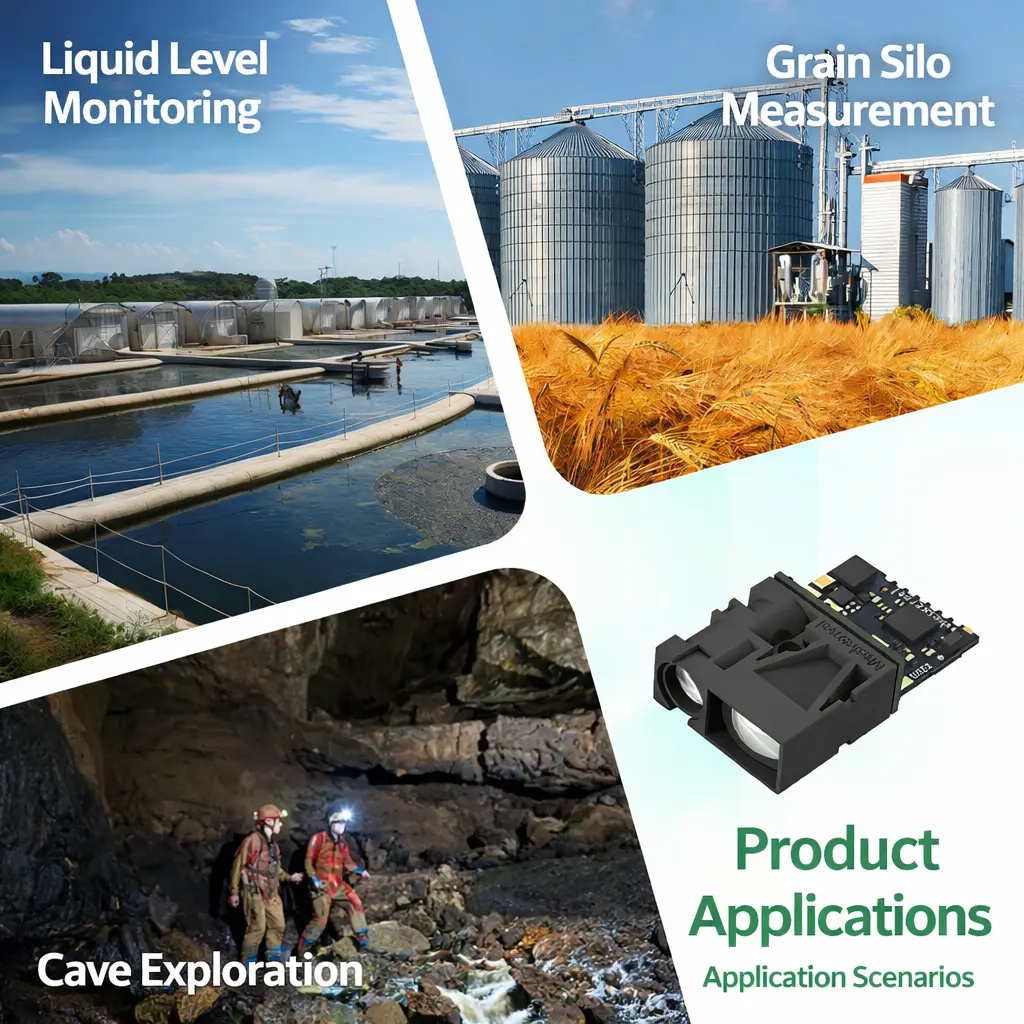
- Where compact Sensori ToF are used in robotics, drones, logistica, and automation
- A 5-step selection framework you can apply immediately
- Integration best practices and troubleshooting tips
- How Meskernel supports OEM and industrial buyers with compact, high-performance ToF solutions
1. What Is a Compact ToF Laser Sensor?
A compact ToF (Time-of-Flight) laser sensor is a miniaturized distance-measurement device that calculates distance by measuring the time it takes for a laser pulse to travel to a target and back.
In simple terms:
Distance = (speed of light × time of flight) ÷ 2
What makes a sensor compact is not just its footprint, but how much performance it delivers per millimeter and per gram.
Typical characteristics
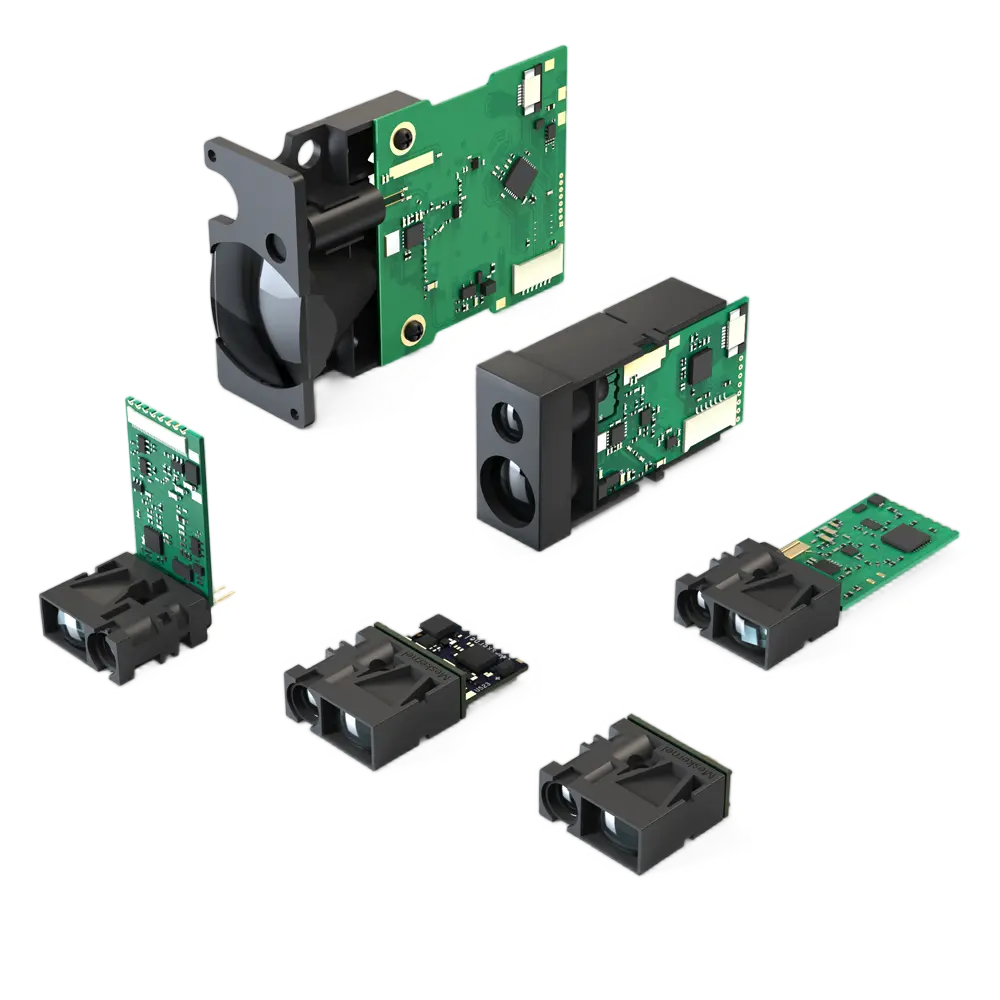
- Dimensions: usually under 100 × 50 × 20 mm
- Weight: often <100 g, with ultra-compact modules below 5–20 g
- Measurement range: centimeters to tens (or hundreds) of meters
- Uscita: digitale (UART, I²C, RS485) or analogico (4–20 mA, 0–10 V)
Compact ToF sensors are increasingly preferred wherever space, weight, and integration flexibility are critical.
2. Why “Compact” Size Matters More Than You Think
In real engineering projects, sensor size directly affects mechanical design, cost, and reliability.
| Integration Challenge | Why Compact ToF Helps |
|---|
| Tight mechanical envelopes | Fits inside robotic joints, grippers, UAV frames |
| Weight limits | Extends drone flight time and reduces actuator load |
| Multi-sensor layouts | Enables 360° coverage without interference |
| Industrial retrofits | Installs where bulky sensors simply won’t fit |
| Product aesthetics | Allows flush, low-profile designs |
Moderno compact ToF sensors prove that small does not mean weak.
Today’s modules can deliver millimeter-level precision, multi-meter range, and update rates up to 1000 Hz in packages small enough for UAVs and collaborative robots.
3. How Does a Compact ToF Laser Sensor Work?
3.1 Direct ToF (dToF) vs. Indirect ToF (iToF)
Understanding this distinction helps you choose the right technology.
| Aspect | Direct ToF (dToF) | ToF indiretto (iToF) |
|---|
| Principio | Measures pulse travel time directly | Misure spostamento di fase of modulated light |
| Best range | Medium to long range | Short to medium range |
| Precisione | Very strong at longer distances | Excellent mm-level at short range |
| Electronics | Ultra-fast timing circuits | Complex signal demodulation |
| Typical use | Outdoor, UAV, long-range sensing | Indoor robotics, precision positioning |
Most compact ToF modules on the market use either dToF (for speed and range) or iToF/phase-shift (for high short-range precision).
4. Compact ToF vs Other Distance Measurement Technologies
Buyers often evaluate multiple sensing technologies before deciding.
| Tecnologia | Punti di forza | Limitazioni | Uso tipico |
|---|
| ToF (laser) | Long range, fast response, lighting-robust | Cost higher than ultrasonic | Robotics, drones, automation |
| LiDAR | 3D mapping, wide FOV | Large size, higher cost | Autonomous navigazione |
| Triangolazione | Very high short-range precision | Limited range (<5 m) | Metrology, alignment |
| Ultrasuoni | Basso costo | Poor resolution, slow | Simple level rilevamento |
Il risultato principale è che
If your application needs compact size + fast updates + reliable range beyond a few meters, ToF is usually the best compromise between performance and integration complexity.
(For a deeper comparison, see:Time-of-Flight Sensor vs LiDAR)
5. Where Compact ToF Laser Sensors Are Used
5.1 Robotics & AMR/AGV
Compact sensors fit directly into wrists, grippers, and slim robot chassis.
5.2 Drones & UAVs
- Mantenimento dell'altitudine
- Seguire il terreno
- Landing assist
- Indoor obstacle avoidance
High update rates (hundreds to 1000 Hz) enable smooth control loops.
5.3 Automated Logistics
- Conveyor gap detection
- Shuttle positioning
- Box height and fill-level monitoring
Slim form factors allow installation between racks and conveyors.
5.4 Industrial Automation
- Presence/absence detection
- Assembly positioning
- Machine safety distance monitoring
Compact size simplifies retrofitting into existing machinery.
6. How to Choose the Right Compact ToF Laser Sensor (5-Step Framework)
Step 1: Define Range & Accuracy
Be specific:
- Min / max distance (e.g. 0.2–12 m)
- Required accuracy (±5 mm vs ±20 mm)
- Target reflectivity
⚠️ Many datasheets quote maximum range at 90% reflectivity.
Dark targets may reduce usable range by 30–50%.

Step 2: Check Environmental Conditions
- Ambient light resistance (70k–100k lux for outdoor use)
- IP rating (IP65 / IP67 for industrial environments)
- Operating temperature (-20 °C to +60 °C typical)
- Vibration & shock resistance
Step 3: Match the Interface
| Interfaccia | Il migliore per |
|---|
| UART | Direct MCU connection |
| I²C | Compact multi-sensor systems |
| RS485 | Long-distance industrial wiring |
| 4–20 mA / 0–10 V | PLC integration |
Step 4: Verify Mechanical Fit
- Dimensioni
- Peso
- Mounting holes
- Connector access
Always check enclosure and cable clearance—not just the sensor body.
Step 5: Evaluate Total Cost of Ownership
Look beyond unit price:
- Integration effort
- Documentation & sample code
- Lead time and supply stability
- OEM customization options
7. Integration Best Practices
Alimentazione
- Use clean, regulated power
- Avoid noisy DC rails
- Check startup current peaks
Mounting & Alignment
- Rigid mounting reduces vibration noise
- Avoid reflective surfaces near the beam
- Keep optical window clean
Communication
- Confirm baud rate and protocol
- Match update rate to control loop
- Verify continuous vs request-response mode
8. Troubleshooting Common ToF Issues
| Problem | Likely Cause | Soluzione |
|---|
| No data | Power or baud mismatch | Verify voltage & settings |
| Unstable readings | Ambient light or reflections | Shield or reposition |
| Short range | Low reflectivity target | Adjust expectations |
| Data dropouts | Power dips | Improve wiring & regulation |
9. Why Engineers Choose Meskernel Compact ToF Sensors
Meskernel focuses on industrial-grade compact laser distance sensors designed for real-world integration—not lab demos.
What Sets Meskernel Apart
- Compact designs with high sampling rates (up to 1000 Hz)
- OEM customization: pinout, firmware, cable length, enclosure
- Balanced price/performance vs premium Western brands
- Engineering support with documentation and sample code
Explore related resources:
Applicazioni del mondo reale
- UAV altimetry with compact sub-20 g modules
- AGV collision avoidance using 1000 Hz ToF sensors
- Robotic pick-and-place with mm-level phase-shift precision
10. Conclusion: What to Do Next
If you are specifying a compact ToF laser sensor in 2026, success depends on choosing a solution that fits mechanically, electrically, and operationally—not just on paper.
Next steps
- Shortlist sensors using the 5-step framework
- Test under real reflectivity and lighting conditions
- Work with a supplier that supports OEM integration
👉 Industrial vs compact laser sensor performance comparison
Your system deserves a sensore di distanza that fits your space and your performance goals.
FAQ: Compact ToF Laser Sensor
What is a compact ToF laser sensor?
A compact ToF laser sensor is a small-sized distance sensor that measures distance by calculating the time it takes for a laser pulse to travel to a target and return. It combines Tempo di volo technology with a miniaturized form factor, making it suitable for space- and weight-constrained applications such as robotics, drones, and industrial automation.
How does a compact ToF laser sensor work?
A compact ToF laser sensor emits a laser pulse toward a target, measures the round-trip travel time of the reflected light, and converts that time into distance using the speed of light. The distance is calculated as:
distance = (speed of light × time of flight) ÷ 2.
What is the difference between direct ToF and indirect ToF sensors?
Direct ToF (dToF) sensors measure the exact arrival time of a laser pulse and are better suited for long-range and outdoor applications.
Indirect ToF (iToF) sensors measure the phase shift of modulated light and are optimized for short-range, high-precision indoor measurements.
What are compact ToF laser sensors used for?
Compact ToF sensori laser are commonly used for:
Obstacle detection in robots and AGVs
Altitude and terrain sensing in drones
Misura della distanza in automated logistics systems
Position and presence detection in industrial automation
They are preferred when space, weight, and fast response time are critical.
How accurate is a compact ToF laser sensor?
Accuracy typically ranges from ±1 mm to ±30 mm, depending on:
Measurement distance
Target reflectivity
Sensor technology (dToF vs iToF)
Environmental conditions such as ambient light
Manufacturers often specify accuracy under controlled conditions, so real-world testing is recommended.
What is the typical measurement range of a compact ToF sensor?
Most compact Sensori laser ToF measure distances from a few centimeters up to 10–80 meters.
Some long-range compact models can exceed this under high-reflectivity conditions.
How does target reflectivity affect ToF sensor performance?
Target reflectivity has a major impact on effective range.
A sensor rated for 12 m at 90% reflectivity may only achieve 6–8 m on dark or absorbing surfaces (e.g., black rubber). Always consider reflectivity-adjusted specifications when selecting a sensor.
What interfaces do compact ToF laser sensors support?
Common interfaces include:
UART (TTL)
I²C
RS485
Analog outputs (4–20 mA or 0–10 V)
The best interface depends on whether the sensor connects to a microcontroller, PLC, or industrial network.
How fast is the update rate of compact ToF sensors?
Update rates range from 10 Hz to 1000 Hz, depending on the model.
High-speed ToF sensors (500–1000 Hz) are especially important for fast-moving systems such as drones, robotic arms, and AGVs.
How is a compact ToF sensor different from LiDAR?
A compact ToF laser sensor typically provides single-point distance measurement in a much smaller package, while LiDAR systems generate multi-point or 3D scans and are larger, more complex, and more expensive. ToF sensors are better suited for embedded distance measurement, while LiDAR excels at mapping and navigation.
What should I consider before integrating a compact ToF sensor?
Key considerations include:
Stable power supply
Proper mounting and alignment
Clean optical path
Matching communication settings
Environmental protection
Poor integration is one of the most common causes of unreliable readings.
Does Meskernel offer OEM or customized compact ToF sensors?
Yes. Meskernel provides OEM and customization services for compact ToF laser sensors, including firmware modification, interface selection, cable length adjustment, and enclosure customization for volume projects.