How Do Laser Distance Sensors Work: TOF vs Phase Shift vs Triangulation
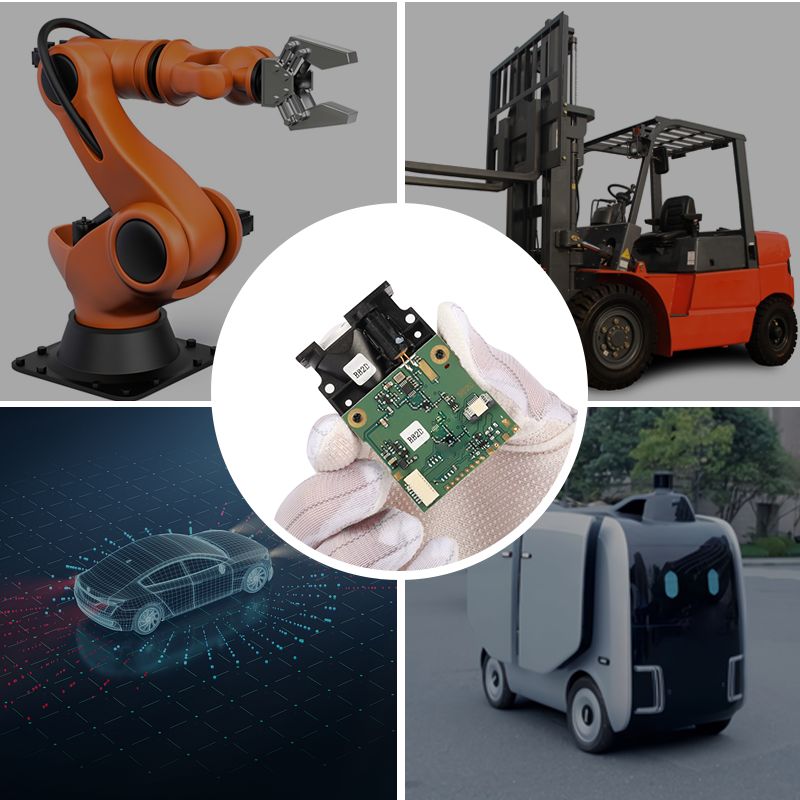
레이저 거리 sensors are widely used in industrial automation, robotics, drones, 건설, and smart infrastructure—but how do they actually work?
This guide explains how 레이저 거리 센서 measure distance, compares the three core working principles, and highlights real-world factors that affect accuracy, helping engineers and system designers choose the right solution.
What Is a Laser Distance Sensor?
레이저 거리 센서 is a device that measures the distance to an object by emitting a laser beam and analyzing the reflected light.
In simple terms:
A 레이저 거리 센서 sends out light, waits for it to bounce back, and calculates distance based on how the light behaves.
Unlike ultrasonic or 적외선 센서, laser-based measurement offers:
- Higher accuracy
- 빠른 응답 시간
- Longer measurable distance
- Better directionality
How Does a Laser Distance Sensor Measure Distance?

Think of it like shouting in a canyon and listening for the echo—but instead of sound, it uses light, which travels incredibly fast.
The sensor:
- Emits a laser pulse
- The laser hits the target surface
- Light reflects back to the receiver
- Electronics calculate distance using time, phase, or geometry
Different sensors use different calculation methods, which leads us to the three main working principles.
The Three Core Working Principles of Laser Distance Sensors
How it works
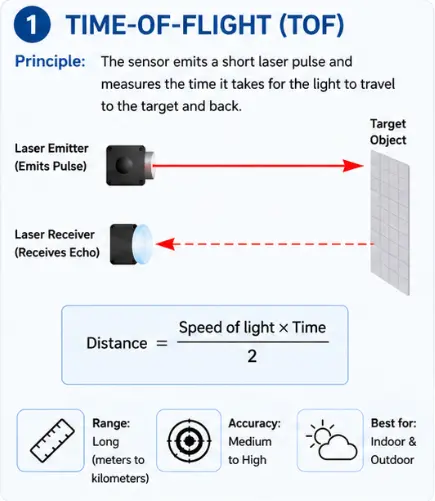
그리고 TOF laser distance sensor measures how long the laser pulse takes to travel to the object and return.
Distance formula:
Distance = (Speed of light × Time) / 2
Strengths
- Long measurement range (meters to kilometers)
- Works well outdoors
- Suitable for drones, robotics, and large-scale automation
Limitations
- Accuracy affected by surface reflectivity
- Requires precise timing electronics
Typical applications
- UAV 고도 측정
- Autonomous robots
- 산업 거리 모니터링
- Safety and obstacle 탐지
How it works
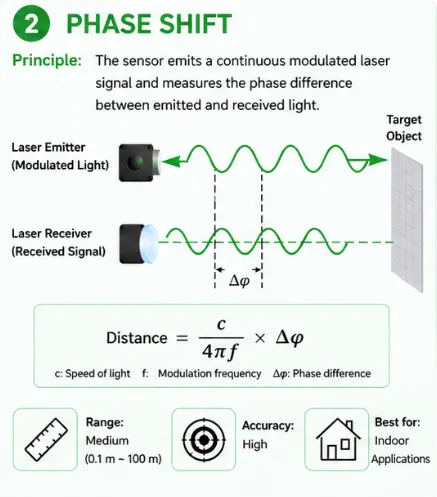
Instead of measuring time directly, the sensor emits a continuous modulated laser and measures the phase difference between emitted and received signals.
Strengths
- Higher accuracy than standard ToF
- Excellent for medium-range measurements
- Stable readings in controlled environments
Limitations
- Limited maximum range compared to ToF
- More complex signal processing
Typical applications
- Precision industrial positioning
- 창고 자동화
- Machine alignment systems
3. Laser Triangulation Sensor
How it works
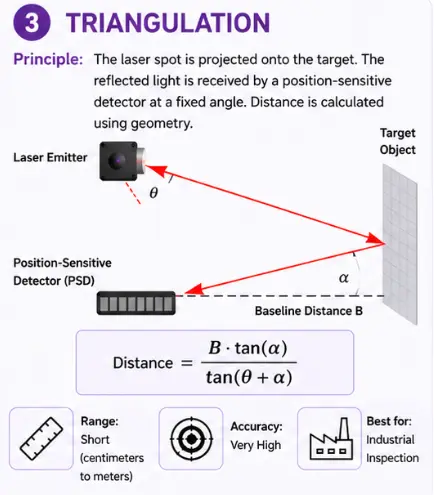
The laser spot reflects onto a position-sensitive detector at a specific angle. Distance is calculated using geometry.
Strengths
- Extremely high accuracy at short range
- Excellent resolution
- Fast response
Limitations
- Short measurement range (usually centimeters)
- Sensitive to alignment and surface texture
Typical applications
- 두께 측정
- 표면 프로파일링
- Precision manufacturing and inspection
Comparison: TOF vs Phase Shift vs Triangulation
| 원칙 | 범위 | 정확성 | Outdoor Use | 최상의 대상 |
|---|
| 비행 시간 | Long | Medium–High | 우수 | Robotics, drones, large distances |
| 위상 시프트 | Medium | 높음 | 보통 | 산업 자동화 |
| 삼각 측량 | 짧은 | 매우 높음 | Poor | Precision inspection |
What Affects Laser Distance Sensor Accuracy?
Key accuracy influencers:
- Target surface color & reflectivity
- Ambient light (especially sunlight)
- Measurement distance
- Angle of incidence
- Temperature and internal calibration
예를 들어
- Dark or matte surfaces reduce reflected signal strength
- Highly reflective or transparent targets may cause multi-path reflections
- Outdoor environments require 광학 filtering and stronger signal processing
Laser Distance Sensors vs LiDAR vs Ultrasonic Sensors
| 기술 | 정확성 | 범위 | 비용 | 일반적인 사용 |
|---|
| 레이저 거리 센서 | 높음 | Medium–Long | Medium | Industrial & embedded systems |
| LiDAR | Medium–High | Long | 높음 | Mapping, autonomous vehicles |
| 초음파 | 낮음 | 짧은 | 낮음 | Simple proximity detection |
Key takeaway:
Laser distance sensors provide the best balance of accuracy, size, and cost for most embedded and industrial applications.
How to Choose the Right Laser Distance Sensor
Ask these questions first:
- What is the maximum distance?
- Indoor or outdoor use?
- Required accuracy and resolution?
- Target surface characteristics?
- Power consumption constraints?
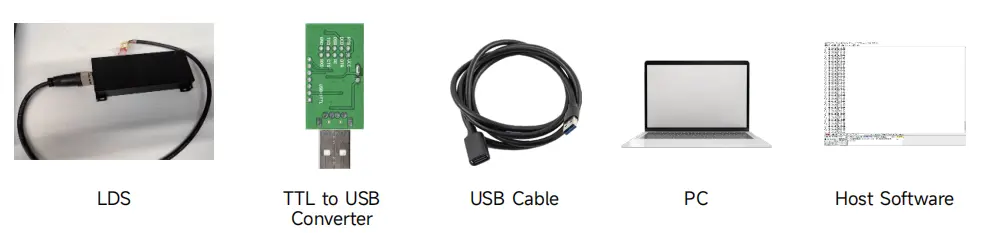
- Interface needs (UART, RS485, 아날로그 output)?
Matching the working principle to the application environment is far more important than chasing headline accuracy numbers.
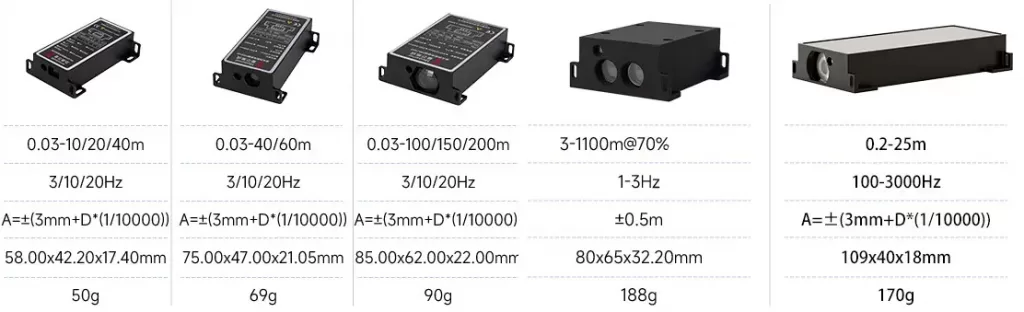
Compare different Meskernel laser distance sensor models in video demos
Common Mistakes Engineers Make
- Choosing triangulation sensors for outdoor use
- Ignoring ambient light interference
- Overspecifying range and increasing cost unnecessarily
- Forgetting calibration drift in long-term deployments
Understanding how the sensor works prevents these issues early in system design.
자주 묻는 질문
How accurate are laser distance sensors?
Accuracy typically ranges from ±1 mm to ±10 mm, depending on technology and conditions.
Can laser distance sensors work outdoors?
Yes—ToF-based sensors are specifically designed for outdoor and high-ambient-light environments.
What’s the difference between LiDAR and a laser distance sensor?
LiDAR scans multiple points to create maps, while laser distance sensors usually measure single-point distance.
Are laser distance sensors safe?
Most industrial sensors use Class 1 or Class 2 lasers, which are eye-safe under normal conditions.
Understanding how laser distance sensors work is essential for selecting the right technology, avoiding design pitfalls, and achieving reliable real-world performance.
Whether you’re building:
- Autonomous robots
- Industrial automation systems
- UAV platforms
- Precision measurement equipment
Choosing the correct measurement principle makes all the difference.
For application-specific design challenges, these in-depth guides provide practical engineering insights.
Suggested Next Reads
If you want to explore related topics in more depth, you may also find these guides useful: