1. Why Industrial Distance Measurement Still Relies on 4-20mA
In modern factories, water treatment plants, and bulk handling facilities, knowing the exact position of a crane, the level of a silo, or the clearance of a moving platform is critical. While digital fieldbuses and wireless sensors have advanced, the 4-20mA analogowy output remains the most trusted, noise-immune, and simple method to transmit real-time distance data from a laser sensor to a PLC or controller.
Unlike general-purpose sensors, odległość lasera sensors with 4-20mA output are specifically designed for:
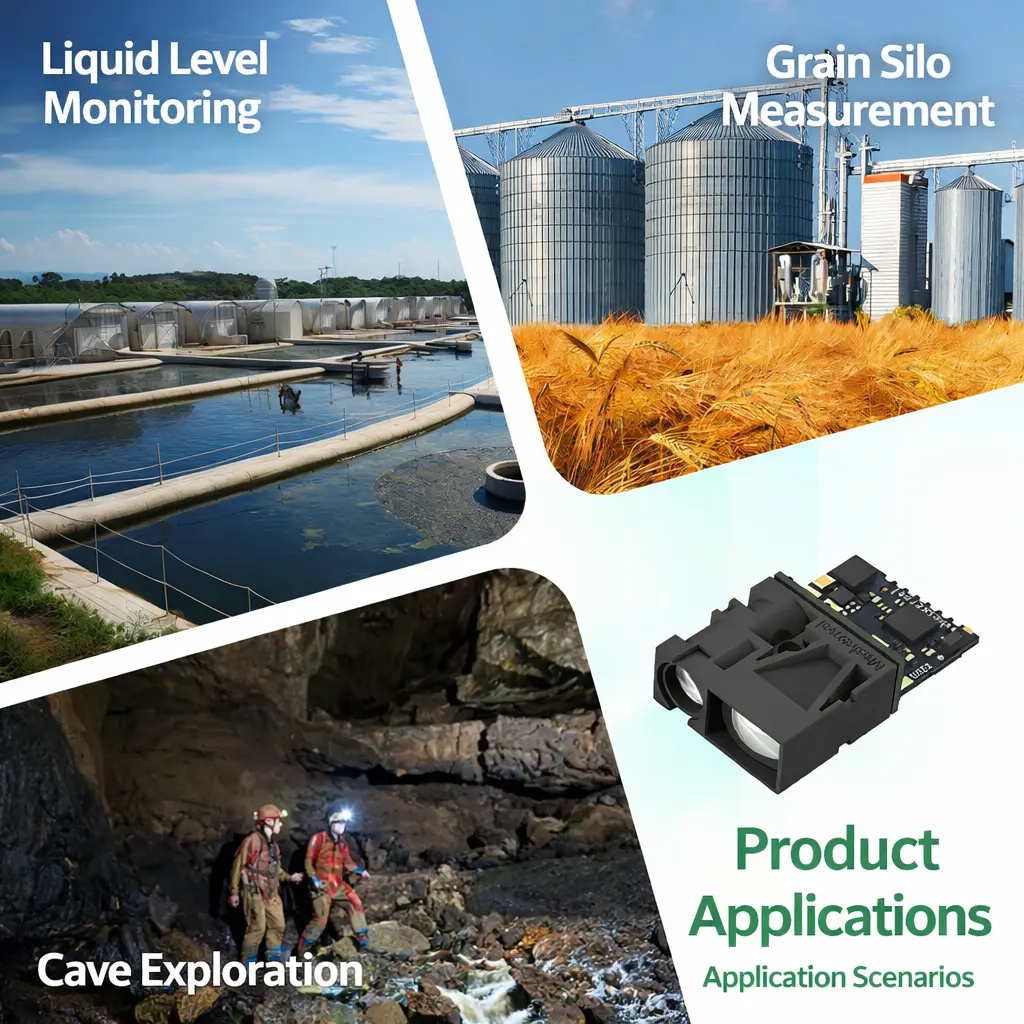
- Non-contact level measurement of liquids, solids, and slurries
- Crane and hoist positioning (collision avoidance)
- Loop control in roll-to-roll manufacturing
- Automated guided vehicle (AGV) positioning
- Hydraulic cylinder feedback
This guide focuses exclusively on 4-20mA laserowe czujniki odległości — how they work, how to wire and scale them, troubleshoot common loop issues, and select the right model for your distance-measurement application.
2. Current Loop Principles Applied to Laser Ranging
2.1 The Four Elements of a Laser Distance Measurement Loop
Every 4-20mA laserowy pomiar odległości system consists of:
- Laser czujnik odległości (transmitter): Measures distance (e.g., 0.1–100 m) and converts it into a 4-20mA current.
- DC power supply: Typically 12–36 VDC (24 VDC common).
- Receiver (PLC analog input card): Includes a precision load resistor (often 250 Ω) to convert current to voltage.
- Two-wire shielded cable: Carries both power (for loop-powered sensors) and the signal.
Because the sensor’s output is a current, it remains accurate over hundreds of meters of cable — a key advantage when the laser sensor is mounted on a remote tank or overhead crane.
2.2 Why Current, Not Voltage, for Distance Signals?
Voltage-based distance sensors (0–10 V) suffer from voltage drop along the cable. A 0–10 V signal sent 300 meters through 22 AWG wire can lose 2–3 V, causing a 20–30% distance error. A 4-20mA current loop experiences no loss; the current measured at the PLC equals the current generated by the sensor.
| Cecha | 4-20mA Laser Sensor | 0-10V Laser Sensor |
|---|
| Max cable length (reliable) | > 1000 m | < 300 m |
| Noise immunity | Excellent (low impedance) | Poor in motor environments |
| Wire break wykrywanie | Yes (0 mA = broken wire) | No (0V could be zero distance) |
2.3 The 4-20mA Scaling Rule for Distance
The mapping between physical distance and loop current is linear:
Output Current (mA) = 4 mA + (Measured Distance / Full Scale Distance) × 16 mA
Przykład:
A laserowy czujnik odległości with range 0–10 meters:
- 0 m → 4 mA
- 5 m → 12 mA
- 10 m → 20 mA
For a tank with a non-zero minimum distance (e.g., sensor mounted 2 m above empty level), you can offset the scaling in the sensor or PLC.
2.4 Loop-Powered vs. Separately Powered Laser Sensors
Most 4-20mA distance sensors are 3-wire or 4-wire devices (separate power and signal return) because pomiar laserowy requires more than 4 mA of operating current. However, low-power czujniki laserowe (e.g., for simple level detection) can be loop-powered (2-wire).
| Configuration | Power | Signal | Typical Laser Sensor Example |
|---|
| 2-wire (loop-powered) | 4-20mA loop | Same two wires | Short-range (<20 m), low update rate |
| 3-wire | Separate DC + common | 4-20mA return | Most industrial laser sensors (Meskernel LDL-T series) |
| 4-wire | Isolated AC/DC | Isolated loop | Long-range, high-power laser diodes |
The Meskernel LDL-T series uses a 3-wire configuration: power (24 VDC), ground, and 4-20mA output. This allows fast 100 Hz update rates and high precision (±1 mm) without power constraints.
3. Core Technical Concepts for Distance Measurement Engineers
3.1 Compliance Voltage in a Laser Distance Loop
Your power supply must provide enough voltage to push 20 mA through the laser sensor, the receiver load resistor, and the cable resistance.
Example calculation for a crane positioning system:
- Laser sensor: LDL-T, min operating voltage = 12 V
- PLC analog input: 250 Ω resistor → drops 5 V at 20 mA
- Cable length: 500 m of 22 AWG (round-trip resistance ≈ 33 Ω) → drops 0.66 V at 20 mA
- Total voltage needed: 12 + 5 + 0.66 = 17.66 V
A 24 VDC supply provides ample margin. If the voltage drops below the sensor’s minimum (e.g., due to longer cable or smaller gauge), the loop fails.
3.2 Scaling Distance to 4-20mA – Practical Formula
Most laser distance sensors allow you to program the 4 mA and 20 mA setpoints via:
- Push buttons on the sensor
- RS485/Modbus command
- External teaching process
Example: Silo level measurement
- Sensor mounting height: 15 m above floor
- Empty level (floor): 15 m distance → want 4 mA
- Full level: 1 m distance → want 20 mA
Because distance decreases as level rises, you may reverse the scaling: 4 mA = full (short distance), 20 mA = empty (long distance). Or simply invert in the PLC.
PLC scaling formula (linear):
Distance = (Current – 4) × (MaxDistance – MinDistance) / 16 + MinDistance
3.3 Choosing the Right Load Resistor
The receiver’s load resistor determines the voltage range seen by the PLC analog input.
| Load Resistor | Voltage at 4 mA | Voltage at 20 mA | Typical Use |
|---|
| 250 Ω | 1 V | 5 V | Most PLC analog inputs (1–5 V) |
| 500 Ω | 2 V | 10 V | Legacy controllers (2–10 V) |
| 100 Ω | 0.4 V | 2 V | Current-input PLC modules |
Do not exceed the maximum loop resistance specified by your laser sensor. Most sensors tolerate up to 500–750 Ω total load.
4. Real-World Applications of 4-20mA Laser Distance Sensors
Here we focus exclusively on distance/level/position applications, not general temperature or pressure.
4.1 Continuous Liquid Level Control in Water/Wastewater
A 4-20mA distance sensor mounted above a tank measures the distance to the water surface. The PLC reads the current, calculates level, and modulates a fill valve or pump. Because the signal is analog and updates rapidly, PID control loops remain stable without the jitter of digital polling.
Why 4-20mA over digital? Deterministic update every 10–100 ms, no network configuration, and immediate failure detection (0 mA).
4.2 Crane Collision Avoidance & Positioning
Overhead cranes in steel mills or shipyards require real-time distance between trolleys or to the end stops. A 4-20mA laser sensor (e.g., Meskernel LDL-T with 100 m range) sends the distance to a safety PLC. The PLC reduces speed or stops the crane when the distance falls below a threshold. The analog signal ensures no delay or data loss, unlike Ethernet that might suffer from switch congestion.
4.3 Bulk Solids Level in Silos (Cement, Grains, Plastics)
Non-contact laser sensors measure the distance to the material surface. Dusty environments require robust optics, but the 4-20mA output remains reliable. The control room sees the level continuously, and the 4 mA live-zero alerts immediately if the sensor loses signal (e.g., due to heavy dust obscuring the beam).
4.4 Hydraulic Cylinder Position Feedback
In mobile equipment (excavators, forklifts) and industrial presses, a 4-20mA laser distance sensor can measure the extension of a cylinder rod. The analog output directly feeds a proportional valve controller, creating a closed-loop positioning system without the overhead of fieldbus protocols.
4.5 Roll-to-Roll Loop Control (Web Handling)
In paper, film, or metal strip processing, the dancer position or loop depth must be controlled. A laser sensor measures the loop depth and outputs 4-20mA to a PLC or direct tension controller. The analog signal’s smooth, high-resolution nature avoids step changes that could tear the web.
4.6 AGV/AMR Navigation and Docking
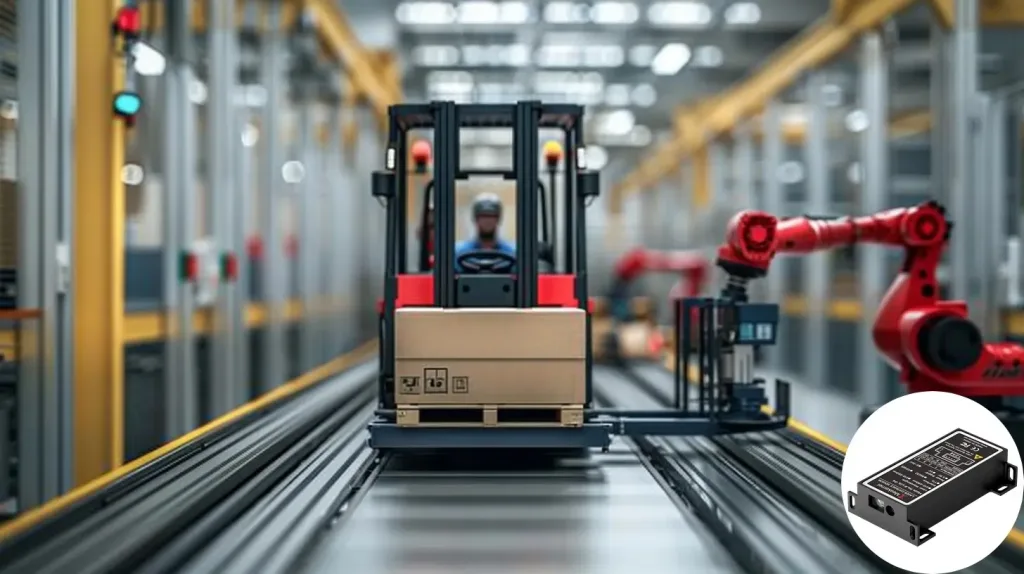
Automated guided vehicles use laser distance sensors to detect distance to walls, docking stations, or obstacles. 4-20mA output provides a simple, real-time distance value to the vehicle’s motion controller. Even as AGVs adopt more complex sensors, analogowe czujniki odległości remain a cheap, reliable backup for safety-rated distance monitoring.


5. Advantages: Why Industry Chooses 4-20mA for Laser Distance
| Advantage | Benefit for Pomiar odległości |
|---|
| Długie przebiegi kabli | Mount sensor 1000 m from PLC – no signal loss |
| Noise immunity | Work next to VFDs, welders, motors without jitter |
| Simplified wiring | Two or three wires, no switches, terminators, IP addresses |
| Live zero fault detection | 0 mA instantly tells you sensor/cable is broken – critical for safety loops |
| Standard PLC compatibility | Every PLC has analog input cards for 4-20mA |
| No network latency | Current updates continuously, no packet delay |
6. Limitations and When to Choose Digital (RS485/Modbus)
Honest assessment for distance sensors:
- One distance value per loop – You cannot get temperature, signal quality, or diagnostics on the same two wires (unless using HART, which is rare on laser sensors).
- Manual configuration – You must physically teach or send serial commands to set the 4/20 mA distance points.
- Wire cost for many sensors – If you have 50 sensors, 50 individual pairs of wires vs. a single Modbus bus.
When to choose digital (RS485) instead of 4-20mA:
- You need multiple parameters (distance, amplitude, sensor temperature, reflectivity)
- Many sensors share one long bus (reduces wiring cost)
- You want to reprogram scaling remotely over the bus
Meskernel offers both: Many of our laser distance sensors (e.g., LDL-T and LDK-P4) include simultaneous 4-20mA + RS485 output, giving you analog for real-time control and digital for diagnostics.
7. Troubleshooting 4-20mA Laser Distance Sensor Loops
7.1 Essential Tools
- Precision mA clamp meter (e.g., Fluke 773) – measures current without breaking loop
- Process calibrator – simulates 4-20mA to test PLC input
- Known reflective target (white card) – verify laser sensor operation
7.2 Common Failure Modes in Distance Loops
| Symptom | Likely Cause | Fix |
|---|
| Reading 0 mA | Broken wire, disconnected sensor, blown fuse | Check continuity, power supply |
| Reading <4 mA (e.g., 3.8 mA) | Laser sensor in low alarm (power brownout) or target beyond max range | Check voltage at sensor terminals; check if target is within specified range |
| Reading erratic / jumping | Electrical noise (VFD nearby) or loose connection | Use shielded twisted pair, ground shield at one end; tighten terminals |
| Reading stuck at 4 mA or 20 mA | Laser sensor in fault (e.g., internal error) or scaling misconfigured | Use RS485 to read sensor diagnostic; re-teach limits |
| Reading offset but linear | Wrong scaling in PLC (0–10 m vs. 0–5 m) or sensor’s 4 mA point not set | Verify scaling parameters in sensor and PLC |
7.3 Ground Loop Issues in 3-Wire Sensors
A 3-wire laser sensor shares the power ground with the 4-20mA return. If multiple sensors are powered from different power supplies with different ground potentials, you can get ground loop currents that add offset to the signal.
Rozwiązanie: Use a signal isolator (4-20mA input, 4-20mA output with optyczny isolation) or power all sensors from a single, well-grounded 24 VDC supply.
7.4 Testing the Loop Without the Laser Sensor
Disconnect the sensor and connect a process calibrator set to source 4 mA, 12 mA, 20 mA. If the PLC reads the corresponding distances correctly, the sensor is faulty or misconfigured. If not, check wiring and PLC scaling.
8. How to Set Up a 4-20mA Laser Distance Sensor (Step-by-Step)
Using a Meskernel LDL-T series sensor as example:
- Mount the sensor rigidly facing the target (avoid ambient light interference).
- Drut:
- Brown → 24 VDC (+)
- Blue → 24 VDC ground (GND)
- Black → 4-20mA output (connect to PLC analog input +)
- Also connect GND to PLC analog input common (unless using differential input)
- Power up – verify green LED indicates laser on.
- Set 4 mA point (e.g., farthest distance):
- Position target at maximum distance (e.g., 10 m)
- Press “Teach 1” button (or send Modbus command)
- Set 20 mA point (e.g., closest distance):
- Move target to minimum distance (e.g., 0.2 m)
- Press “Teach 2” button
- Test – move target; verify mA changes linearly.
- Scale PLC:
- For 0–10 m range, PLC input scaling: 4 mA → 0 m, 20 mA → 10 m
- If tank level is inverse (4 mA = full), set PLC scaling accordingly.
9. Product Spotlight: Meskernel 4-20mA Laser Distance Sensors
Meskernel designs and manufactures high-precision laser distance sensors with analog output specifically for industrial automation.
LDL-T Series – Long Range, High Speed
| Parametr | Wartość |
|---|
| Measuring range | 0.05 – 100 m (natural targets) |
| Dokładność | ±1 mm |
| Wyjście | 4-20mA + RS485 (Modbus RTU) |
| Update rate | Up to 100 Hz |
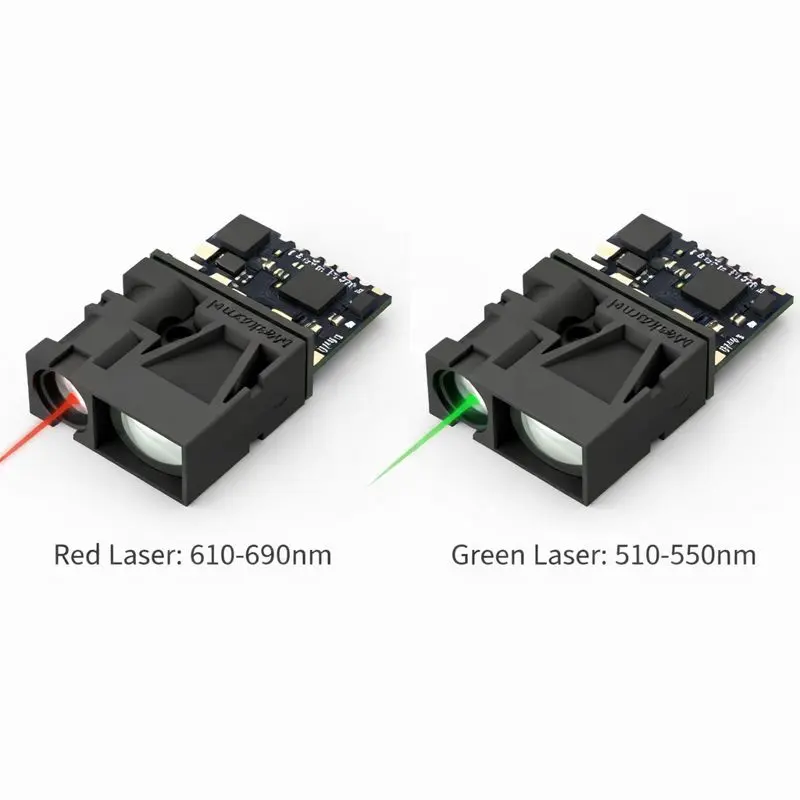
| Klasa lasera | Class II, 635 nm (visible red) |
| Napięcie zasilania | 12-30 VDC |
| Operating temp | -10°C to +50°C |
Najlepsze dla: Crane positioning, silo level, AGV obstacle detection.
LDK-P4 Series – Compact, Cost-Effective
| Parametr | Wartość |
|---|
| Measuring range | 0.03 – 40 m |
| Dokładność | ±2–3 mm |
| Wyjście | 4-20mA + digital |
| Update rate | 20 Hz |
| Supply | 12-24 VDC |
Najlepsze dla: Small tank level, parking guidance, simple positioning.
Meskernel Analog Distance Module – OEM Integration
- Ultra-compact board-level module
- 4-20mA output, 30 Hz update, 80 m range
- Ideal for integrators building custom level or positioning systems.
All Meskernel 4-20mA laser sensors feature programmable analog output – you can assign 4 mA and 20 mA to any two distances within the sensor’s range, even reverse scaling (4 mA = far, 20 mA = near). They also include RS485 for configuration and diagnostics, giving you the best of both analog and digital worlds.
Explore Meskernel laser sensor video library
10. The Trusted Analog Output for Distance Measurement
The 4-20mA standard has been the industrial workhorse for decades, and when combined with modern laser distance technology, it provides unmatched simplicity, noise immunity, and long-distance reliability. Whether you are measuring water level in a remote tank, positioning a steel crane, or controlling a roll of film, a 4-20mA laser distance sensor delivers accurate, real‑time data directly to your PLC without network complexity.
Meskernel’s laser distance sensors with 4-20mA output are designed to meet these demands – with millimeter accuracy, fast update rates, and the flexibility of both analog and digital interfaces.
Ready to integrate 4-20mA laser distance sensing into your next project? Browse our product range or contact our engineering team for application support.
FAQ – 4-20mA Laser Distance Sensor
What is a 4-20mA laser distance sensor?
A 4-20mA laser distance sensor is an industrial device that measures the distance to a target using a laser beam and outputs the measured distance as a proportional analog current signal between 4 mA and 20 mA. The current varies linearly with distance: 4 mA typically represents the farthest measured point (or empty level), and 20 mA represents the closest point (or full level). This signal is highly immune to electrical noise and cable resistance, allowing long-distance transmission (up to 1000 m) to a PLC or controller.
How far can you run a 4-20mA laser sensor signal?
A 4-20mA signal from a laser distance sensor can be transmitted reliably over 1000 meters (3280 feet) or more, depending on cable gauge and the sensor’s compliance voltage. Unlike voltage signals (0-10 V), the current does not drop over distance. The practical limit is determined by the power supply voltage and the total loop resistance (wire + receiver resistor + sensor internal load). For most industrial installations, 800–1000 m is standard with 24 VDC supply and 22 AWG shielded cable.
How to test a 4-20mA laser distance sensor with a multimeter?
1.Set multimeter to mA mode and connect it in series with the loop (break the black wire).
2.Or use a clamp meter (e.g., Fluke 773) to measure current without breaking the loop.
3.Place a reflective target at a known distance (e.g., 2 m).
4.Read the current. For a sensor scaled 0–10 m: 4 mA + (2 m / 10 m) × 16 mA = 7.2 mA.
5.If current is not as expected, check sensor scaling, target reflectivity, or loop wiring.
Can I reverse the 4-20mA output (4 mA = close, 20 mA = far)?
Yes. Most programmable laser distance sensors, including the Meskernel LDL-T series, allow you to assign 4 mA and 20 mA to any two distance values independently. For example, you can set 4 mA at 1 meter (full tank) and 20 mA at 10 meters (empty tank) to simplify PLC scaling for level applications. This is often called “reverse scaling” or “inverse analog output”.
What is the maximum load resistance for a 4-20mA laser sensor?
Maximum load resistance = (Supply voltage – Sensor minimum voltage) / 0.02 A. For a 24 V supply and a sensor requiring 12 V minimum: (24 – 12) / 0.02 = 600 Ω. This includes the PLC resistor (typically 250 Ω) plus cable resistance. Exceeding the maximum load will prevent the sensor from reaching 20 mA
Is a 4-20mA laser sensor suitable for outdoor or dusty environments?
Yes, but you must choose a sensor with adequate laser power and optics. For dusty silos or outdoor applications, use sensors with Class II or III laser (e.g., 635 nm visible red) and anti-condensation housing. The 4-20mA signal itself is immune to environmental electrical noise. However, heavy dust may cause weak reflections; many sensors have a “signal low” alarm that can be reported via RS485 but not over the analog output alone. For reliable outdoor use, consider models with heater optics and IP65/IP67 protection.
Can I connect two 4-20mA laser sensors to one PLC analog input?
No. Each 4-20mA sensor requires its own dedicated analog input channel because the loop is a series circuit. However, you can connect multiple sensors to the same PLC using a multi-channel analog input module. For more than 8–16 sensors, consider switching to RS485/Modbus to reduce wiring.
What accuracy can I expect from a 4-20mA laser distance sensor?
Typical accuracy for industrial models: ±1 mm to ±3 mm over the full range (e.g., 0.05–100 m). The 4-20mA output itself introduces a very small error due to the DAC and load resistor tolerance (usually ≤ ±0.1% of full scale). Overall system accuracy is dominated by the laser measurement engine, not the analog output.