In modern industrial automation, conveyor systems are central to material handling, assembly, sorting, and packaging. As production lines become faster, more flexible, and increasingly complex, the need for precise, non-contact medição de distâncias has grown significantly.
This is where alcance laser sensors for conveyor systems, also known as laser distance measuring modules, play a critical role. These modules provide real-time distance data, enabling smarter automation, improved safety, and adaptive control.
Why Conveyor Systems Need Laser Ranging Sensors
Traditional conveyor automation often relied on sensores fotoeléctricos, mechanical limit switches, or fixed encoders. While these solutions are cost-effective, they frequently fall short in applications that require:
- Continuous distance measurement rather than simple presence deteção
- High positional accuracy for objects of varying sizes
- Non-contact sensing to prevent wear and contamination
- Reliable operation in dusty, vibrating, or high-speed environments
A distância do laser measuring module provides real-time distance feedback, allowing conveyor systems to move beyond simple on/off logic into closed-loop control and adaptive automation.
Typical Conveyor Applications for Distance Measuring Modules
1. Object Positioning and Stop Control
Precise stopping is critical in accumulation conveyors and transfer stations to avoid collisions or misalignment.
Laser ranging sensors and medição de distâncias por laser modules can:
- Measure the exact distance to approaching objects
- Dynamically adjust deceleration profiles
- Compensate for speed variations and load differences
This is especially valuable when handling products with inconsistent lengths or shapes, such as cartons, pallets, or irregular components.
2. Height and Profile Detection
Em logística and packaging lines, it is often necessary to monitor:
- Product height
- Stack levels
- Overhanging or deformed packages
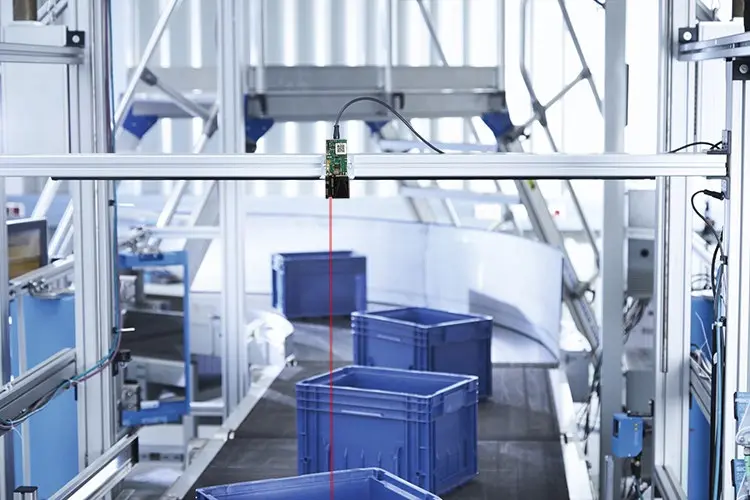
Mounted above or beside the conveyor, a laser distance measuring module continuously scans distance data to:
- Trigger reject mechanisms
- Adjust downstream machinery
- Prevent jams and mechanical damage
Compared to light curtains or ultrasonic sensors, módulos de alcance laser provide higher resolution and faster response.
3. Conveyor Speed Synchronization
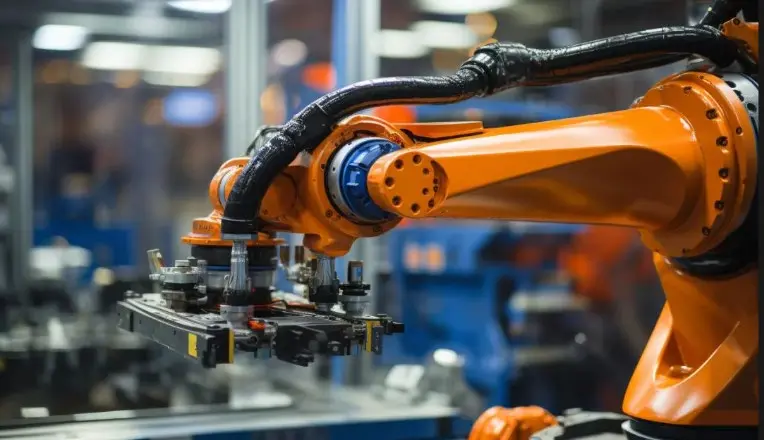
When conveyors interact with robotic arms, pushers, or diverters, synchronization is critical.
Laser distance measuring modules enable:
- Real-time tracking of object position
- Predictive triggering of actuators
- Smooth handoff between conveyor zones
This ensures seamless coordination in high-speed production lines and prevents collisions or bottlenecks.
4. Jam Detection and Gap Monitoring
Unexpected stoppages can cause costly downtime. By continuously measuring distance along the conveyor, laser ranging sensors can detect:
- Abnormal spacing between items
- Sudden object pileups
- Missing or misrouted products
This allows control systems to act before a full blockage occurs, improving overall equipment effectiveness (OEE).

Why ToF Distance Measuring Modules Are Ideal for Conveyors
Time-of-Flight (ToF) distance measuring modules are particularly suitable for conveyor applications due to their combination of performance, compactness, and integration simplicity.
Key advantages include:
- Longer detection range compared to triangulation sensors
- Stable measurement across different surface colors and materials
- Compact housing, ideal for tight conveyor frames
- High measurement frequency, supporting fast-moving lines
For distributed conveyor systems, compact ToF modules reduce installation complexity and maintenance effort.
Key Selection Criteria for Conveyor Applications
When selecting a laser distance measuring module for your conveyor system, consider the following:
Measurement Range and Accuracy
Ensure the sensor covers the full working distance and meets the required resolution for your control system.
Tempo de resposta
High-speed conveyors require fast update rates to avoid latency-related errors.
Environmental Robustness
Dust, vibration, and ambient light can impact performance. Industrial-grade enclosures and stable ótico designs are essential.
Output Interfaces
Analógico outputs, digital switching signals, or industrial communication protocols should align with your existing control architecture.
Model selection guide: real product comparison videos
Common Installation Considerations
Proper installation is as important as module selection:
- Avoid mounting angles that cause specular reflections
- Ensure a clear optical path free from moving obstructions
- Use stable mechanical brackets to minimize vibration effects
- Calibrate sensing zones based on real operating conditions
Correct installation ensures consistent performance and reduces false triggers.
How Conveyor Applications Support Broader Automation Systems
Laser ranging sensors for conveyor systems often serve as data providers for larger automation systems, including:
- Robotic pick-and-place stations
- Automated storage and retrieval systems (AS/RS)
- Sorting and distribution lines
By sharing accurate distance data across systems, manufacturers achieve higher flexibility, scalability, and process transparency.
Conclusão
The use of sensores de alcance laser for conveyor systems, also called laser distance measuring modules, has evolved from simple detection to precise, real-time measurement that enables smarter automation. Compact ToF laser modules offer the ideal combination of accuracy, speed, and robustness for modern conveyor environments.
As conveyor lines become more adaptive and closely integrated with robotics and intelligent control systems, these modules will continue to play a foundational role in improving efficiency, reliability, and overall system intelligence.
FAQ
What is a laser ranging sensor for conveyor systems?
It is a non-contact sensor that measures distances in real-time on conveyor lines. Also called a distance measuring module, it enables precise object positioning, speed synchronization, and jam detection.
How does a ToF distance measuring module work on conveyors?
ToF modules emit a laser pulse and measure the return time, calculating distance with high accuracy for real-time monitoring, even on high-speed lines.
Can laser distance measuring modules replace traditional photoelectric sensors?
Yes. Unlike photoelectric sensors, laser distance measuring modules provide continuous distance data for adaptive automation, improving precision and reducing downtime.
How to choose the right laser distance module for conveyor systems?
Consider measurement range, accuracy, response time, environmental robustness, and compatibility with your control system.
Can laser ranging sensors be used for conveyor jam detection?
Yes. By continuously monitoring distance changes along the conveyor path, laser ranging sensors can detect abnormal spacing, pileups, or unexpected stops, allowing the system to react before a full jam occurs.
Where should a laser ranging sensor be installed on a conveyor?
Laser ranging sensors can be installed above, beside, or at an angle to the conveyor, depending on the application. Common positions include overhead mounting for medição da altura and side mounting for position or spacing control.
Are laser ranging sensors affected by dust or vibration on conveyors?
Industrial-grade laser ranging sensors are designed to withstand dust, vibration, and ambient light, but proper mounting, stable brackets, and correct alignment are essential to ensure long-term measurement stability.
What output signals are commonly used for conveyor integration?
Laser ranging sensors typically support analog outputs (e.g., 4–20 mA or 0–10 V), digital switching outputs, or industrial communication interfaces, allowing easy integration with PLCs and conveyor control systems.
Why are ToF laser sensors often preferred for conveyor applications?
Tempo de voo sensores laser are preferred because they offer longer measurement ranges, stable performance, compact size, and simple installation, making them ideal for distributed conveyor systems with limited mounting space.
Can one laser ranging sensor replace multiple traditional sensors on a conveyor?
In many cases, yes. A single laser ranging sensor can replace multiple photoelectric or mechanical sensors by providing distance-based logic, reducing wiring complexity and improving system flexibility.
How does using laser ranging sensor improve conveyor system efficiency?
laser ranging sensor enable adaptive control, reduced downtime, fewer mechanical adjustments, and better coordination with automation equipment, leading to higher throughput and improved overall equipment effectiveness (OEE).