Autonomous Mobile Robots (AMRs) are increasingly used for material handling, pallet transfer, and production line feeding. However, AMR docking remains one of the most failure-prone steps in real-world deployments.
Common complaints from system integrators and end users include:
- “Our AMR doesn’t stop at the correct position”
- “The robot docks crooked or misaligned”
- “It sometimes crashes into the docking station”
- “LiDAR looks fine on paper, but accuracy is unstable at close range”
In this article, we explain why lazer mesafesi sensors are critical for high-precision AMR docking, why LiDAR alone is often insufficient, and how to design a reliable, millimeter-level docking solution using the right sensing principle.
Why AMR Docking Is More Challenging Than Navigation
During normal navigasyon, AMRs typically operate with centimeter-level tolerance. Slight positional errors are acceptable.
Docking, however, is different.
For charging, pallet handover, or conveyor alignment, AMRs often require:
- ±1–3 mm position accuracy
- Repeatable stopping distance
- Stable alignment over thousands of cycles
- Resistance to reflection, vibration, and surface variation
This gap between navigation accuracy and docking accuracy is where many systems fail.
Why LiDAR Is Not Ideal for Precision Docking
LiDAR excels at global positioning and engellerden kaçınma, but it is not optimized for short-range, high-precision alignment.
Typical limitations of LiDAR in docking scenarios include:
- Angular resolution limits at close range
- Centimeter-level distance noise
- Sensitivity to reflective metal surfaces
- Inconsistent tespit of docking edges or corners
- Data filtering latency that affects real-time stopping
In practice, LiDAR can guide an AMR toward a docking station, but it struggles to determine exact final stopping distance and alignment.
Docking Accuracy Requirements: mm-Level vs cm-Level
| Application Stage | Typical Accuracy |
|---|
| AMR navigation | ±20–50 mm |
| Pre-docking approach | ±5–10 mm |
| Final docking alignment | ±1-3 mm |
Only the final stage determines whether docking succeeds or fails.
This is where dedicated lazer mesafe sensörleri become essential.
ToF vs Triangulation: Which Is Better for AMR Docking?
En iyisi:
- Medium to long docking distances (0.2–10 m)
- Varying surface colors
- Zorlu endüstriyel ortamlar
Avantajlar:
- Stable measurement regardless of target texture
- Ortam ışığına karşı güçlü direnç
- Good balance of range and accuracy
Laser Triangulation Sensors
En iyisi:
- Very short-range docking (<1 m)
- Extremely high accuracy requirements
Sınırlamalar:
- Sensitive to surface reflectivity
- Narrow measurement window
- Installation angle is critical
👉 In most AMR docking systems, compact high-speed ToF laser distance sensors are preferred for their robustness and ease of integration.
Sensor Placement and Installation: What Actually Matters
Even the best sensor will fail if installed incorrectly.
Key installation guidelines:
- Mount the sensor as close as possible to the docking interface
- Ensure the laser beam is perpendicular to the target surface
- Avoid angled metal plates that cause specular reflection
- Use reference targets (flat plates or docking markers) if needed
- Isolate the sensor from vibration where possible
Correct placement often improves docking reliability more than changing the sensor model.
Common Docking Failure Cases (and How to Fix Them)
1. AMR Stops Too Early or Too Late
Cause: LiDAR distance averaging or delayed filtering
Fix: Use a dedicated laser mesafe sensörü for final stop control
2. Docking Is Not Straight
Cause: Single-point sensing without alignment reference
Fix: Use dual sensors or combine distance + mechanical guides
Cause: Specular reflection or signal saturation
Fix: Select ToF sensörleri with multi-echo processing or diffuse targets
Recommended System Architecture for High-Reliability Docking
A proven AMR docking architecture looks like this:
- LiDAR / vision → global navigation and obstacle avoidance
- Laser distance sensor → final approach and stopping control
- Mechanical guides or pins → passive alignment tolerance
- PLC or controller logic → soft stop + safety margin
This layered approach delivers both flexibility and precision.
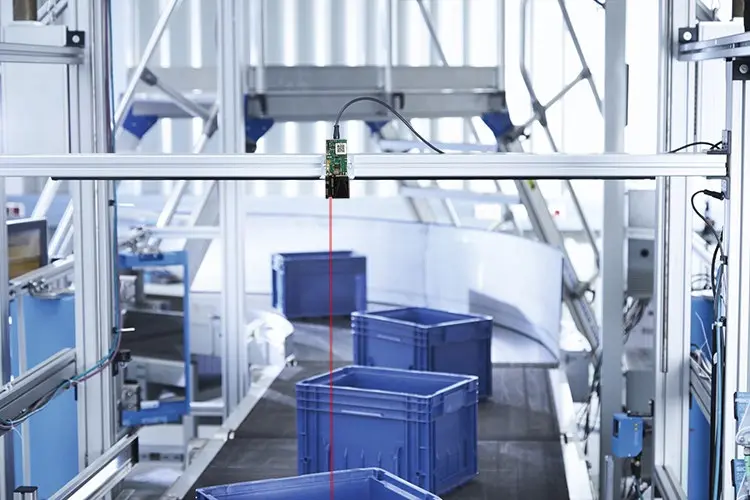
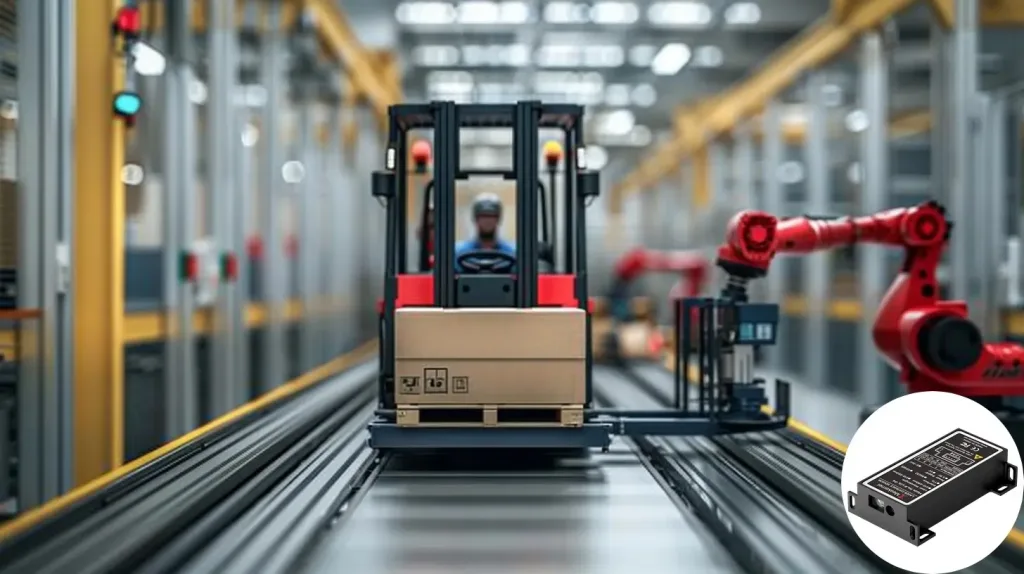
Model selection guide: real product comparison videos

Conclusion: Precision Docking Requires the Right Sensor Strategy
AMR docking failures are rarely caused by software alone.
In most cases, the root cause is insufficient distance sensing precision at the final approach stage.
By integrating a laser distance sensor specifically designed for AMR docking, you can achieve:
- Repeatable millimeter-level alignment
- Reduced collision risk
- Faster docking cycles
- Higher system uptime
If your AMR currently “almost docks correctly,” the solution is not more tuning — it’s better mesafe ölçümü.
An In-Depth Look at the Applications of Laser Ranging Technology Across Various Industries
SSS
Why is a laser distance sensor necessary for AMR docking?
AMR docking requires millimeter-level stopping accuracy and repeatability, especially for charging, pallet transfer, and conveyor handover.
While LiDAR is effective for navigation, it typically cannot provide the stable, real-time distance precision needed for final docking. A dedicated laser distance sensor ensures accurate final positioning and reduces docking failures.
Can LiDAR alone achieve accurate AMR docking?
In most real-world applications, LiDAR alone is not sufficient.
LiDAR is designed for global localization and obstacle detection, not for precise short-range distance control. At close distances, its angular resolution and filtering can lead to unstable or delayed stopping decisions. This is why many AMR systems combine LiDAR with laser distance sensors for docking.
What accuracy is required for reliable AMR docking?
Typical accuracy requirements are:
Navigation phase: ±20–50 mm
Pre-docking phase: ±5–10 mm
Final docking phase: ±1-3 mm
Laser distance sensors are specifically used to meet the final docking accuracy requirement.
Is Time-of-Flight (ToF) or triangulation better for AMR docking?
Both technologies are used, but for most AMR docking scenarios:
ToF sensors are preferred for their robustness, longer range, and resistance to surface color and ambient light.
Triangulation sensors can offer very high accuracy at short distances but are more sensitive to surface reflectivity and installation angle.
The optimal choice depends on docking distance, target material, and environmental conditions.
How should a laser distance sensor be installed on an AMR for docking?
For stable and repeatable docking:
Mount the sensor close to the docking interface
Align the laser beam perpendicular to the docking surface
Avoid highly reflective or angled metal targets
Minimize vibration at the mounting point
Incorrect installation is one of the most common causes of docking instability.
How many laser distance sensors are needed for AMR docking?
Many AMR systems use:
One sensor for simple straight docking
Two sensors to detect angular misalignment
Çoklu sensörler for redundancy or wide docking interfaces
The number depends on the required alignment tolerance and docking geometry.
Do laser distance sensors work reliably on metal docking stations?
Yes, but sensor selection matters.
For metal surfaces, it is recommended to use ToF laser distance sensors with strong signal processing or apply diffuse reference targets. This reduces the risk of unstable readings caused by specular reflection.
What are common causes of AMR docking failure even with a distance sensor?
Common issues include:
Incorrect sensor mounting angle
Insufficient update rate during final approach
Poor target surface design
Over-reliance on a single sensing source without redundancy
A well-designed docking system combines proper sensor placement, control logic, and mechanical guidance.
Can laser distance sensors improve docking speed as well as accuracy?
Yes.
Accurate real-time distance feedback allows the AMR to approach faster and decelerate later, reducing docking time while maintaining safety and precision.
Is a laser distance sensor suitable for both charging and material transfer docking?
Absolutely.
Laser distance sensors are widely used for:
Charging station alignment
Pallet or tote transfer
Conveyor docking
Workstation positioning
Any application requiring repeatable and precise AMR stopping can benefit.